


Written by Bo Winegard.
In a now-famous quip, the conservative commentator William F. Buckley wrote that he would rather be governed by the first 2,000 names in the telephone directory than by the faculty at Harvard.1 Many conservatives before and since have shared Buckley’s skepticism of intellectuals, praising the common sense and humility of ordinary men, while deriding the arrogance of educated elites.
The basic intuition is clear enough. Geniuses might be able to guide a spacecraft back from the moon, but they can also create and promulgate disastrous ideologies like communism or abstruse hocus pocus like postmodernism. Furthermore, they can become haughty, dogmatic and dismissive of tradition, insisting that they know better than their benighted ancestors. Their considerable mental prowess might make them more not less vulnerable to baroque nonsense than the average man. Thus we have the hackneyed phrase, “An idea so dumb only an intellectual could believe it.”
But the anti-intellectual attitude memorably captured in Buckley’s line is wrong. Evidence suggests that intelligent people are not only more cooperative and more capable of building flourishing societies, but also more epistemically competent.2 Thus, although the faculty of Harvard may have political views deplorable to most conservatives, they would, with virtual certainty, govern better than 2,000 random people.
It is true that intelligence is related to social liberalism—to more support for gay marriage, abortion, drug legalization, immigration and so forth. And, being opposed to all these policies, the conservative may claim that they are not only wrong but pernicious. It is also true that smart people are responsible for all kinds of elaborate nonsense, from baffling postmodern texts and beliefs to avant-garde art that is deliberatively provocative and ugly.
But when we ask: who on average is more epistemically competent, smarter or ordinary people, the answer seems to be smarter people.
So far as I know, we have nothing near a full account of epistemic competence. But we can use Stanovich’s account of rationality as a useful working model, without necessarily endorsing all his views. His model is tripartite, consisting of the autonomous mind, the algorithmic mind and the reflective mind. This model will allow us to understand why smarter people have greater epistemic competence.
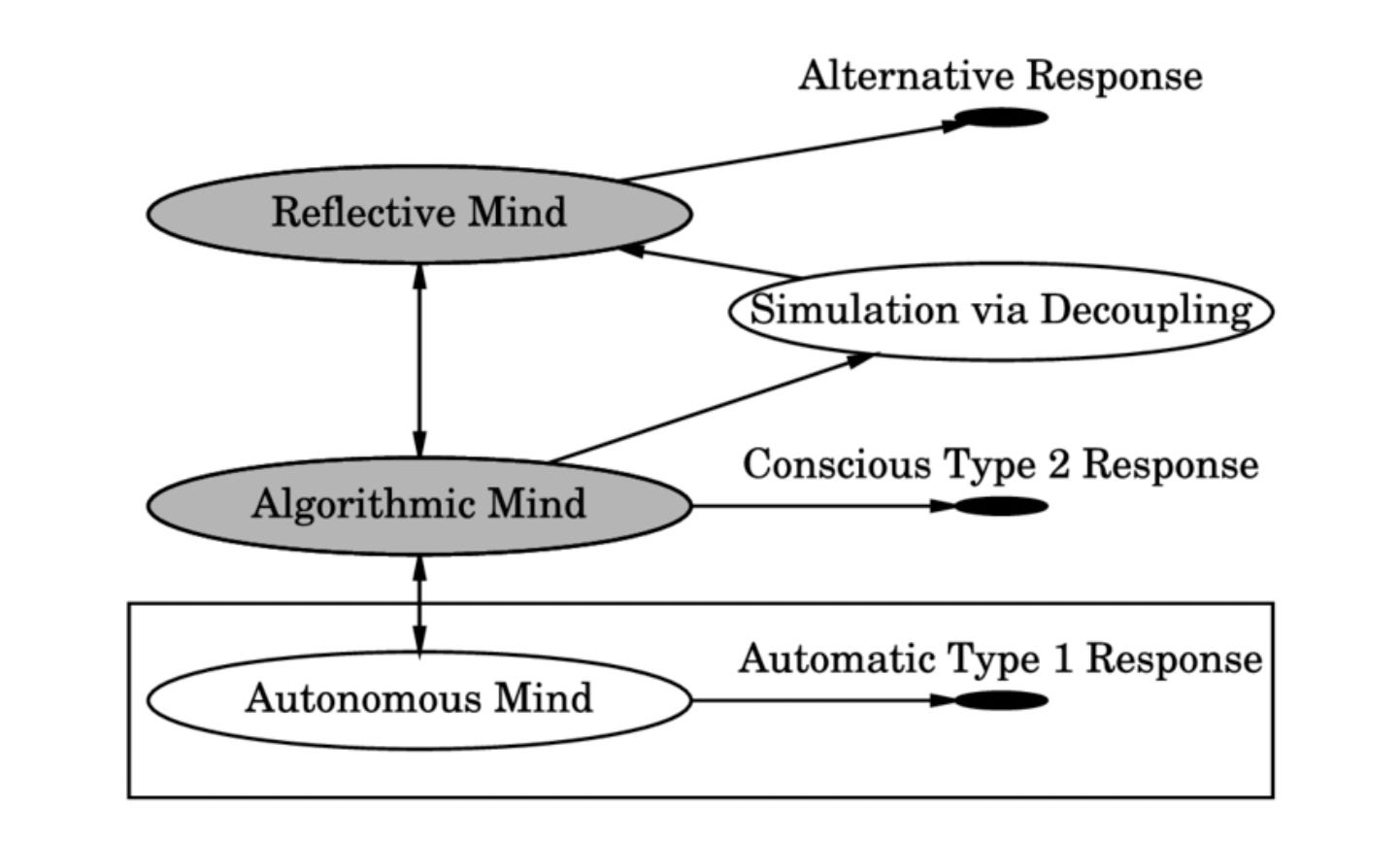
The autonomous mind generates responses from evolved mechanisms, habitual associations, learned skills and rules and so forth, producing representations without cognitive effort or deliberation. For example, if somebody says, “Let’s go to the store” in your native language, you automatically understand it. It requires no effort to parse the words or to represent the speaker’s intentions. It is thus useful for solving everyday tasks and recurrent evolutionary problems faced by our ancestors, e.g., recognizing faces and emotions, judging quantities and distances, manipulating objects and tools.
The algorithmic mind provides the computational capacity for deliberate cognition (working memory, inhibition, decoupling, counterfactuals) and is therefore related to fluid intelligence. This is necessary for holding and manipulating representations in the mind, imagining alternatives, overriding intuitive responses and so on.
For example, if you are presented with an intellectual puzzle such as “A bat and a ball cost $1.10 in total and the bat costs $1.00 more than the ball. How much does the ball cost?” you first need to inhibit your intuitive response, which is likely 10 cents. You then need to hold the representation “$1.00 more” in your mind while manipulating other representations, arriving at the correct answer, which is 5 cents.
Finally, the reflective mind governs whether and toward what ends the computational resources of the algorithmic mind are directed. After watching Patrick Mahomes play a particularly lousy football game game, you might think, “How much is this guy actually worth anyway?” Then you might spend hours reading advanced stats and using your intelligence (your algorithmic mind) to calculate his approximate value over a replacement quarterback.
Notice that a less rational but equally intelligent person might instead think, “I hate Mahomes. God is he overrated,” and then spend an hour reading evidence-free essays assailing the cult of Mahomes and deriding him for being an overrated lightweight. One could even make a good living on an ESPN morning debate show with this style of thinking! Thus epistemic competence requires both raw intelligence and appropriate motivations and tendencies of thought.
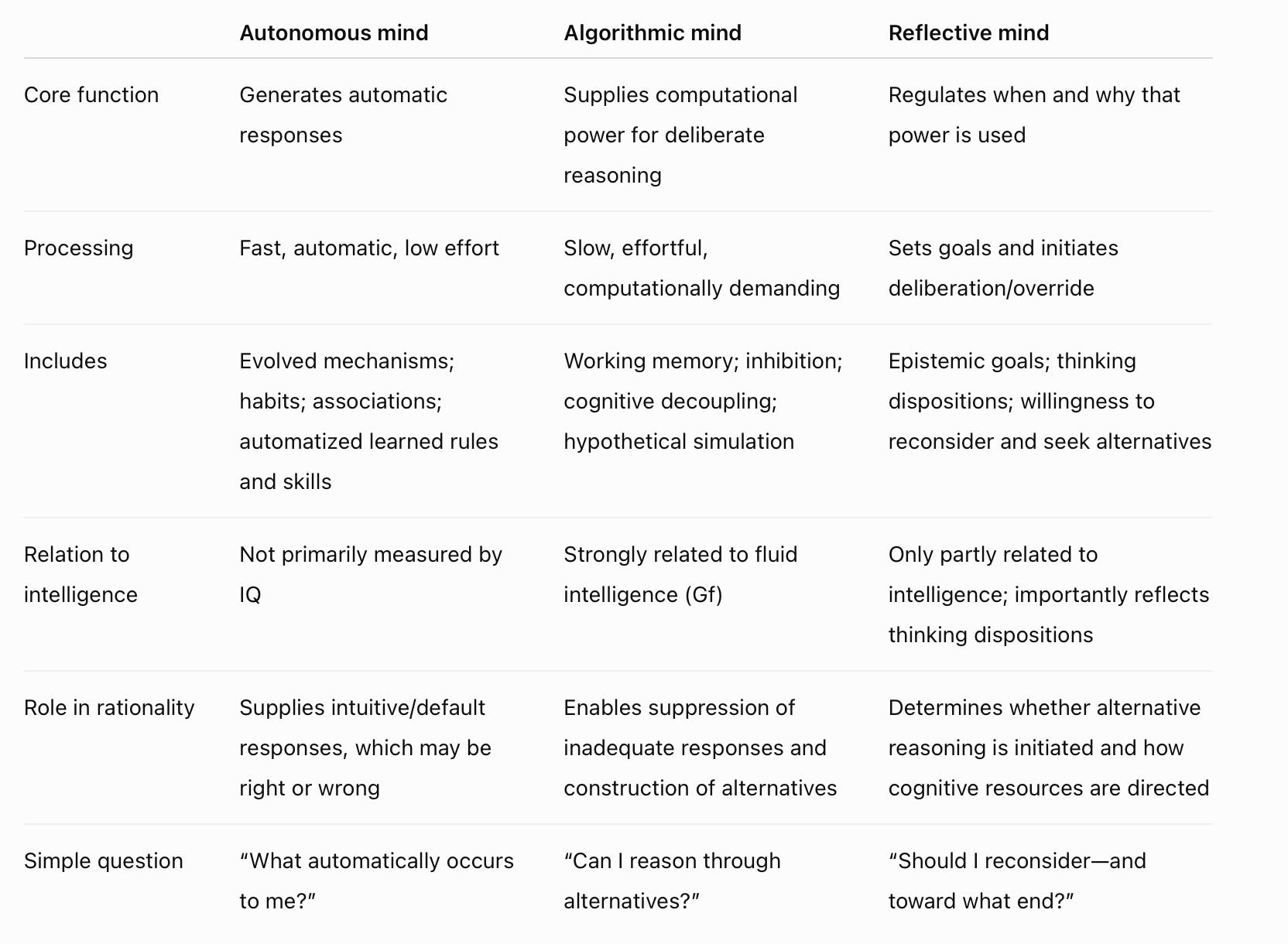
I will return to this model later. For now, the important point is that intelligence is related not merely to abstract reasoning capacity but also to some of the mental machinery required to override intuitive or automatic responses: inhibition, cognitive decoupling, and the simulation of alternatives. Whether that mental machinery is actually used depends on the reflective mind, i.e., one’s goals and thinking dispositions.
For example, a person using her autonomous mind might respond to the assertion that the population is growing in a certain city by thinking, “Population growth means more workers competing for jobs and competition for jobs is bad because jobs are limited.” This is a simple and natural representation which treats jobs as a limited resource that can be used up by other people—hence the lump of labor fallacy.
But after deliberation, that same person, using her algorithmic mind, might think, “Well, wait a moment. Population growth also means more people are spending money. And that means more people will be hired and more businesses created. And that means there will be more resources and more overall production.” This is a complicated and unnatural representation that must be learned and seems difficult for even educated people to grasp. Instead of representing labor as a finite, fixed supply, it represents it as a dynamic product of multiple interacting variables.
This model of epistemic competence leads to a straightforward prediction: ceteris paribus, intelligence will be positively related to epistemic competence, especially as the mismatch between our evolved mental predispositions (the autonomous mind) and our environment increases. So in large, modern, anonymous societies with advanced economies, intelligence should be positively related to epistemic competence and accurate views about the world.
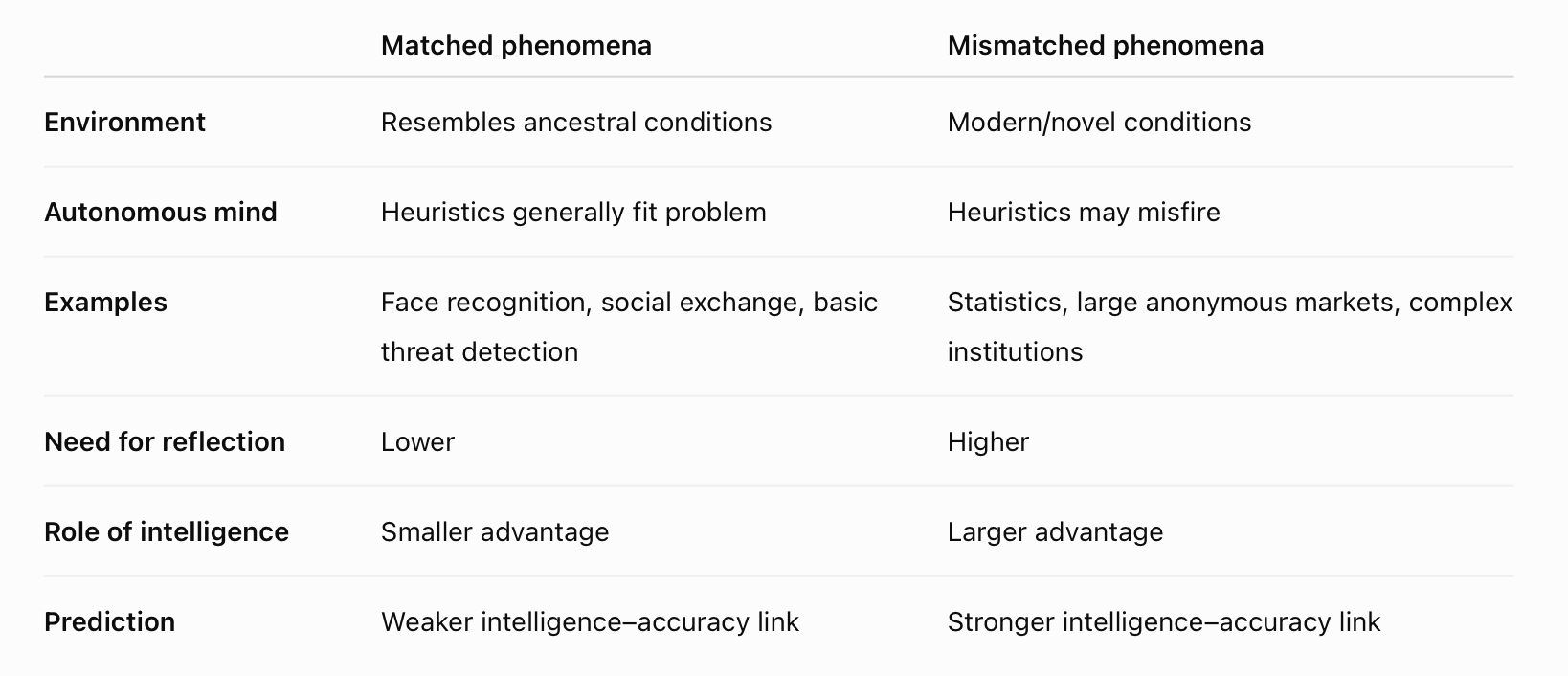
The claim here is not, of course, that smart people are infallible. They are not. Nor is it that automatic processes and common sense are worthless. They are not. Rather, it is that there will be a positive relation between intelligence and epistemic competence because intelligence is related to the ability better to process and manipulate information and because it is related to the propensity to override automatic responses.
Much of the available evidence supports this hypothesis. For example, Phil Tetlock and his colleagues found that even among a highly intelligent subset of forecasters, intelligence was positively related to forecasting accuracy, with this relationship partially mediated by the tendency of more intelligent forecasters to update their beliefs more frequently as evidence accumulates. They weren’t just better at guessing; they were better at changing their minds.
Relatedly, Pennycook and Rand found that cognitive reflection predicts better discrimination of real from false news headlines. A large review of the research on false news similarly confirmed robust support for the hypothesis that cognitive reflection and analytical thinking predicted better discrimination between true and false headlines.
Although the Cognitive Reflection Test used by Pennycook and colleagues is intended to measure the propensity to override an initially compelling response and engage in further analytical reasoning, it is substantially related to intelligence. Furthermore, there is suggestive evidence that fluid and crystallized intelligence themselves are directly related to better news discrimination. Still, I want be cautious here, for as D. Alan Bensey noted, “A review of the research shows that critical thinking is a more inclusive construct than intelligence, going beyond what general cognitive ability can account for.” Intelligence matters. But so do other cognitive tendencies associated with the reflective mind.
Importantly, the predictive power of cognitive reflection and analytical thinking does not depend on better rationalizing preexisting preferences. Greater reflection in these studies on false news predicted better truth discernment even for politically congenial falsehoods. The evidence is therefore consistent with the hypothesis that people with higher cognitive ability are more epistemically competent and form, over time and on average, more accurate beliefs about the world—and this is partially because they have a greater propensity to engage in analytical thinking.
A similar pattern appears in the literature on conspiracy beliefs. In a large meta-analysis, Lukasz Stasielowicz found that cognitive ability was negatively related to such beliefs. The effect size was modest but robust: smarter people are, on average, slightly less likely to endorse conspiracy theories.
Consistent with the model of epistemic competence used here, research suggests that both cognitive ability and epistemic motivation matter. Tomas Ståhl and Jan-Willem van Prooijen found that skepticism toward conspiracy theories and other paranormal beliefs was associated with a combination of cognitive ability and valuing epistemic rationality.
Research on the Cognitive Reflection Test provides convergent evidence. Kristy Martire and her colleagues found that performance on the CRT was negatively associated with the endorsement of implausible claims. And implausible-belief endorsers performed worse on the CRT despite taking longer on their answers, suggesting that differences in cognitive ability, knowledge or reasoning ability rather than deliberation itself, may explain the association.
Suppose you are skeptical of these data. Maybe the forecasters are more accurate because they are seeking answers to highly constrained questions. Maybe the false news literature is biased. And maybe conspiracies really do happen and believing in them is perfectly reasonable. Fine. We can look at perhaps the most persuasive data of all: the real world. Smart people reliably and consistently create more functional, flourishing societies. If everyday life is an intelligence test, this provides strong evidence that smart people are more epistemically competent.
At the broadest level of social organization, namely the nation state, there is a positive relation between average IQ and practically all favorable outcomes, including per-capita GDP, economic growth, technological innovation, life expectancy, institutional quality, economic freedom and equality of happiness. Similar relations have been found at the state level in the United States, and suggestive relations have been found in other analyses of local organization (e.g., provinces of the Russian Federation). Everywhere you look, intelligent people create more flourishing societies.
This should not be surprising, since smarter people tend to be more productive, cooperative, innovative, law-abiding and peaceful. They are more prosocial, as Noah Carl noted in a recent essay. Speculating about which of these many advantages matter most for societal flourishing is risky, but not recklessly so. According to Garrett Jones, there are five major causal pathways from intelligence to economic growth:
Patience and saving. Smarter people have a longer time horizon and are more willing to delay gratification. This means they save more. And savings generate positive social effects because they can be used to invest in factories, equipment, research and design, and other forms of capital. Moreover, patience leads to long-term commitments, which are crucial for economic development and cooperation. If you kill the cow today, you cannot get the milk tomorrow. Many productive businesses do not bear immediate fruit. They require time to mature.
Cooperation. Smarter people are better at cooperating both because they are more patient but also because they better understand the nature of nonzero-sum interactions and the benefits of sustained teamwork, even when interests are not perfectly aligned. This means they can better solve collective-action problems, and create functional bureaucracies and other impartial institutions that protect property rights and maintain public goods while discouraging private plunder and nepotism.
Economic beliefs and policy. Smarter people have greater factual knowledge and better understand comparative advantage, opportunity costs, inflation and incentives. They are therefore more likely to support and implement policies that increase productivity.
Good workers and good products increase productivity. Many forms of modern production are complementary. The value of one worker’s effort depends upon the quality of others’ work. A better coder produces better software for others to use, which makes other people more productive. Smarter people therefore raise productivity not only through their own output but by their contributions to other economic processes.
Imitation and social norms. People copy others, especially high-status others. So if a group is full of smarter, more disciplined, more law-abiding people, others will tend to copy them, becoming more disciplined and law-abiding in the process. This creates communities of well-behaved and productive people without costly enforcement or coercion.
Some of the relation between intelligence and social outcomes is caused by variables only indirectly related to epistemic competence—patience, for example. But much of it seems to be directly causal: smarter people cooperate more, discover and promulgate better policies, sustain better institutions, create better and more reliable technology and so on.
Put in the form of a thought experiment, my strongest claim is that if 2,000 elite university professors and 2,000 random people were put on separate desert islands, the 2,000 professors would create a better, more flourishing society. And at least part of the reason is that would show more epistemic competence. They would discover better solutions to challenges, including those related to group coordination and cooperation.
None of which is to say that smart people are immune to errors, biases and balderdash. They obviously aren’t.
What is more, there is reason to think that they can err in more elaborate and socially destructive ways. Their errors tend to be more influential. This is probably why anti-intellectualism feels plausible. The ludicrous views of the ordinary person may attract derision in liberal media, but ordinary people rarely acquire intellectual prestige. Wayne the truck driver or may believe that Bill Gates has a plan for global depopulation, but with the exception of his friends and family, others will be spared from having to listen to his florid conspiracies. Certainly, he is unlikely to write a New York Times bestseller.
To understand why smart people might make more spectacular errors without being more prone to errors in general, we need to distinguish the ability to arrive at the truth from the ability to create and manipulate complex representations. My claim is that the same abilities that allow intelligent people to understand calculus, economics, and physics also allow them to create abstruse and erroneous theories that are inaccessible to those without high intelligence.
Thus, intelligence simultaneously expands the truths a person can understand and the errors he or she can make. Put another way, high intelligence is like a sports car. It can perform better than ordinary cars, but for precisely that reason, its crashes are more spectacular. Hitting a wall in a Toyota Camry at 85 is not fun, but hitting a wall in a Ferrari at 155 might end in a astonishing ball of fire.
David Geary makes a useful distinction between biologically primary cognitive abilities and biologically secondary cognitive abilities, which I will call primary and secondary abilities for short. Primary abilities are those that have evolved largely by natural or sexual selection and therefore develop in most normal humans, whereas secondary abilities are those that co-opt primary abilities and develop only in some humans in specific cultural contexts.
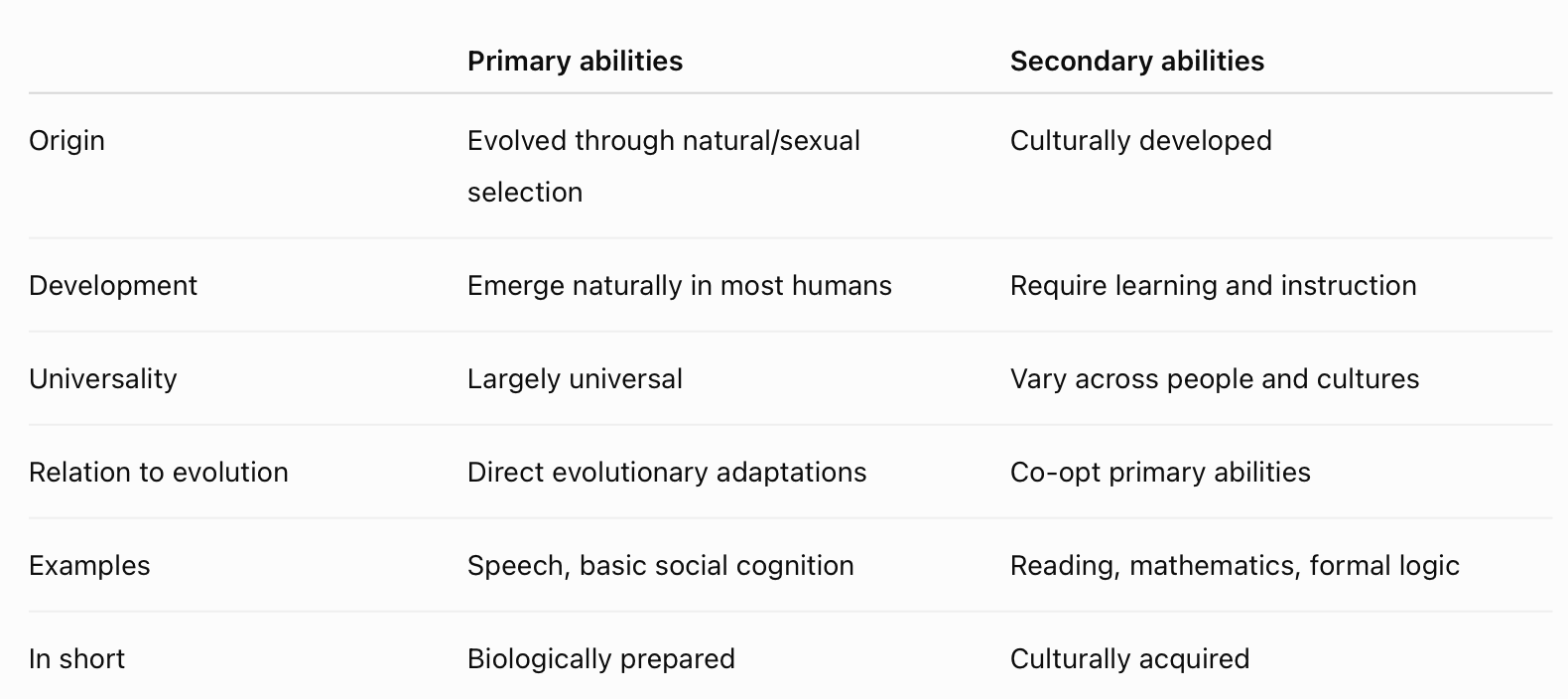
Consider the difference between speaking (a primary ability) and writing poetry in iambic pentameter (a secondary ability). Normal humans across the globe learn to speak without disciplined effort. The human brain was selected to understand and produce speech, and does so naturally. On the other hand, only a subset of humans learn to read and write and an even smaller subset learn to read and write iambic pentameter verse. We did not evolve to read and write; rather, we invented reading and writing a few thousand years ago. And although we almost certainly evolved to appreciate rhythm, rhyme and other sonic effects of language, we did not evolve to write very specific and constrained forms of poetry.
In the terms of Stanovich's model, many secondary abilities supply what he calls “mindware,” e.g., heuristics, skills, procedures, declarative knowledge, and other cognitive tools that guide reasoning and problem solving. So if the problem is, “Write a poem in iambic pentameter,” you might use a rule (ten alternating unaccented and accented syllables to a line) and some kind of cognitive guide (repeating da-dum, da-dum in your head) to produce the appropriate solution. But unless you are Shakespeare—who could apparently emit beautiful blank verse as effortlessly as mere mortals can speak—you will have to shift from automatic thinking to effortful thinking to write a poem of even middling quality.
The important thing is that smarter people are better at acquiring and deploying secondary abilities and thus at acquiring more sophisticated mindware. They can more easily learn calculus, Coase, chemistry and so on. They can also more easily learn magniloquent words and arcane jargon. Generally, this mindware is helpful. If you want to know whether tariffs are good for the economy, whether a spacecraft can make it to the moon with 300,000 gallons of fuel, or whether a certain hunting strategy is more effective than another, possessing the appropriate mindware is helpful.
The problem is that smart people can “download” bad-but-sophisticated mindware like communism3, or they can use other mindware such as an impressive vocabulary and knowledge of formal reasoning to defend bad ideas with charm, elegance and sophistries.
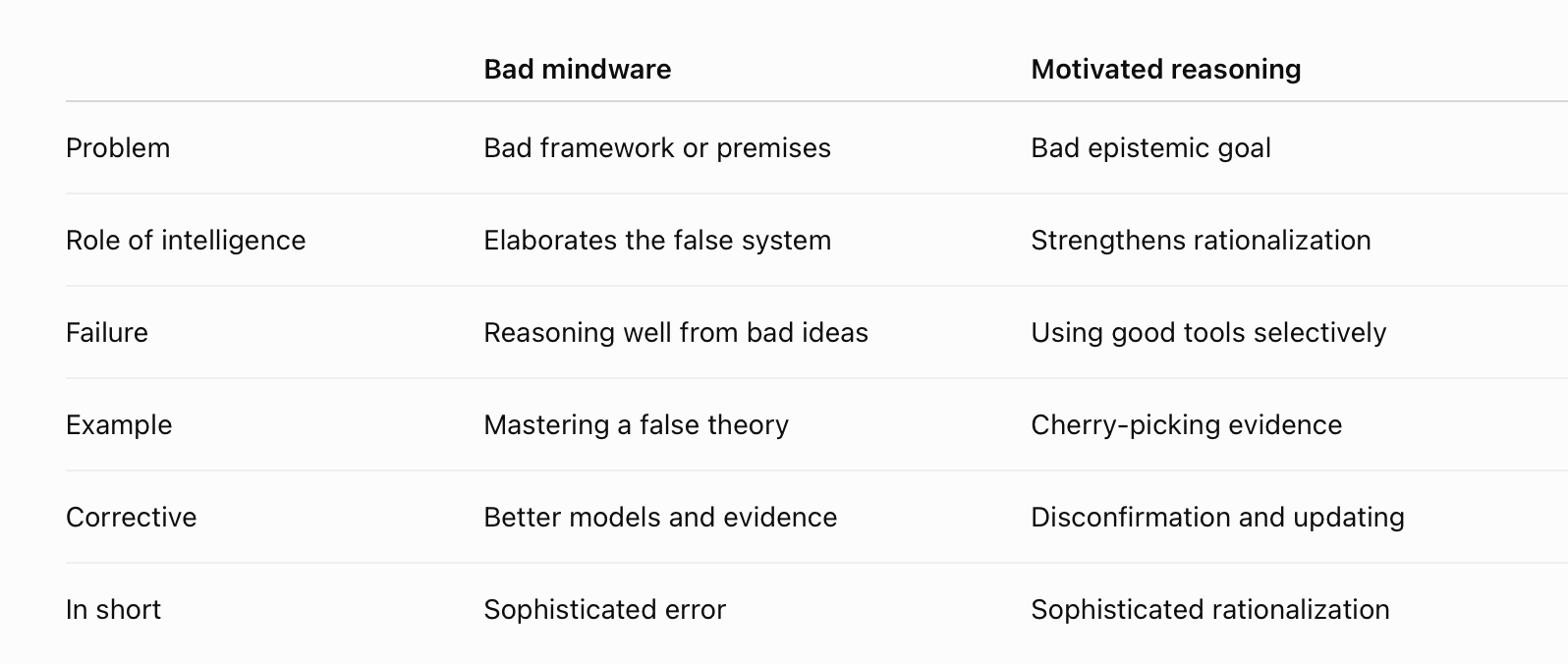
My guess is that certain departments in modern universities exacerbate this problem because they are far removed from the constraints of empirical data and insulated from the rigors of the free market or the exigencies of a hostile environment.
In the humanities, for example, intelligent people behave like captive spiders who are remarkably good at spinning webs that no longer catch flies. Much of what they do might be compared to an intellectually intricate game with little relation to reality. This provides salient examples of smart people being stupid and makes the anti-intellectual narrative appealing, especially to those who justifiably hate what progressives have done to the university or are envious of professors’ status—or both.4
Yet it is important to resist hasty generalizations. The fact that many extravagantly bad ideas have been embraced by intellectuals does not mean than intellectuals are less epistemically competent than ordinary people. And it certainly does not mean that intelligence is related to lower epistemic competence after a certain threshold, as Charles Murray recently suggested.5 Rather, it means that the errors of intellectuals are more memorable and influential.
Anti-intellectualism has long been popular on both the Right and the Left, especially among populists. Sometimes it is driven by envy and political outrage. But sometimes it is driven by a sincere and laudable spirit of democracy: yes some people are smarter than others, but that does not mean that they are better at understanding the world. I can certainly sympathize with this desire to honor the reasonableness of the average Joe. Intelligent people already have so many advantages in our society. Why give them more? Why say that the views of the ordinary man are, on average, less likely to be true than the views of the tenured professor?
But, as we must constantly remind ourselves, nature does not give a fig for our sense of fairness. Smart people have greater epistemic competence because they are capable of producing and manipulating more complicated representations and because they are somewhat more likely to reflect critically upon their own cognitions. The appeal to the epistemic sturdiness of the average Joe might be politically expedient and might feel morally righteous, but it is not supported by empirical evidence. This is not to say the average American is wrong about most things. Obviously, she is not. But it is to say that she is wrong about more things than the average American with an IQ of 130.
Instead of promoting anti-intellectualism, which unnecessarily denigrates intellectuals, professors and higher education altogether, we should criticize stupid intellectual ideas, of which there are plenty. For the world is a complicated place, and even the smartest among us will often be confused or fooled by it.6
Bo Winegard is an Editor of Aporia.
Become a free or paid subscriber:

Like and comment below.
Buckley’s attitude was more complicated than this quip captures: “Not, heaven knows, because I hold lightly the brainpower or knowledge or generosity or even the affability of the Harvard faculty; but because I greatly fear intellectual arrogance, and that is a distinguishing characteristic of the university which refuses to accept any common premise. In the deliberations of two thousand citizens of Boston I think one would discern a respect for the laws of God and for the wisdom of our ancestors which does not characterize the thought of Harvard professors who, to the extent that they believe in God at all, tend to believe He made some terrible mistakes which they would undertake to rectify…”
One imagines, though, that his fear of the arrogance of Harvard professors would be dramatically higher today since the average Harvard professor’s views are more distant from the “laws of God” and the “wisdom of our ancestors” than they were in the 1960s!
Still the point here is not to argue against Buckley but against his many less sophisticated imitators who love his quip but not his respect for intelligence and erudition.
We can consider epistemic competence as both the ability and the tendency to have better or more accurate beliefs about the world. Of course, my claim is not that every smart person has more accurate beliefs than every ordinary person. Rather, it is that on average smart people have not only a greater capacity for accuracy but also that they realize that capacity. In some settings, though, people with greater epistemic competence may, by chance or bad luck or some other combination of factors, have less accurate beliefs.
Compare this to, say, quarterbacking competence. On average, quarterbacks with higher competence will be better than those with lower competence. But not every quarterback who is higher in competence will perform better than every quarterback who is lower in competence.
I don’t mean to suggest that most communists hold a sophisticated view of communism, but whatever one thinks of Marx’s corpus, it is rather impressive intellectually. Only a few geniuses could have synthesized German idealism, socialism and classical economics as effectively as he did.
Envy is a normal human emotion and likely motivates many behaviors, good and bad. And many progressive professors and bureaucrats have espoused a noxious and illiberal ideology that deserves severe criticism.
In his debate with Nathan Cofnas, Murray put the threshold at 120 IQ. Obviously he was speaking extemporaneously and thus should not be held to this specific estimate. Nevertheless, he was very clear throughout the debate that intelligence, after a certain level, is related to pathological thinking and even blamed the jury decision in the Clancy case on the possibly high intelligence of the jurors.
I want to be charitable here. Murray was having a podcast conversation, and we all say things on podcasts that should be clarified or qualified. But I am reasonably confident that if we care merely about accuracy, the smarter the jury, the better the outcome—on average. And I do not think the problem in the Clancy case was that the jurors were too clever for their own good. Rather, it was a complicated case, and the law in Massachusetts puts the burden of proving criminal responsibility on the prosecution.
One might add that intellectuals, like other humans, are often selfish and desirous of status and fame. They may promote bad ideas for a variety of reasons, including conformity, status signaling and spite. Some intellectuals might be so morally reprehensible that they deserve personal criticism. But in general, it is best to criticize ideas and to promote education and critical thinking, while recognising that only those who do not think at all do not make errors.
Which leads me to wonder what smarter than all humans combined levels of AI would be capable of. Higher levels of abstraction, better patience, better at cooperation and creating positive sum games, and so on.
“…high intelligence is like a sports car. It can perform better than ordinary cars, but for precisely that reason, its crashes are more spectacular. Hitting a wall in a Toyota Camry at 85 is not fun,…”
Brings back memories of my grad school days. In class one day, my major professor was being “baited” by a co-ed wrt to the IQ controversy (a third rail, even in those days)—its meaning and analysis. He responded to her question with an analogy as you’ve used above in today’s commentary.
His answer was quick. He responded to the co-ed that “Some folks in this world drive Ferraris. They can accelerate to breath taking speeds quickly, take hairpin turns with ease, stop on a dime. Most of us drive Chevy’s….and remember, it’s a 55 mph world.”
As to one of our most famous Ferrari drivers, Elon Musk, I must say that for all his “smarts” he has many of the same human faults as us “normal” folk. For example, his incessant need to promote the colonization of Mars. The difficulties in such an undertaking never mentioned by him (to my knowledge) nor does he seem to be working on projects to solve such.
It seems being really smart is not protection against “willful blindness” or “motivated reasoning”. Are these two better in result than just plain ignorance or stupidity?