


Written by Bo and Ben Winegard.
Lindsay Clancy killed her children. Nobody disputes that. What many people do dispute is why she killed her children, whether she was psychotic when she did so, and what the subsequent mistrial means.
One side sees Clancy as a victim of catastrophic mental illness, viewing
her mistrial as evidence that postpartum depression is still not taken seriously enough in the US. The other side sees her as a calculated murderer, viewing her mistrial as evidence that our empathy can be too easily exploited. Though they are certainly understandable, these positions and the hot takes they inspire are not tailored to the actual dispute. They are generally unedifying.
We say the positions are understandable because such a salient and tragic case can easily provoke a culture-war mentality—where horror, pity, anger, outrage and team loyalty often determine our conclusions before we have thought
carefully about the evidence. However tempting it may be, we should resist
turning this tragedy into another fractious culture-war debate. Instead, we
should constrain our own intuitions and employ disciplined evidential reasoning.
The available documentary evidence suggests that Lindsay Clancy suffered from severe mental illness. Her children—Cora, Dawson and Callan—suffered unthinkable deaths. We can all agree that the events of January 24, 2023 were tragic and horrifying. But this does not tell us whether Clancy was psychotic when she killed her children. That is an empirical hypothesis, and it should be treated as one.
Two questions that have largely been conflated in the public debate should be distinguished. The first is evidentiary: Which of the two competing hypotheses in the Lindsay Clancy case better explains the available evidence?
Hypothesis 1: When Lindsay Clancy killed her children, she was suffering from psychosis.
Hypothesis 2: When Lindsay Clancy killed her children, she was not suffering from psychosis.
Although these two hypotheses are mutually exclusive, they are compatible with many of the same background facts. Both can accept that Lindsay Clancy was suicidal and desperately sought treatment for her disorder. Indeed, the only feature that necessarily distinguishes them is the claim that Clancy was suffering from psychosis when she killed her children.
This is often obscured in public discourse. One can believe that Lindsay Clancy was severely depressed and even that the mental health system “failed” her without believing that she suffered from acute psychosis at the moment of the killing. One can pity her, while still thinking she was legally responsible for murder. The question, here, is not about one’s attitude toward Lindsay Clancy. Rather, it is a narrow empirical question about her mental state: was she suffering from acute psychosis when she killed her children?
The second question is legal. Given that the law in Massachusetts requires the prosecution to prove criminal responsibility beyond a reasonable doubt, was a hung jury a reasonable outcome in the Clancy case? Here, we must keep in mind that even if a juror believed that the psychosis hypothesis was considerably less plausible than the alternative, she could rationally conclude that the prosecution did not meet its burden under the McHoul standard.
These are precisely the kinds of problems for which Bayesian reasoning is useful. Such reasoning is not magic. It does not eliminate judgment nor promise artificial certainty. Instead, it forces us to make our beliefs explicit. Although we may start with our intuitions, we must make those intuitions clear and update them on available evidence. We specify our competing hypotheses (e.g., H1 and H2 from above), and then ask how much each piece of available evidence should alter the relative probability of those hypotheses.
Thus, in the Clancy case, the crucial Bayesian question about a given piece of evidence is not whether it is consistent with an episode of acute psychosis. Almost every important fact can be made consistent with psychosis. Rather, the crucial question is comparative: how much more or less likely would we be to observe the evidence if she was psychotic when she killed her children than if she was not psychotic when she did so? In other words, consistency is cheap; what matters is the relative probability of seeing the evidence given the competing hypotheses.
This might be easier to understand with a less contentious example, before applying it to the Clancy case. Suppose that you wake up at two in the morning to sirens and smoke billowing into the sky. Thomas Smith’s house is on fire. The next day, you formulate two hypotheses.
Hypothesis 1: Thomas purposefully set his house on fire.
Hypothesis 2: The fire was an accident.
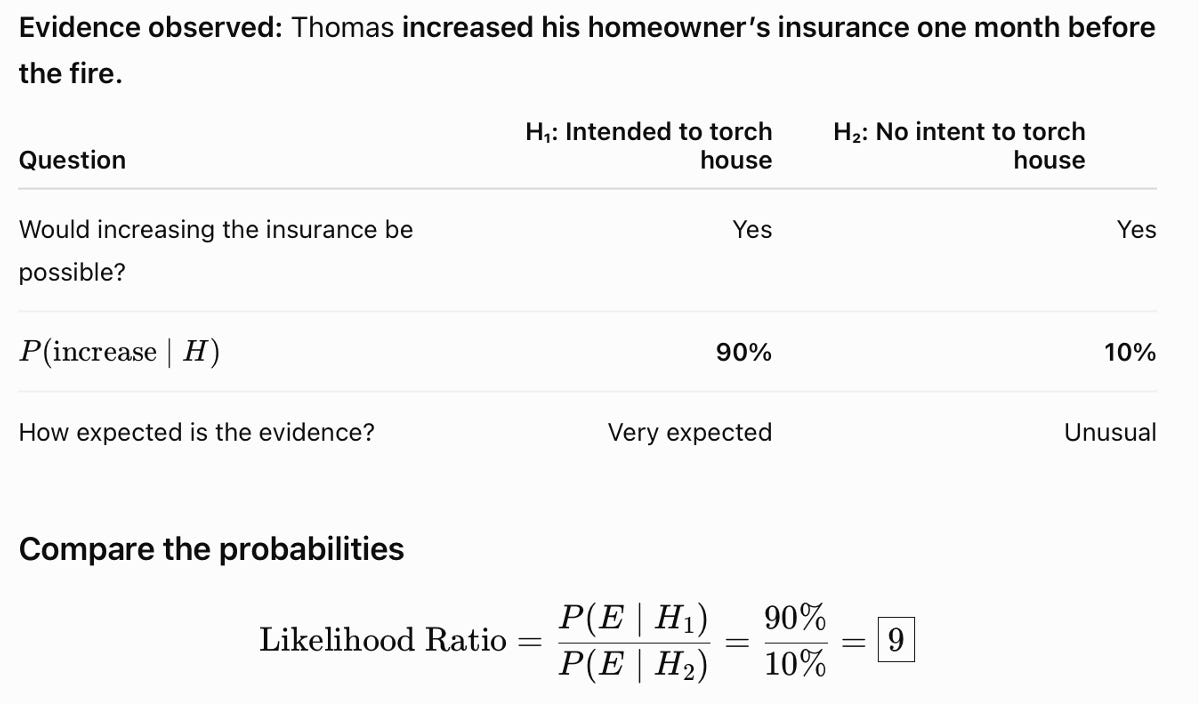
A few days after your initial hypotheses, your learn that Thomas substantially increased his homeowner’s insurance a month before the fire. That fact, although suspicious, is consistent with both stories: he might have planned an insurance fire, or he might simply have received a windfall and decided to buy better coverage.
What you want to know is the probability that he would have increased homeowner’s insurance under each of your hypotheses. Suppose, just for purposes of illustration, you conclude that:
P(increase | intended to torch the house) = 90%
P(increase | no intent to torch house) = 10%
Now, you divide the probabilities 90%/10% = 9 to get your likelihood ratio (LR). The evidence, on these assumptions, is nine times more likely if Thomas intended the fire than if he did not. You then multiply your prior odds by that likelihood ratio, significantly updating toward the insurance fire hypothesis. The likelihood ratio, not some vague sense of consistency, is what powers your reasoning—because the posterior odds = prior odds × LR.
Now consider one piece of evidence from the Clancy case. Before the killings, she had seen numerous mental-health professionals and had never been diagnosed with psychosis. The only reported psychotic episode is a single, transient one on January 24, 2023, after Patrick left the house. This pattern is not impossible under either hypothesis. The relevant question is whether this pattern is more probable under H1 (that she did suffer from psychosis when she killed her children) or H2 (that she did not suffer from psychosis when she killed her children). If we judge it as more probable under H2, then it has an likelihood favoring H2.
To be clear, this is contested evidence, and the likelihood ratio here is not given by nature. Reasonable people will disagree. That is why, when we go deeper into the Bayesian analysis, we will offer a range of likelihood ratios. The important thing is not this or that specific estimate. It is making the reasoning transparent. Bayes’ theorem does not offer uncontested truth. It offers clarity.
Before we can update on the evidence, however, we need a starting point, or a prior, because (as noted above) the posterior odds are the product of the prior odds and the likelihood ratio.
A prior is one’s estimate of the probability of a hypothesis before assessing the evidence whose significance you want to evaluate. Let’s return to the house fire example before getting back to the Clancy case. To estimate a prior or base rate in that simplified example, you look up the most recent evidence on the causes of all house fires. A recent analysis found that roughly 8% of house fires were intentional, meaning that out of 100 fires, 8 were intentional and 92 were accidental.1
You then convert your prior probability into prior odds, or 8:92 (i.e., 8 purposeful and 92 accidental). And you multiply this by your LR, which is 9:1. So 8 × 9 = 72. And 92 × 1 = 92. You therefore have posterior odds of 72:92. To convert this posterior odds back into a probability, you calculate 72/(92 + 72), which is roughly 44%.
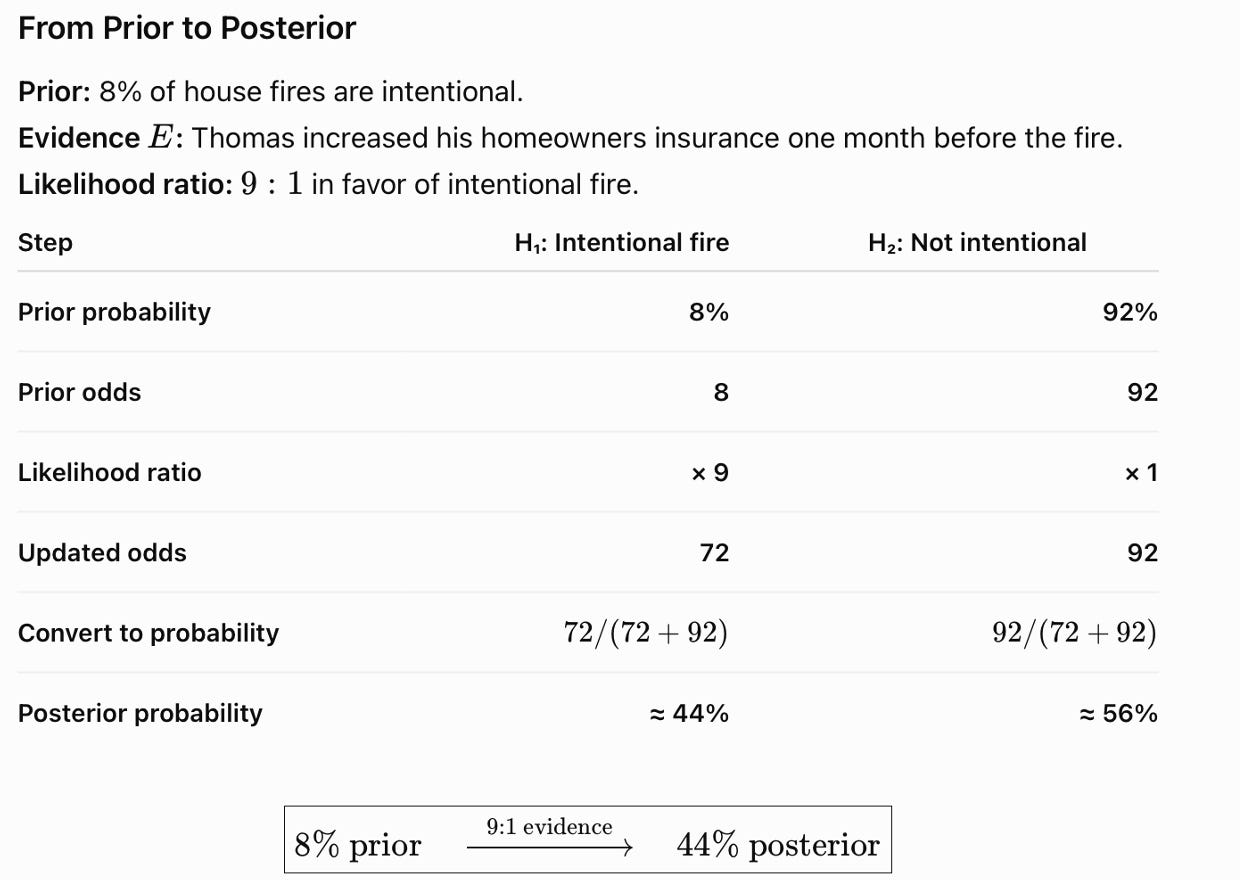
Note that the prior is crucial because it often plays a large role in determining one’s posterior belief. Even quite strong evidence might not overcome a low prior. Suppose, for example, that the prior probability of an intentional house fire was only 1% instead of 8%. After updating on the very suspicious act of Thomas having significantly increased his homeowner’s insurance a month before the fire, you would obtain a roughly 8% posterior. Thus, even though increasing the insurance a month before the fire has a large LR (9:1) in favor of the insurance fire hypothesis, our prior is very low, so our posterior remains low.
Now, having examined the basic machinery of Bayesian reasoning, we will apply it to the Clancy case. Since all disputants agree that Lindsay Clancy killed her children, our prior that she suffered from psychosis will be conditioned on this fact.
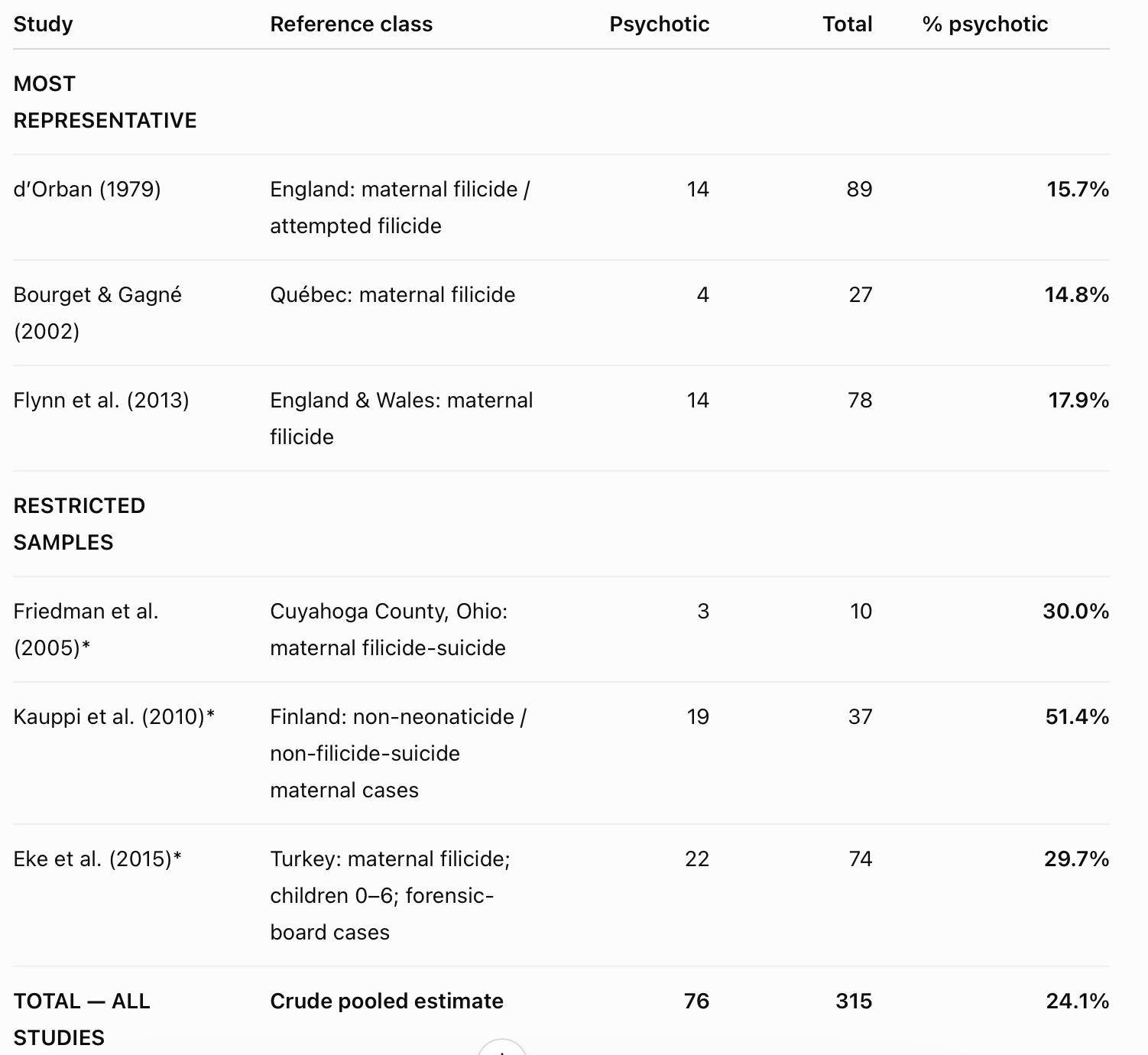
We will offer a wide range of priors in a Bayesian sensitivity analysis below, allowing readers to decide for themselves, but our best estimate for heuristic purposes after a review of the literature on filicidal mothers is 24.1%.2 In other words, we would assign a probability of roughly 24.1% to the hypothesis that Lindsay Clancy was psychotic when she killed her children, before considering anything else about her case.3
Now we turn to the documented evidence in the case, and for each piece of evidence, we ask:
P(evidence | acute psychosis) = ?
P(evidence | no acute psychosis) = ?
Importantly, because we already conditioned our prior on the fact that Lindsay Clancy killed her children, we do not treat that again as evidence. We update only on additional case-relevant evidence. These strike us as the most relevant pieces, though they are by no means exhaustive:
First, Lindsay Clancy was extensively treated for mental health problems, but not diagnosed with psychosis. Dr Jennifer Tufts saw her 14 times, including on January 23, 2023, the day before she killed her children, and testified that she saw no signs of psychosis or mania. This evidence is more probable given H2 (not psychotic).
Second, Lindsay Clancy was suffering from severe mental illness before killing her children, which included suicidal ideation, inpatient psychiatric admission, thoughts about killing her children, and apparent paranoia. This evidence is more difficult to assess. Because we already conditioned our prior on the fact that Lindsay Clancy killed her children, the relevant comparison is not between Clancy and an otherwise healthy woman, but between psychotic filicidal and non-psychotic filicidal mothers. Since depression and suicidal ideation are common among non-psychotic filicidal mothers, this evidence does little to distinguish H1 from H2.
Third, Lindsay Clancy reported that she suffered from a command hallucination, a masculine voice that instructed her to kill her children. If we believed her testimony, this would be strong evidence for H1. However, we must consider the entire cluster of evidence surrounding this testimony, which casts doubt on her account.
On January 24, 2023, when Patrick first discovered Lindsay on the ground after her attempted suicide, she did not mention a voice to him and told him that the children were in the basement. Two days later on January 26, when Dr Jhilam Biswas met with Lindsay Clancy, who was still intubated, Clancy wrote on a whiteboard “Do I have an attorney”. Dr Biswas did not see evidence of psychosis. Only on January 31 in a conversation with Chaplain Sheila Cavanaugh did Lindsay Clancy, then extubated, report hearing a man’s voice; she also said that she is glad her children are “safe.”
On February 6, after a previous call to her husband went to voicemail, she reached him using psychologist Paul Zeizel’s phone and told him that she heard a man’s voice telling her to kill herself and her children. She also reported experiencing a “moment of psychosis.” Patrick later testified that she had not previously told him about hearing a voice. Nor had she previously used the term psychosis with him. What is more, according to Dr Gregory Saathoff, Lindsay Clancy’s reports about the command voice were inconsistent. She told Margaret Spinelli that the voice began immediately after Patrick left on January 24, at about 5:10-5:15 p.m., but she told Dr Saathoff that the voice began after the 5:34 p.m. phone call with Patrick.
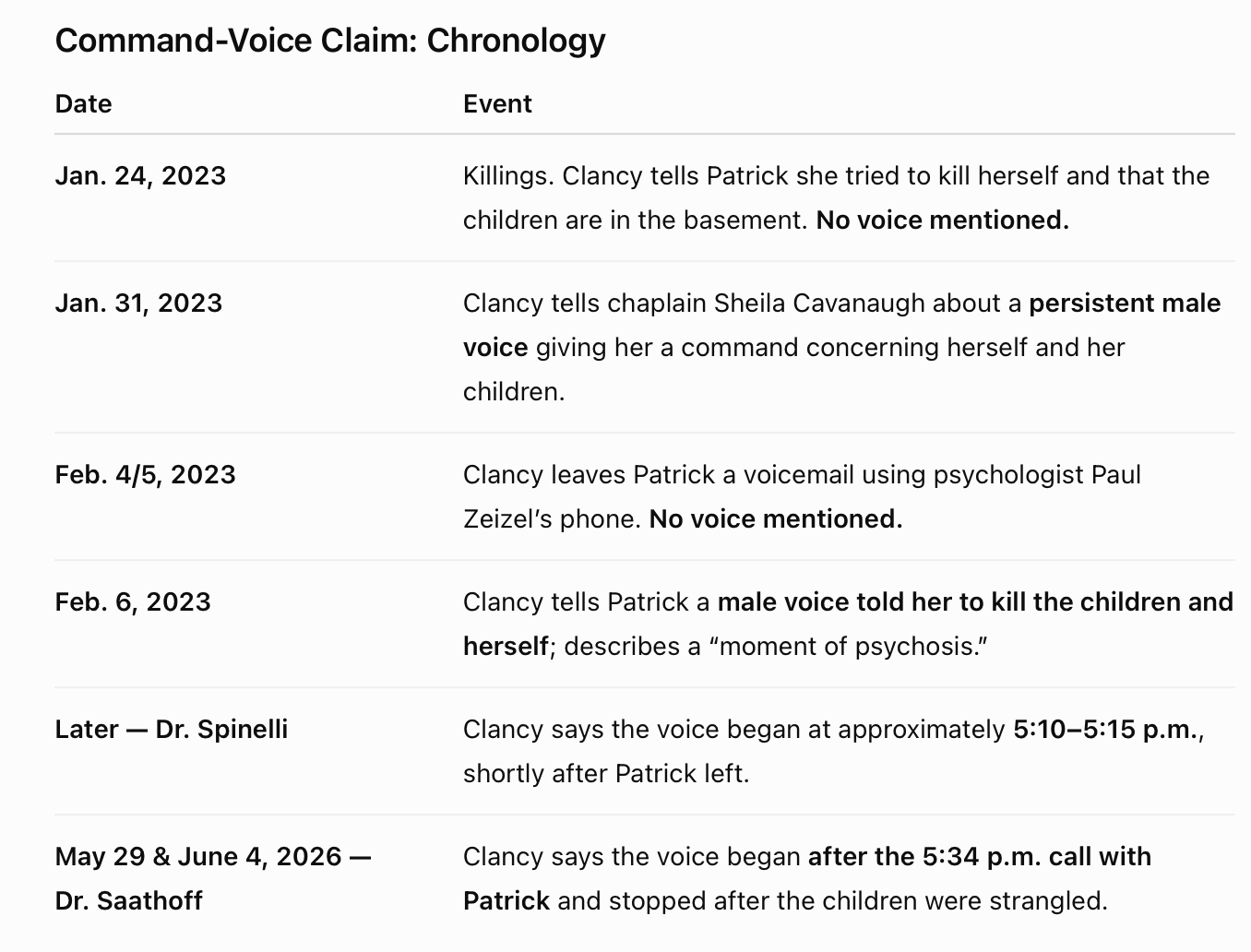
Given this chronology and the inconsistencies in Lindsay Clancy’s accounts, our view is that this supports H2 rather than hypothesis H1. Note: we are not contending that Lindsay was actively lying about hearing a voice. Perhaps, after trying to reconstruct the events of January 24, she earnestly came to believe that she heard a voice. We take as established fact that she was profoundly mentally ill, and it is quite plausible that her cognitive processes were abnormal and her memory labile. Of course, she may also be lying. We do not know, and we do not need to know. Our estimate here is only how likely the evidence is given H1 and H2.
Fourth, Lindsay Clancy seemed to behave in a goal-directed way on January 24, which is suggestive of a plan to kill her children. She arranged for Patrick to pick up takeout from ThreeV Restaurant and medicine from CVS, searching the route to the restaurant and using Apple Maps to see how long it would take at 4:13 p. m.
This is consistent with both H1 and H2. Contrary to common caricatures, individuals suffering from psychosis are capable of forming plans. So the mere fact that she seemed to purposefully get Patrick out of the house does not mean that she was not psychotic when she killed her children.
However, this evidence is less likely on the defense’s account of the case4, since it requires a coincidence, namely that Lindsay wanted Patrick out of the house for some reason (maybe an intent to commit suicide) and a voice coincidentally started commanding her to kill her children almost immediately after he left. Under H2, the planning behavior can be explained without requiring the coincidence that she was motivated to get Patrick out of the house and then experienced a temporary command hallucination almost immediately afterward.
Notice something important here. The likelihood ratio of each piece of evidence is uncertain. We must use our best empirically informed judgment. Thus, we include posteriors for likelihood ratios that are relatively more favorable for the prosecution, relatively more favorable for the defense, and a moderate position between. We also update on a range of priors from 10% to 60%. Because the evidentiary items are not entirely independent and reliable empirical likelihood ratios are unavailable, we do not multiply separate likelihood ratios for each item; instead, we examine a range of stipulated likelihood ratios for the case-relevant evidence considered as a whole.
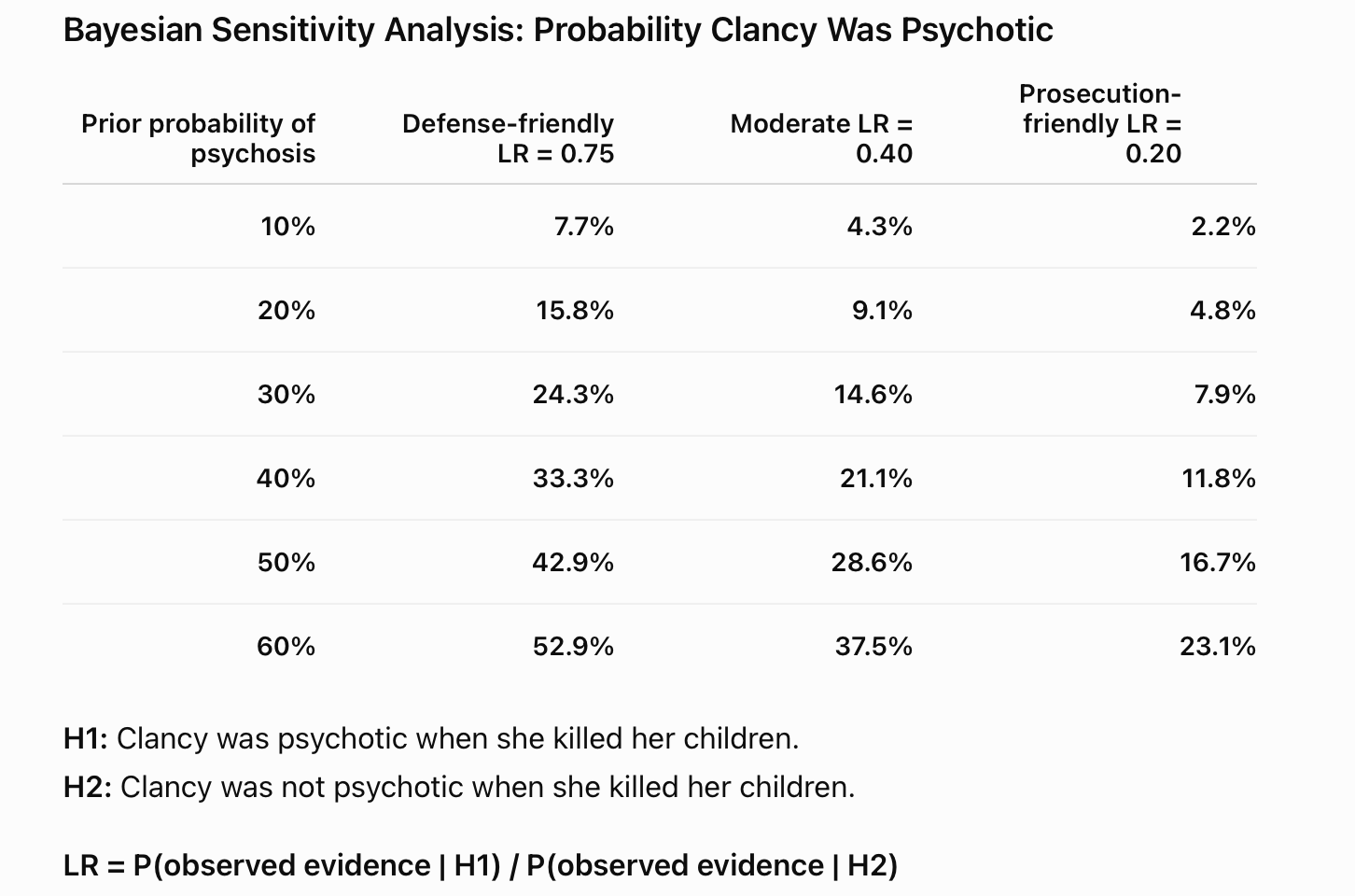
We end with a wide range of posterior probabilities from 2.2% all the way to 52.9% and a mean of approximately 20.6%. This mean should not be treated as the best Bayesian estimate, since it is merely the unweighted average of our 18 estimates. Our own judgement is that the best single posterior estimate lies somewhere in the 4-20% range for H1, meaning we believe that it is more plausible that she was not psychotic when she killed her children than that she was. However, our confidence in this estimate is not high. as the posterior is sensitive to difficult judgements about priors and likelihood ratios.5
Now, although this Bayesian analysis is certainly relevant, it is not the same as the legal question the jurors faced in the case, for two reasons. Once the court raised the question of criminal responsibility, Massachusetts places the burden on the prosecution to prove criminal responsibility beyond a reasonable doubt. And under McHoul, a defendant could potentially be found guilty even if the jury thought he or she suffered from psychosis at the time of the act. As SERPA law office puts it:
What matters is whether, when the act was committed, the illness had deprived the defendant of substantial capacity. Mental illness alone does not establish lack of criminal responsibility, and juries are instructed accordingly. Commonwealth v. Loya, 484 Mass. 98 (2020).
Thus, on the one hand the prosecution in the Clancy trial had to prove criminal responsibility beyond a reasonable doubt, but on the other hand, psychosis does not necessarily eliminate criminal responsibility.
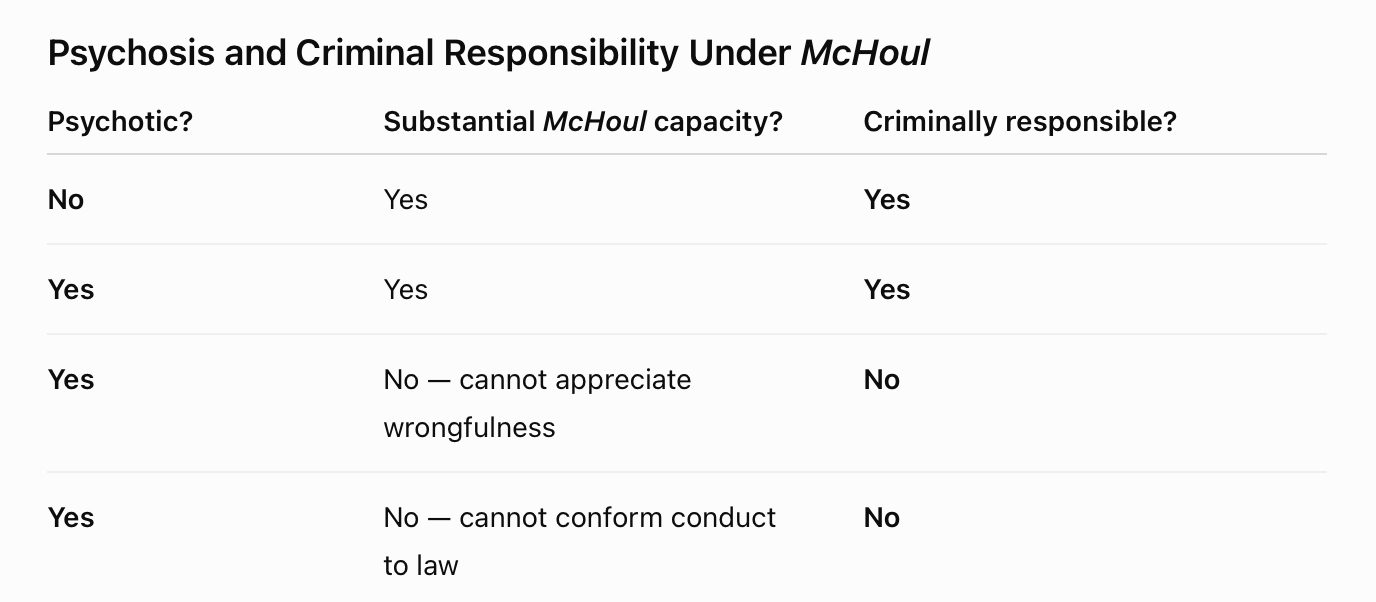
The jury was thus confronted with a different question from the one that we analyzed here. For the jury, the relevant question was: “Did the prosecution prove, beyond a reasonable doubt, that at the time Lindsay Clancy killed her children, she was criminally responsible?” This is a complicated question both because the standard of criminal responsibility is complicated and because the meaning of reasonable doubt is notoriously (and purposefully) vague.
Neither of us was inside the court. We do not know everything the jury saw or heard, so we cannot say how we would have voted had we been on the jury. However, we can answer a more humble question: Was a mistrial a sensible and understandable outcome given the facts of the case?
In our view, this case is exceedingly difficult to assess and demands epistemic humility. Our own best estimate, as noted above, is that Lindsay Clancy was probably not psychotic when she killed her children. However, that does not mean that we believe the prosecution proved criminal responsibility beyond a reasonable doubt.
Suppose, for illustration, that we place our credence that she was psychotic at 10%, but we have low confidence in that estimate. Maybe it should be 3%, but maybe it should be 20%. Even if she were psychotic, however, that would not necessarily mean that she lacked criminal responsibility. Under McHoul, we’d still have to ask whether she lacked substantial capacity either to appreciate the wrongfulness of her conduct or to conform her conduct to the requirements of law.
Would we have reasonable doubt? Quite possibly. There is unfortunately no mathematical formula that can produce an answer to the question: “Should the jury have found Lindsay Clancy guilty?” All we can do here is note that although a rational juror may have concluded that psychosis was unlikely, he or she still might have concluded that the Commonwealth had not proved criminal responsibility beyond a reasonable doubt.
Thus, despite some claims otherwise, a hung jury is neither a surprising nor a disconcerting outcome in this case.6 In fact, it seems like an understandable conclusion to an exceedingly complex and ambiguous case.
We began our inquiry into this case reasonably confident that Lindsay Clancy was not psychotic when she killed her children, and we worried about the mistrial. Although we are less confident now, we remain convinced that Lindsay Clancy was likely not psychotic when she killed her children. However, the mistrial now seems perfectly reasonable, which is perhaps the most useful lesson of Bayesian reasoning here. It has not provided us with certainty. It has not even reversed our beliefs. But it has compelled us to reconsider some of our assumptions and to think more carefully about our priors and the strength of the evidence.
We will probably never know exactly why she killed her children on January 24. And that is undeniably disturbing. But we must learn to live with doubt, striving as best we can to discipline our reasoning while eschewing easy answers and unwarranted certainty.
Bo Winegard is an Editor of Aporia. Ben Winegard is Assistant Professor of Psychology at Bismarck State College.
Become a free or paid subscriber:

Like and comment below.
This is simplified because the causes of some residential fires are still under investigation.
The general maternal-filicide samples include neonaticides, a group with low rates of serious mental illness, which may lower overall psychosis estimates. Therefore, the pooled estimate may underestimate psychosis rates. Our prior is for heuristic purposes and is a rough but informed anchor.
Note that this is even more complicated because the real reference group we would like is the proportion of maternal filicides who were psychotic when they killed their children. Nevertheless, it is not an unreasonable prior for heuristic purposes.
The defense’s account here relies heavily on Lindsay Clancy’s own testimony.
A diligent Bayesian analysis would spend more time with each piece of evidence and would include more evidence, for example, Lindsay Clancy’s phone searches and more of her history. This is just an example of what a Bayesian analysis of the case might look like.
We do not know that the jury behaved rationally. We are only contending that the outcome is sensible given how complicated the case is.
She is guilty of killing three children. Regardless of the reason, other than self defense, which is highly unlikely, she needs to be put away from society. Otherwise, this may happen again:
https://www.timesnowworld.com/us-news/historical-constance-fisher-case-resurfaces-amid-lindsay-clancy-trial-article-156034930
There is a third possibility, that Lindsay Clancy has one or more Cluster B personality disorders... or character disorders, if you will... and that some event triggered a Narcissistic Collapse, which led this modern day Medea to kill her children and then jump out of a second floor window.
A personality disorder is not a mental illness.