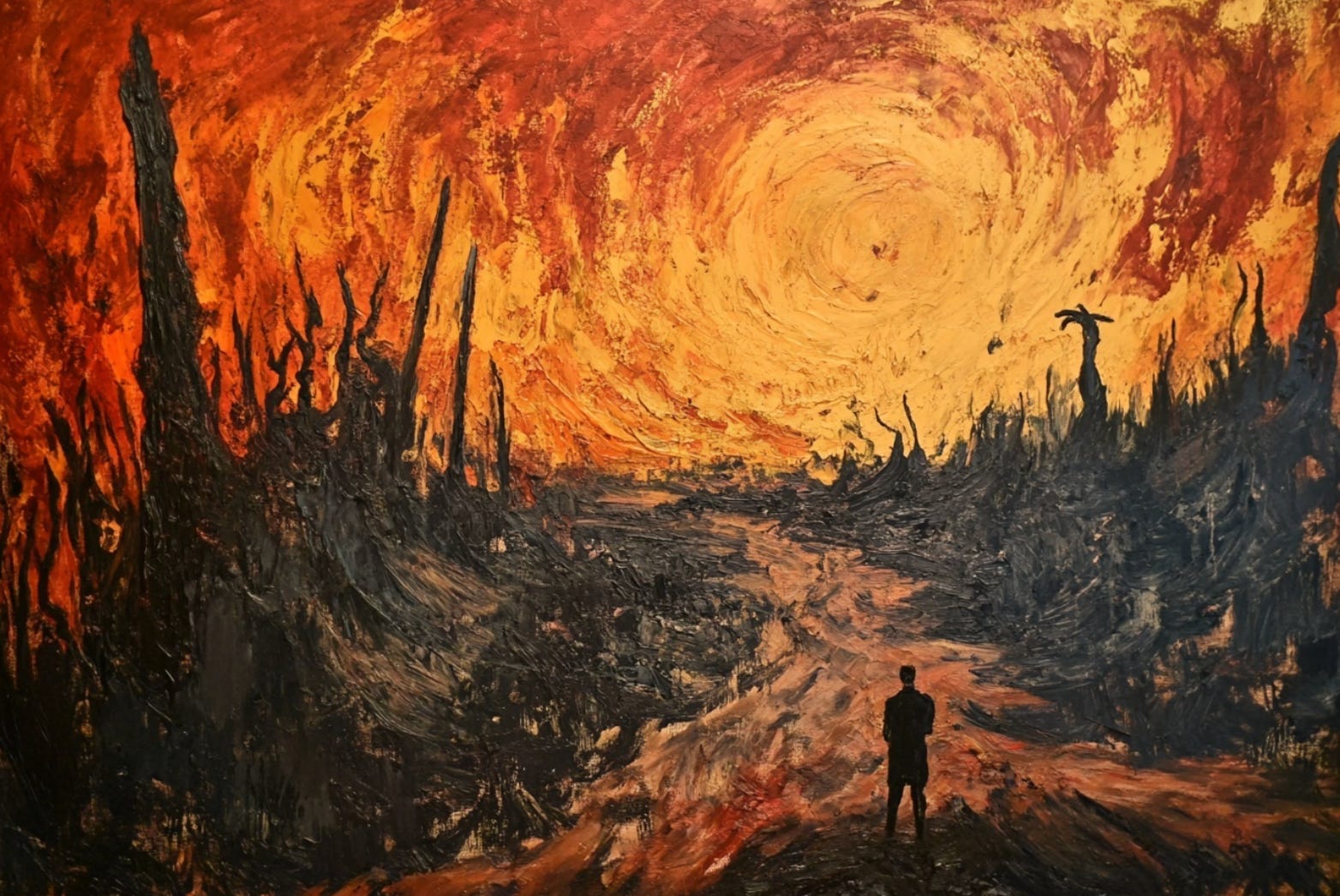
The Case for Disgust
Many rationalists reject the wisdom of disgust, but disgust is indispensable for community life.
Written by Bo Winegard.
Many liberal philosophers have insisted that disgust is an obstacle to enlightened morality. At best, it is unreliable. At worst, it is authoritarian. Dangerous, exclusionary, and obsessed with imaginary harms. It dehumanizes minorities. Fosters stigma. Justifies bigotry. And therefore, like other destructive passions, it should be subdued, not encouraged.
However, this indictment misapprehends a more complex reality. Disgust plays a legitimate and indeed indispensable role in our moral lives. Like all passions, and like reason itself, it is not infallible. But when treated with appropriate caution and prudence, it is not the enemy of a just community, but its ally.
In this essay, I defend three claims. First, disgust, in certain contexts, is a direct mode of moral perception. Some things are immoral because they are ugly, unpalatable, or revolting. Second, disgust is a fallible but reasonable guide to real harms, alerting us to practices that degrade people, corrode social trust, or otherwise undermine the conditions of communal life. Third, disgust facilitates the expression and reinforcement of shared symbolic values, values that divide the sacred from the profane, the holy from the mundane, the thinkable from the intolerable. These shared values contribute to community cohesion and moral identity.
Let us begin with the simplest and least controversial cases, those that do not involve sacred symbols, ritual meanings, inherited religious taboos, or speculative extrapolations to future harms. Some things are immoral because they are ugly, foul, or revolting. They are immoral, in other words, simply because they elicit disgust. Public urination into a sewer during a rainstorm is not wrong because it spreads disease. It is wrong because it degrades a shared space, and virtually all normal people find it repellent. The same is true of defecating in a field or park or of leaving rancid refuse to rot on a sidewalk. These acts are not immoral because they desecrate the sacred or violate the inviolable. They are immoral because they are repugnant, and because they display an indifference to the senses of others in public spaces.
The built environment provides further examples. Some forms of architecture, like unwanted pests, are ugly intrusions into the human space. The harsh, desolate high-rises of urban ghettos; the massive, forbidding concrete facades and inhuman scale of brutalist complexes; the garish neon signs of strip clubs and other seedy establishments, these structures seem almost intentionally hostile to a mind that values order, proportion, and beauty. They assail the senses and oppress the imagination, and we recoil from them. They are not immoral because they cause further harm. They are immoral because they are hideous, thwarting our natural desire for beauty and distorting the spaces in which we live.
The same holds for various forms of bodily and sexual behavior. Public masturbation, fetishistic erotic exhibitions, or intentionally offensive, salacious performances in parks or public campuses are not morally objectionable because they cause further harm (although they might) but because their ugliness itself is indecent. The disgust they elicit is a direct perception of aesthetic and moral disorder. In these cases, the act or display is wrong because it is disgusting. No further harm is needed.
To be clear, there are contexts in which the presentation of the repellent, the depraved, or the debauched is entirely appropriate. Certain works of art, e.g., David Cronenberg’s The Fly, provoke disgust deliberately. But in such cases the disgust is part of a broader aesthetic experience and serves a legitimate moral and artistic function. Furthermore, one can voluntarily engage and disengage. Finding Cronenberg distasteful, a person can choose not to watch his films. Public displays are different. They belong to the community; and they are often not easily avoidable.
The second of my claims—that disgust is a reasonable heuristic for detecting behaviors that cause future harm—is more controversial. Many liberal intellectuals reject it. Martha Nussbaum, for example, argues that disgust is largely an irrational moral reaction, “based on magical thinking rather than real danger.” From her perspective, disgust evolved as a pathogen-avoidance mechanism. Feces, wounds, rotting meat, bodily fluids, and other sources of contagion are repellent because they are potential vectors of disease. In this narrow domain, disgust is useful, if overcautious. But when extended to morality, she argues, it becomes dangerously unreliable, motivated not by an accurate perception of threats but by a futile attempt to avoid or our own animality. “Disgust,” she writes, “revolves around a wish to be a type of being that one is not, namely nonanimal and immortal.”1
The retort here is that disgust warns not just about pathogens but also about social dangers. About behaviors and displays that reliably undermine trust, predict further disorder, and fray the fragile norms that hold communities together. Evolution has wired humans with exquisite sensitivity to signals of underlying personal and social disfunction. Squalid houses, sordid streets, rancid cities, sexual promiscuity, vulgar speech, public intoxication, and other indicators of degradation provoke disgust, not because of magical thinking, but because they, like the spoiled skin of a fruit, suggest a deeper decay, a decay of trust, reciprocity, dignity. Thus the disgust and attendant moral disapproval that greet such signs of personal and social decay is not irrational. It is a reasonable heuristic alerting us to a potentially disintegrating social fabric.
Similar considerations apply to the contentious domain of sexual norms. Many sexual behaviors provoke disgust because they reliably correlate with social instability. Norms of fidelity, of restraint, of monogamy are not antiquated. They serve crucial community functions. When these norms weaken, communities experience predictable harms. Increased disease transmission. Diminished relationship stability. Reduced or disordered fertility. Broken kin networks. Increased vulnerability to exploitation. Promiscuous sex, transgressive sex, and sex detached from commitment trigger the disgust response because they vitiate norms that allow families and communities to flourish.
Of course, none of this means that disgust is an unerring guide to future harms or that we should always defer to it. All moral emotions—and reasons itself—are limited and fallible. Disgust can mislead. It may be provoked by features that have no moral relevance, such as physical unattractiveness or congenital deformity. A person who is unsightly or malformed might evoke an initial aversion, but in such cases decency requires us to overcome the reaction and treat them with respect and dignity.
Homosexuality presents more difficult questions. Liberal intellectuals often cite intolerance of gays and lesbians as one of the obvious costs of relying on moral disgust. I’m not convinced that attitudes toward homosexuality are primarily driven by disgust. Opposition to same-sex marriage, for example, may reflect a sincere commitment to traditional, fertility-oriented conceptions of pair-bonding. Certainly disgust may play a preliminary role here, but it is not determinative. I’m also not convinced that current embrace of alternative sexuality is healthy, though I would of course condemn bullying, disparaging, or otherwise harassing sexual minorities. At any rate, this is a complex, incendiary topic that deserves its own essay.2
And to repeat, the point of this section is not that disgust is an infallible oracle whose every warning we must obey. Rather, it is that disgust is often a useful guide to future harms. And its wisdom is deeper than rationalists typically allow. Like a speed limit sign on a new road, we should heed it, not recklessly ignore it.
The third claim—that disgust plays an important role in sustaining shared symbolic values—is perhaps the most controversial, for many modern liberals (and especially libertarians) deny the significance of such shared values. But communities are not held together like molecules by ineluctable physical laws. Nor are they held together like computer simulations by rule-following rational agents. Instead, they are held together through mutually endorsed expressive commitments: shared conceptions of right and wrong, good and evil, meaning and identity. They persist by establishing and enforcing boundaries between the sacred and the profane, the honorable and the degrading, the thinkable and the intolerable.
As Mary Douglas observed, notions of purity and pollution are universal. Every community sacralizes certain people, places, and practices, and these demand reverence, restraint, and protection from defilement. Disgust is perhaps the predominant emotion that enforces these boundaries. So-called “harmless wrongs,” which so often puzzle rationalists, e.g., desecrating graves, spitting on a national flag, mocking a war memorial, or hurling vulgar denunciations at the holy, provoke disgust precisely because they represent an attack on shared symbolic values. The moral opprobrium that follows is not a relic of superstition nor an irrational reflex but a crucial way for a community to affirm and preserve its collective identity.
Rationalists and others skeptical of disgust often dismiss these symbolic values. They find them irrational and superfluous. If an act does not directly harm another person, they contend, then it should not be taboo, and certainly not subject to moral condemnation.
But this is an impoverished view of morality and community. Treating the cemetery as a sacred place where the dead are hallowed is not a frivolous cultural indulgence; it is a way of binding people across generations. Those who violate the sacred space of the cemetery may not inflict physical injury upon a living person, but they do assault the community’s sense of identity and its conviction that the dead remain part of its moral universe, connected spiritually to the present through memory and ritual. As Emile Durkheim noted, societies are bound by shared rituals and collective representations that embody their ideals. And as communal philosophers from Aristotle to Hegel to Charles Taylor have argued, humans inhabit a dense web of meaning that cannot be reduced to individual desires and preferences. Or to mutual contracts.
Disgust thus can be seen as a sentinel of these shared symbolic meanings. It moralizes violations of taboos because such violations devalue the symbols through which a community understands itself. In effect, such violations are a moral assault on the community’s symbolic web, a way of altering or even destroying shared stories and myths.
Of course, like the story of the Trojan War and other sacred myths, a community’s symbolic web, its moral and metaphysical identity, evolves over time. And in the modern West, we rightly encourage a prudent form of self-criticism, even toward the sacred. In some contexts the questioning of common knowledge, sacred taboos, and even the holy is appropriate. The seminar room, the philosophical essay, the reflective conversation among the educated. My claim is not that a community’s moral identity is beyond reproach or reconsideration. Rather, it is that the disgust that protects that identity expresses a genuine form of moral wisdom, a recognition that meaning and cohesion cannot be sustained by reason and legal contract alone. Hypothetical societies built entirely on rational deliberation and legal agreement are fantasies every bit as utopian as the classless paradise of Marxist theory.
Communities endure through shared symbols and moral boundaries. Without disgust, those boundaries would remain perpetually unstable, easily undermined by indifference or transgression. A community that relied solely on reason would, at the first sign of stress, evaporate like a volatile vapor. It is only with a shared sense of sacred morality that the withering debate and philosophical restlessness of the West can flourish. Liberty requires order. And order requires strong norms and taboos. And strong norms and taboos require disgust.
Bo Winegard is an Editor of Aporia.
Support Aporia with a paid subscription:
You can also follow us on Twitter.
The claim that we are disgusted by things that remind us of our animality is implausible on its face. Animals sleep, run, care for offspring, drink water, and so on. None of these things are disgusting when humans do them.
We moralize somethings we do not find disgusting, e.g., stealing a knickknack from a store; and we do not moralize somethings that we do find disgusting, e.g., sexual relations among the very old. That homosexuality (especially among men) may trigger a disgust response is probably not the primary reason homosexuality has been moralized throughout the history of the West.


