

Written by Bo Winegard.
Somewhere there is, I am sure, an example of an online political argument that ended in a genuine change of mind. But I have yet to see it. In fact, online political argument more often divides friends than persuades enemies. Yet many of us engage in it, sometimes constantly and feverishly, like addled gamblers repeatedly pulling the lever of a losing slot machine. Twitter, for example, is full of debate—most of which seems designed to exacerbate disagreement and rancor, not mitigate it.
This appears to falsify a simplistic but superficially plausible view of the goals and functions of political behavior and, indeed, of the human mind itself: that we try to discover what is true about the world and then persuade other people. The predictable outcome of belittling ideological opponents or adopting extremist political slogans is certainly not that other people will be persuaded. Yet there are hundreds, perhaps thousands, of tweets a day that do just this, often from people of not inconsiderable intelligence.
Nor does our way of engaging with political material, newspapers, magazines and journal articles seem optimal for arriving at the truth. For many of us come to dwell in ideological cocoons, reading only material that confirms our tribe’s beliefs. And if, from time to time, we stray from that cocoon, it is only to remind ourselves just how silly or even sinister the outgroup really is. And perhaps to provide ammunition for our next tweet assailing our ideological foes with acerbic ingenuity.
This is almost certainly not the behavior one would see from a rational agent designed to pursue the truth and persuade others. Thus, we need another model of ideological behavior, one that accounts for the apparently self-defeating behavior of many ideologues.
A plausible alternative is that political beliefs, like many other higher-level beliefs with social consequences, are more about signaling tribal allegiance and competing for status and belonging than they are about discovering and converting others to the truth. From this perspective, the alienating nature of much political discourse is not a quirk or a flaw, but a design feature. Like a “Jesus Saves” shirt, a septum ring, or a tattoo of Satan, political discourse quickly and reliably sorts team us from team them.
Participants engaged in political discourse thus often act like partisan lawyers, rather than scientists attempting to ferret out the truth. They learn the claims and nomenclature of their tribe. They cite the sources their tribe approves of. And they consult alternative sources only to anticipate arguments they might be forced to rebut.
At first, these claims might seem puzzling. We might concede that humans are often rude online and that they avoid reading materials that might falsify their passionately held convictions. But to believe falsehoods? To avoid the truth altogether? That’s a stretch. Why would evolution select for an organism whose brain was not designed ultimately to seek the truth?
Tribalism.
Evidence suggests that mortal human competition is old and ubiquitous. Throughout human evolution, coalitions assembled and struggled for limited resources such as territory, food, water and mates. At best, the vanquished were relegated to less desirable lands; at worst, they were slaughtered. Fossilized indicators of violent death are common, and support this gloomy vision of human nature and the pervasiveness of violence and competitiveness.
Tribal conflict is not an anomaly. It is not the creation of capitalism or modernity. It is an enduring feature of humans and is likely ineradicable.
Four thousand years ago, it might have manifested as violent warfare; today, it might manifest as rhetorical jousting on social media. But whatever its modern shape, it is important to understand that it was constant and potentially mortal throughout human history, creating intense selection pressures for tribal behavior, including an ability to discriminate between ingroup and outgroup members; a propensity to punish disloyal or ineffective ingroup members; and a propensity to reward loyal and effective ingroup members, generally with resources and prestige.
Tribes face an information problem because a person’s level of loyalty is often difficult to ascertain. Maybe Bobby is just pretending to be loyal and at the first sign of impending conflict, he will flee to the enemy. Maybe Jill is just pretending to be loyal to obtain status and resources before joining another tribe. A tribe infiltrated by frauds, cheats and skeptics is a weak tribe indeed. Like a flawed crystal, it easily fractures, the shards being anything from hurt feelings to thousands of dead men and women.
One potential solution to this problem is the development of costly signals of loyalty. These are signals that loyal members can afford to display but that most disloyal members cannot or will not. For example, a sincere Catholic may be willing to spend many hours at church, may learn Ecclesiastical Latin, and may assent to beliefs that many outsiders view as ridiculous. A fraudulent Catholic would not.
Thus beliefs themselves can be particularly useful costly signals of tribal loyalty precisely because they might alienate outgroup members. I will explain these costs in more detail, but for now, let us accept that beliefs can function as signals of tribal affiliation.
Before proceeding, it is important to understand that the human mind is not a truth-maximizing machine; it is a fitness enhancing machine. Other things equal, it maximizes reproductive fitness. And thus it must assess not just the epistemic costs and benefits of belief, but all the costs and benefits, including the social ones. And that means that it often believes things that are false or implausible if those things are socially rewarded.
One might reasonably retort: but surely false beliefs are incredibly costly? Believing that a deadly plant is not poisonous, after all, might end your life in a few hours. No more life, no more children. That is pretty bad for reproductive fitness. Surely it would be better to behave and believe rationally, while lying if necessary about socially important beliefs. If you are born into a group that believes that trees are evil spirits descended from Gorgonos, a three-headed lion spirit, then just say, “Sure, I believe in Gorgonos and in the supernatural trees” publicly, while privately maintaining an accurate representation of the world.
Two responses. First, lies might be more expensive than false beliefs. A lie requires monitoring two conflicting representations, those that you really believe and those that you only pretend to believe. For some things, this is not particularly difficult. Answering ,“Yes I finished my homework” without having even opened the book is presumably as natural to a kid as feigning death is to an opossum. And it does not require much cognitive sophistication.
But for other things, lying is more difficult because it requires constant tracking of complicated representations. Telling some people that you believe in elaborate metaphysical doctrines when you do not might become cognitively taxing. You must take the time to learn the doctrines, and you must distinguish those to whom you can tell the truth from those to whom you must lie. Moreover, you must hope that you do not accidentally reveal your true beliefs. And that only takes one slip in potentially many thousands of yearly interactions.
Furthermore, social groups are not naïve. They know that people often feign belief to receive the benefits of membership. Therefore, they vet potential members, watching constantly for signs of dishonesty. And these signs can be quite subtle.
Suppose, for example, you are not a radical feminist, but all the powerful professors at your university are. So you pretend. You are eating lunch with a few professors when a provocative student peaks in and cracks a joke that might be vaguely sexist. How should you respond? A true believer does not explicitly think about this: he just becomes offended. But a liar? Well, he must simulate the emotional reaction of a believer, then decide the appropriate response. And that small hesitation might give him away. “Did you see John chuckle slightly at that repulsive joke? I sure did.”
Thus group vetting may have selected for various kinds of self-deception and erroneous beliefs, because groups make the task of lying more difficult while potentially increasing the value of a genuinely held false belief.
And second, as thinkers from Sigmund Freud to Robert Kurzban have argued, the human mind is dynamic and contradictory—it can produce multiple representations about the world that are not necessarily consistent with each other. In other words, it can compartmentalize. And this compartmentalization insulates a person from the full costs of holding false beliefs. A person might believe both that prayer really works and also that if a ship is sinking, one should do everything to survive, not sit quietly in the corner asking for God to intervene.
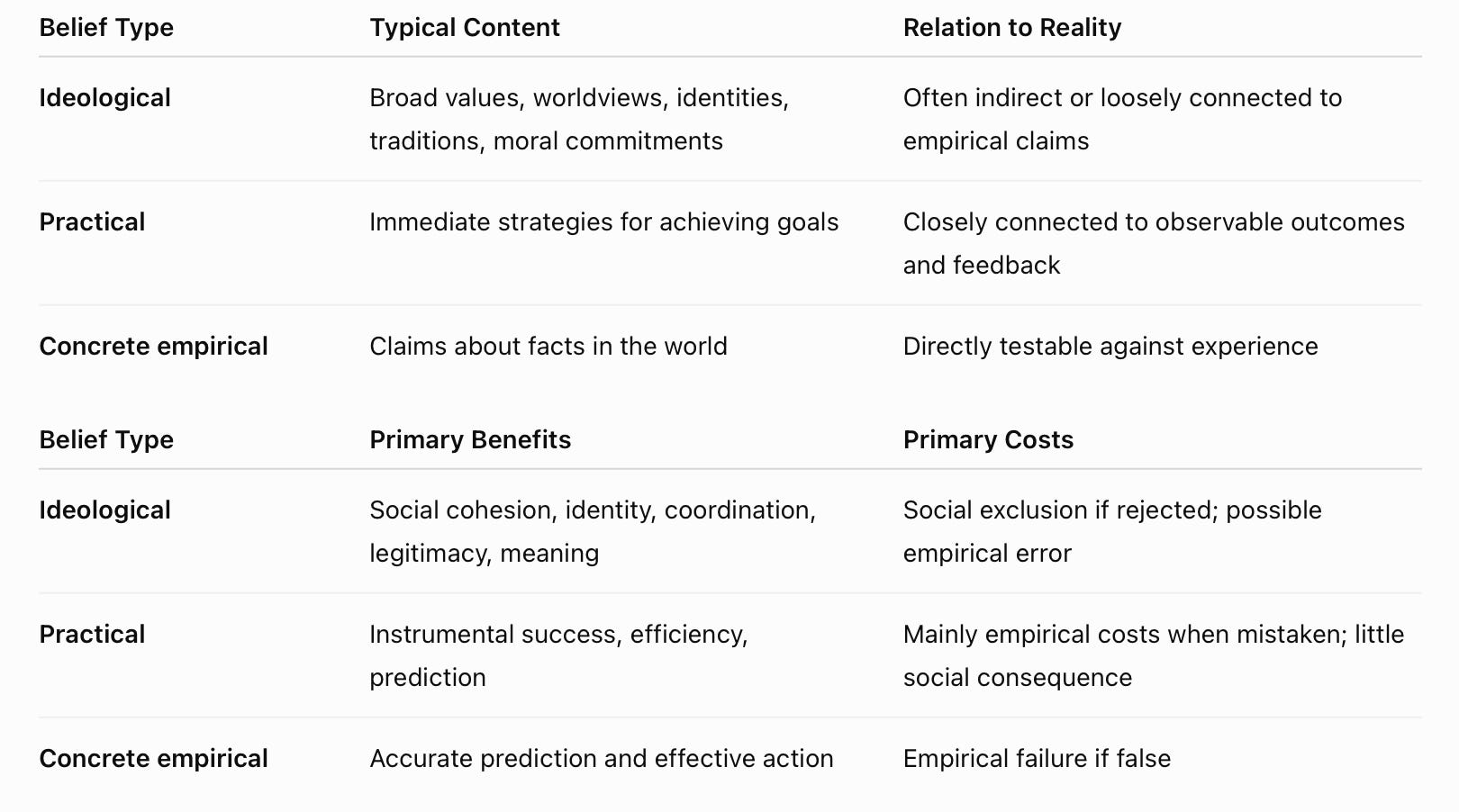
Notice that different types of beliefs have different costs and benefits. What we might call ideological beliefs (e.g., “tradition is a source of wisdom”) are often only vaguely related to concrete empirical claims (e.g., “a diet lacking in vegetables is bad”), whereas, what we might call practical beliefs (e.g., “I should drive early in the morning to beat traffic”) are more closely related.
At the same time, ideological beliefs might have important social consequences, whereas practical beliefs do not because almost everyone believes them, and they do not distinguish the loyal from the disloyal, the orthodox from the heretic.
The fitness value of a belief, to formalize this, is the sum of the social and the empirical benefits minus the social and the empirical costs.
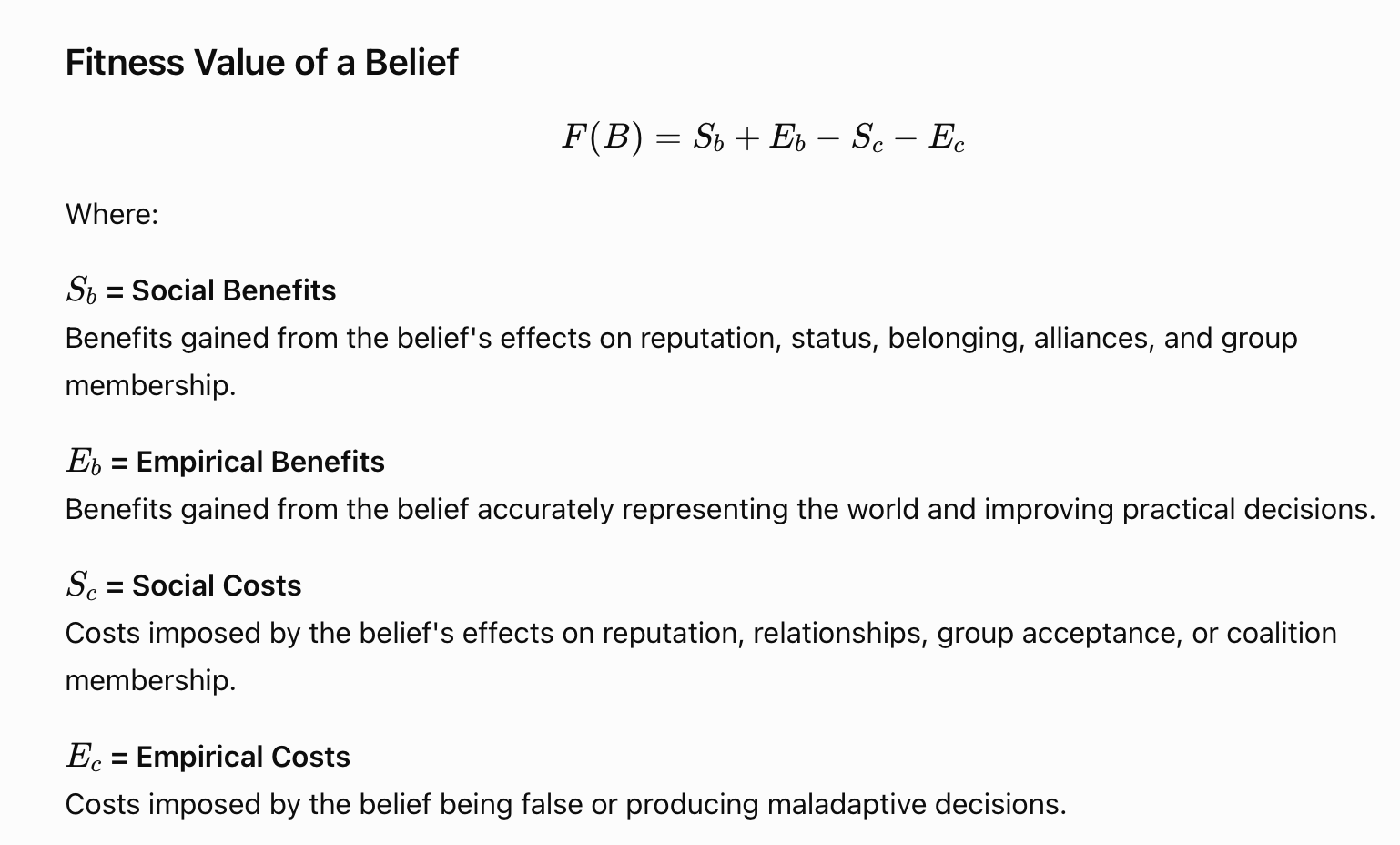
If the human mind is capable of distinguishing these beliefs because it receives differential feedback about them, then a single mind might come to embrace ideological beliefs that are contradicted by its own practical or empirical beliefs.
Consider, for example, the belief in a blissful afterworld. I have known people who sincerely believe, so far I can tell, that all human souls will eventually be saved and spend eternity in a state of ecstasy. One consequence of this, one might think, is that they would be rather insouciant about dying. If the result of death is bliss, then death is not so bad. Yet these same people certainly seemed to hold the practical belief that death is terrible and to be avoided.
This can give rise to what we might call the sincere hypocrite—the person who sincerely believes an ideological claim while also sincerely believing practical and empirical beliefs that appear to contradict it.
Consider the vocalist in a politically radical rock band (The Mad Marxists) that advocates communism. He may sincerely believe that capitalism is an exploitative and immoral system while also benefiting from its fruits and negotiating his contracts ruthlessly. Imagine, for example, his record label offering his band 500k. He retorts, “Absolutely not. We are worth more than that. Why, just last year, we sold three million records. Do you have another band selling that many records?!”
Although he may genuinely detest capitalism, he also seems to accept premises about supply and demand and the legitimacy of worth in such a market. Of course, he might argue that even anti-capitalists have to work within the capitalist system, and these might even be reasonable arguments. (Anti-monarchists, after all, had to participate in a monarchist society.) Whatever the validity of such arguments, the more important point here is that one’s ideological beliefs might contradict one’s practical beliefs and one might not even see the contradiction unless forced to do so.1
Now consider the immediate costs and benefits of ideological belief (“capitalism is a vampire that sucks the world dry!”) to this hypothetical marxist singer. His band’s identity is formed around denouncing capitalism. If the singer read some Friedrich Hayek or Russ Roberts and thought, “You know what, I’ve been wrong about this. It’s virtually impossible to create a prosperous planned economy,” and then went public with his change of mind, it would ruin his band and likely many of his friendships. His status would plummet.
At the same time, his false belief that communism is better than capitalism is virtually costless, at least epistemologically. It does not affect his day-to-day behavior. It does not affect his contract negotiations. It does not even affect public policy, since even if he persuaded one hundred thousand fans to become communists, few of them would vote and the country would remain capitalist. He would still enjoy the fruits of capitalism while denouncing its supposed crimes.
But then what is the cost of the belief? The whole point of beliefs as signals is that they’re costly. But if the cost is largely not in the possession of wrong beliefs, then what is it in? My best guess is that the chief cost is in alienating outgroup members. Take, for example, the political slogan “Transwomen are women.” This belief reliably signals commitment to progressivism because it rankles, irritates, and antagonizes those who are not progressives.
If you are on a date with a person whose politics you do not know, and you assert confidently, “Transwomen are women,” they might respond favorably, or they might end the date very quickly. The foregone relationship, or the risk of losing access to certain social networks, represents a genuine opportunity cost. The signal is costly not because it leads immediately to maladaptive behaviors such as eating poisons or treating men as women, but rather because it alters one’s set of potential social relationships. In effect, it narrows one’s social network and makes it more costly to defect from the group (progressives, in this case).
Notice that this has a perverse effect: the more alienating the belief, the most socially costly it is, the more reliably it functions as an honest signal of group loyalty. The sentiment, “I believe in reasonably generous immigration policies, but recognize that there are complicated tradeoffs” might be laudably humble and conciliatory, but for that very reason it is not an effective tribal signal.
On the other hand, the sentiment, “No human is illegal” is much more audacious, suggesting, as it does, that borders themselves are illegitimate. And for that reason, it is also a more effective tribal signal. The person who asserts that no human is illegal is risking irking others—sometimes even to the point of severing friendships. This is why house signs generally do not say, “We believe in reasonable immigration polices that respect national sovereignty.” House signs are not designed to persuade or inform; they are designed to signal tribal loyalty.
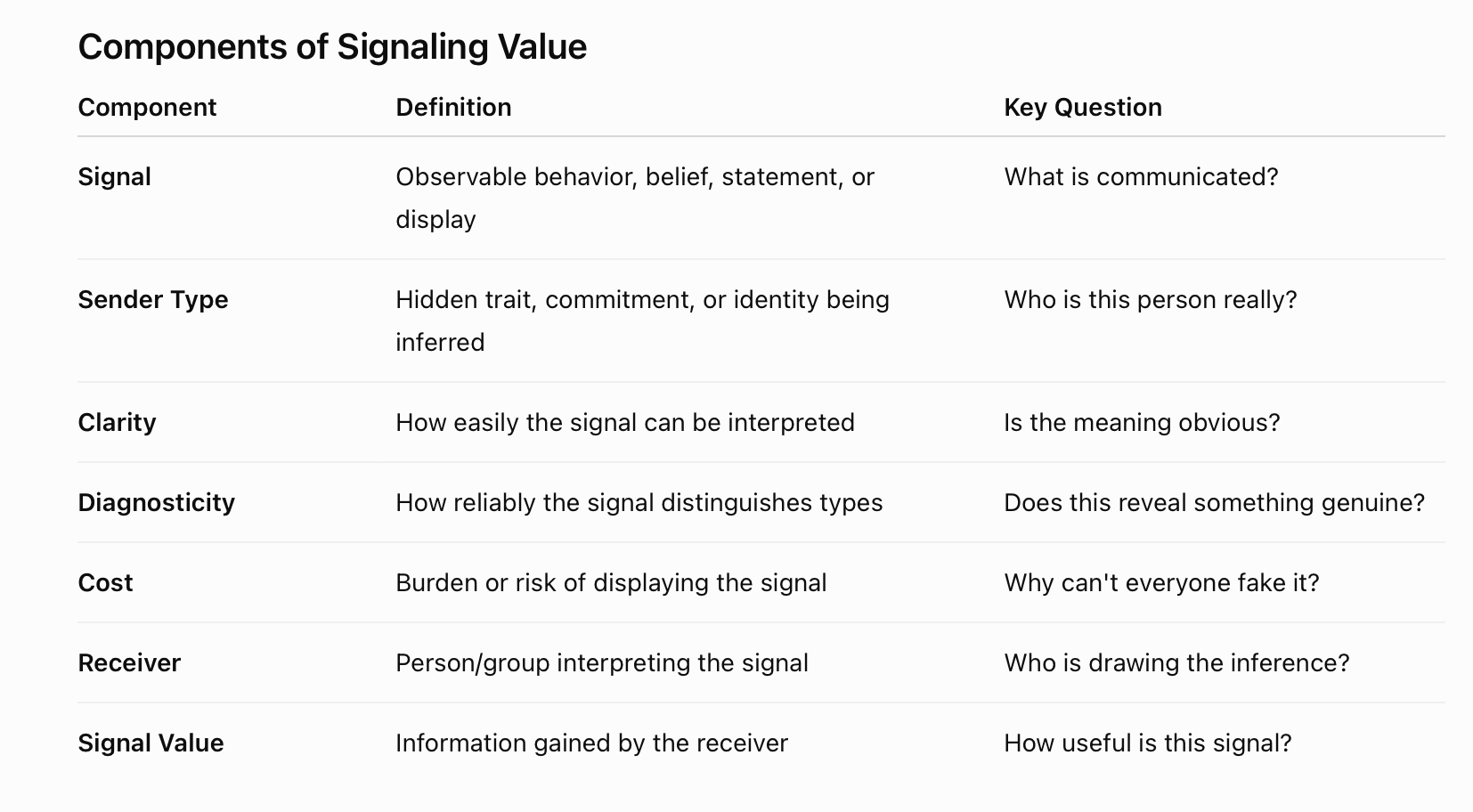
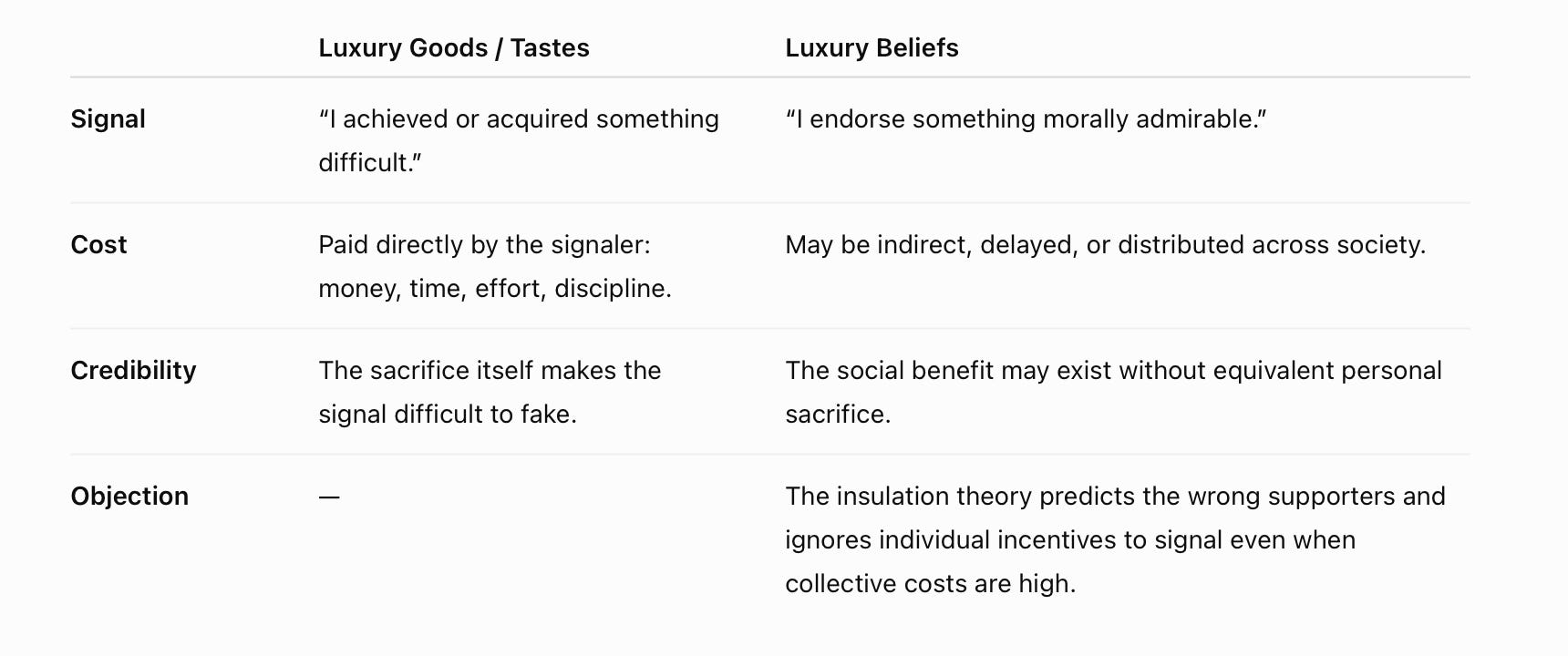
Here it is useful to distinguish this model of political beliefs from another prominent signaling account of political beliefs: Rob Henderson’s luxury beliefs. According to Henderson, luxury beliefs are “ideas and opinions that confer status on the rich at very little cost, while taking a toll on the lower class.” Put more technically, the claim seems to be that luxury beliefs are differentially costly, imposing greater marginal cost on the working class than on the rich.
Henderson thus contends that luxury beliefs are like luxury goods or tastes: they honestly signal status, wealth, leisure and so forth. But, in my view, this analogy is flawed because luxury beliefs do not really function like luxury goods or tastes.
Let’s take luxury goods first because they are the most straightforward. Consider a Porsche. The cost is immediate and obvious: it is very expensive. Therefore, it reliably signals wealth. People who are struggling to pay for their monthly groceries are unable to purchase a Porsche and then keep up with the insurance payments. And, importantly, luxury goods are impressive to most audiences. In other words, their signaling value is not tribal; it is universal. Even the woman who blasts Rage Against the Machine and makes “Fuck the system” her life slogan would probably admire a guy driving a Porsche, in spite of her own stated desires.
Now, let’s take luxury tastes, which are a bit more complicated. Consider the claim “I love Cicero’s Latin prose.” The cost is obvious. In the United States of 2026, very few people learn Latin. And learning Latin as an adult is very difficult. It requires thousands of hours of leisure time and a high-level of verbal intelligence. Therefore, if somebody says, “I love the Latin of Cicero” and then says, “Quo usque tandem abutere, Catilina, patientia nostra?” one can reasonably infer that the person is intelligent, conscientious, and has ample free time—in other words, that the person has high intellectual capital.
Like luxury goods, luxury tastes are often impressive to most audiences. Even the humble midwesterner who abhors intellectual pretentiousness would probably admire a person who can quote Cicero on demand.
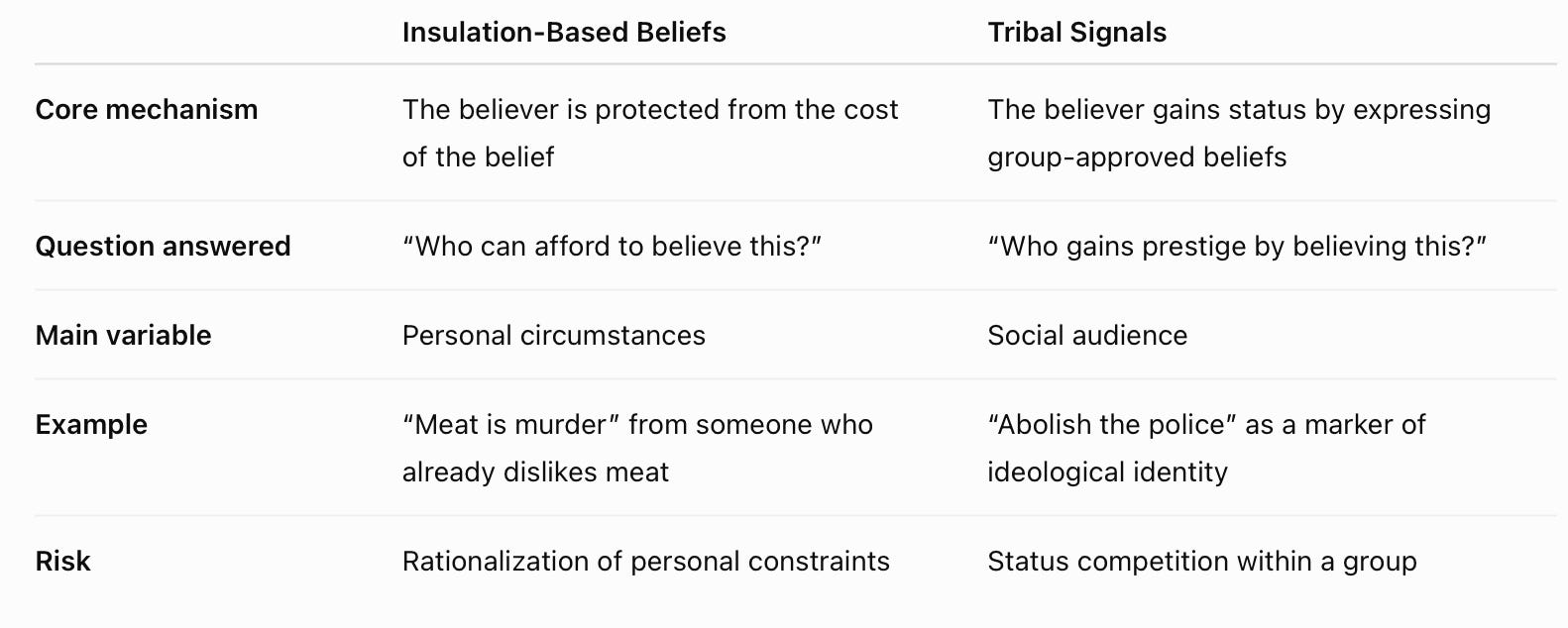
Now luxury beliefs. The cost is not at all obvious. Consider a commonly cited example from Henderson: “abolish the police.” It is not costly to learn to say “abolish the police.” It is a simple slogan with some simple moral claims behind it. Henderson’s retort, I think, would be, “There is a hidden cost: rich people can get by more easily in a world where the police are abolished because they depend less on the police.” According to his model, an insulating variable buffers the rich person from the costs of the signal, but not the working-class person.2 In this case, the insulating variable is living in peaceful communities with private security.
Leaving aside some complications about what counts as the working class, there are two problems here. First, if the insulating variable is the key, the people who should advocate most strongly for abolishing the police are those who live in relatively crime-free, rural communities—so people who live in small towns in Iowa, Montana, Wyoming and so forth, who protect themselves with guns because the two or three police officers in the town would take thirty minutes to get to their house.
But this is clearly not the pattern we see. In fact, such rural people (who tend to be Trump voters) are some of the least likely to support “abolish the police.” In other words, the proposed insulating variable is not really a good predictor of support for “abolish the police.” Ideological alignment is.3
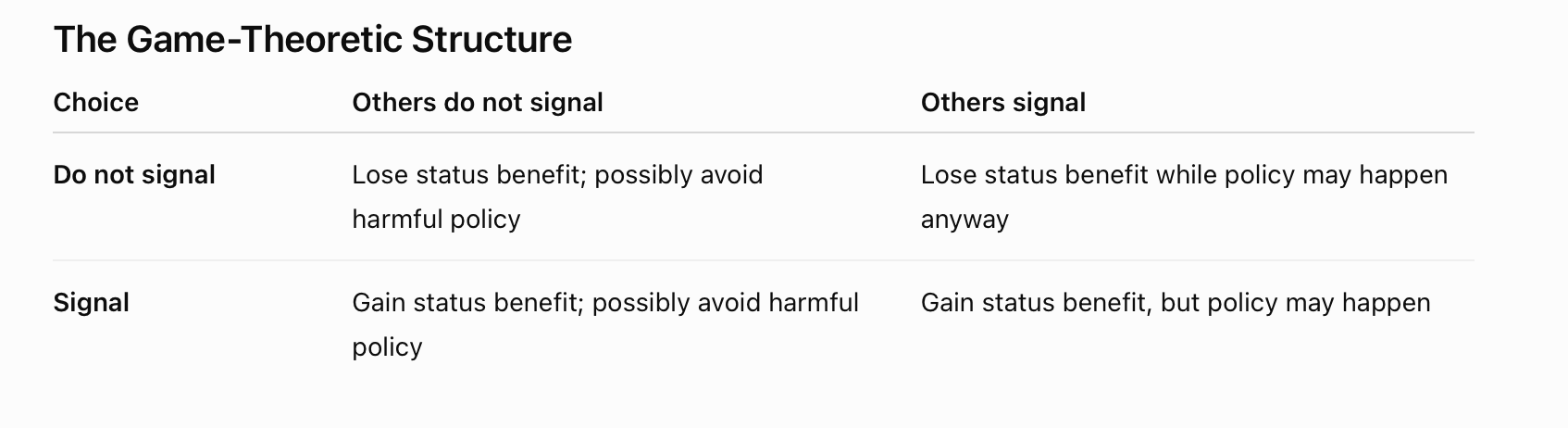
And second, even if the structure of the costs were as Henderson contends, this would create a kind of social signaling dilemma in which the optimal move is still to signal. That is, even if “abolish the police” would actually hurt the working class more than the rich, the optimal move for any particular member of the working class would be to signal and receive the benefits for doing so.
Consider this from the working-class persons’s perspective. He can either not signal, in which case he does not get the status benefit. But other working-class people might signal anyway, getting the status benefit and causing the policy to be enacted. Or he can signal, in which case he at leasts gets the status benefit, even if he also pays the costs of the policy. In many realistic cases of this dilemma, signaling is the dominant strategy and it is always better to signal.
To formalize this in a simplistic way, the utility of signaling equals the status benefit minus the personal cost times the additional probability that an individual’s signal may lead to the adoption of the policy.
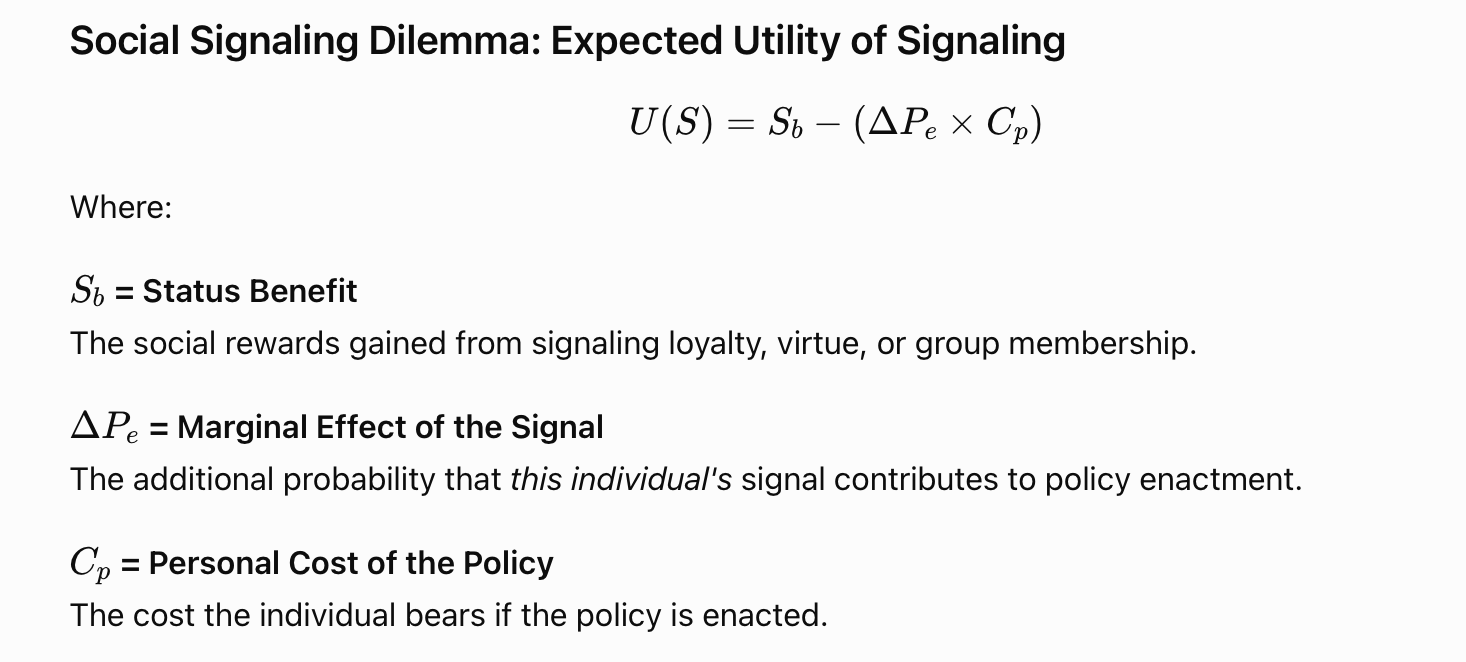
In many cases, the additional probability that any individual person’s signal will in fact lead to the adoption of the policy in question is very low. If Thomas, a man who works at a factory in a dangerous neighborhood in Atlanta, espouses the belief that we should abolish the police, his actual effect on the policy landscape would be virtually zero. Thus, if he could get any status benefit for signaling, it would be worth it from a fitness perspective.
Notice also that unlike luxury goods and luxury tastes, luxury beliefs are not impressive to most audiences. They are not universal.
If you are out with a man on a date, and you say, “I just think it’s important to abolish the police,” his reaction will depend almost entirely on his politics. If he’s a conservative, he will think, “Ugh, she’s a progressive. I should have known.” Whereas if he’s a progressive, he might think, “Ah, we share values. This is promising.” In fact, most of the proposed luxury beliefs in the literature seem designed to be maximally vexing to conservatives. They do not function like luxury goods or luxury tastes; rather, they function like progressive tribal beliefs.
This is not to say that the cost-structure Henderson attributed to luxury beliefs is uninteresting. There may very well be beliefs that signal some quality to others because the believer is relatively insulated from the costs. Somebody who finds the flavor of meat repugnant might more easily espouse that belief that “Meat is murder,” for example. Or somebody who is sexually undesirable might more easily espouse the belief that “Sex outside of marriage is sinful.” But I do not think we would refer to these as luxury beliefs, and I also do not think the most commonly cited examples of luxury beliefs fit this pattern. But they do fit the pattern of tribal signaling.
If we understand political belief in this way, we can understand why political beliefs are so divisive and why online environments are particularly caustic. In real-world communities, people of course still belong to different tribes and still signal with alienating slogans. But in such communities the value of compromise is also often much higher than it is online.
For in real-world communities, people have to live work, and cooperate with each other—behaviors which make life better for everyone. Contentious political disagreements can interfere with cooperation and can lead to costly bickering and social breakdown. Thus, compromise is important.
Because of this, even dedicated political partisans might value compromise and discourage their own tribe from engaging in rhetoric that is too incendiary. At the little league game, saying, “Immigrants are criminals who are poisoning the country” probably will not be well received, even by border hawks. Families want to maintain comity so they can continue to engage in a cooperative venture (baseball) that is valuable for the children.
The value of compromise online, however, is substantially lower. In fact, compromise online is often seen as a weakness, a failure, a sign that one will retreat when the battle begins. Extremity is rewarded, even if many people privately think, “Yeah, that’s probably a bit much.” If nothing else, it captures attention, which is in limited supply online. At the backyard barbecue, you might be competing for attention with ten to twenty other people; online, you are competing with tens of thousands of people.
Furthermore, in real-world communities there are many other ways to display costly commitment to a cause. You can dutifully show up to meetings. You can knock on doors. You can display thorough knowledge of your tribe’s views. And so on. Online, the ways to display costly commitment to a cause are more scarce. You do not usually attend meetings online. You do not often write long policy papers or answers interrogations about tribal beliefs.
Thus, the alienating cost becomes possibly the preeminent signaling cost. And participants compete to provoke the most outrage in the outgroup. This is probably why people on Twitter often boast about being “blocked” by somebody from the outgroup. “Look, I’m so dedicated to the cause, so fiery and formidable, that I was blocked by this prominent member of their tribe!”
Before concluding, one might reasonably ask: If everything in this article is true, how do we ever discover the the truth? How have we flown men to the moon, created smartphones, and so forth?
Although this is not a simple question, my best guess is that philosophy and then institutionalized science were the most important historical developments—philosophy because it often highlights contradictions between different levels of representations, and institutionalized science because it incentivizes empirical accuracy over tribal signaling.
But whatever the answer, I think this is the right question. Instead of asking how we come to hold false beliefs at the abstract (ideological) level, we should ask how we ever come to hold true beliefs.
Only roughly twenty-six hundred years ago, Thales speculated that everything was made from water. Now, physicists believe that everything is made from atoms that are so small there are some twenty to sixty quintillion of them in a single grain of sand. As economists are fond of saying, incentives matter. Science incentivizes truth. Politics incentives signals of loyalty. Science gives us the Neanderthal genome; politics gives us the “I love liberal tears” coffee mug.
To conclude, the human mind has a complicated, dynamic structure and is capable of generating and believing many contradictory beliefs at different levels of representation. Being trained or predisposed to care about consistency, philosophers may find this obnoxious, but it is not pathological. In fact, I’d wager that all of us have some contradictory beliefs. Because of this, we are often insulated from the epistemological effects of holding erroneous high-level beliefs. We may sincerely believe that God intervenes in the world, while also believing that emergencies require action, not patience while we wait for divine aid.
This means that the costs and benefits of high-level beliefs are predominantly social. Such beliefs are used to signal loyalty to tribes (and perhaps sophistication and social capital). These signals of loyalty do not need to be true; they only need to be costly. One important cost they can bear is the alienation of outgroup members. Thus, slogans that are extreme and antagonistic are often more useful to political tribes than those that are reasonable and conciliatory.4
Political debates, especially online political debates, do not persuade people because they are not especially designed to. They are designed to allow partisans to signal their tribal allegiances. Given this, the miracle is not that social media is as full of rancor and hostility as it is, but that it’s not full of more.
Bo Winegard is an Editor of Aporia.
Become a free or paid subscriber:

Like and comment below.
My suspicion is that philosophers from Socrates on are particularly good at simultaneously activating these representations and forcing one to confront the contradiction.
By “insulating variable”, I mean a variable that insulates some groups but not others from the costs of signalling.
It is not at all clear that rich people in cities would be the least hurt by abolition of the police. In fact, if the police were actually abolished, cities would pay the highest price, including, quite likely, wealthy people in those cities. Of course, one might retort that they would eventually hire private security officers, which is fair enough. But distribution of the costs of police abolition is not clear to me a priori, and I have not seen a formal model of it.
Of course, this is nuanced because political tribes also sincerely want to persuade potential voters, which introduces another complicated layer of costs and benefits beyond the scope of this essay.
I agree broadly with this essay, but I specifically read a wide variety of political essays to change my belief. At this age, I don’t usually change 180 degrees, but rarely does a day go by that I don’t refine my views or temper them.
I even find my AI changes my mind on political topics. I say something and it corrects me with facts.
Over the course of my life my views have changed quite an bit and in no way was this a response to be more like my friends or family or any group.
Fantastic article! I found it quite fascinating. Thank you for taking the time to write and to post this.