


Written by Lipton Matthews.
Singapore is admired for its ability to attract exceptionally bright individuals into public service. In 2025, the country ranked first on both the Chandler Good Governance Index and the Elite Quality Index. This state of affairs is not some accidental by-product of growth. It is the result of deliberate policy choices. Singapore has a deep commitment to administrative competence.
To see how this commitment operates, let’s begin with education. Singapore’s school system is designed to identify cognitive outliers through standardised testing, ensuring gifted students are recognised regardless of family background. These students are channelled into accelerated tracks that emphasise abstraction, analytical reasoning and problem-solving.
The process does not end with schooling but rather feeds into a broader talent pipeline. Singapore operates a large number of public-sector talent programmes that recruit top performers into ministries and statutory boards and then rotate them through demanding policy environments. In addition, such individuals are routinely sponsored to participate in foreign talent programmes and executive courses, exposing them to global best practices.
All these arrangements reflect a specific theory of state capacity. Lee Kuan Yew, modern Singapore’s founding father, was familiar with intelligence research and understood that general intelligence becomes increasingly important as work grows more complex.
Today, senior public administration is among the most cognitively demanding forms of work. It requires sustained information processing, long planning horizons, coordination across policy domains, and the ability to make decisions under uncertainty. It is highly g-loaded. We know that as task complexity rises, g explains a greater share of the variation in performance. Hence small differences in ability produce large differences in organisational effectiveness over time. States that consistently select for high ability in public service will eventually diverge from those that don’t.
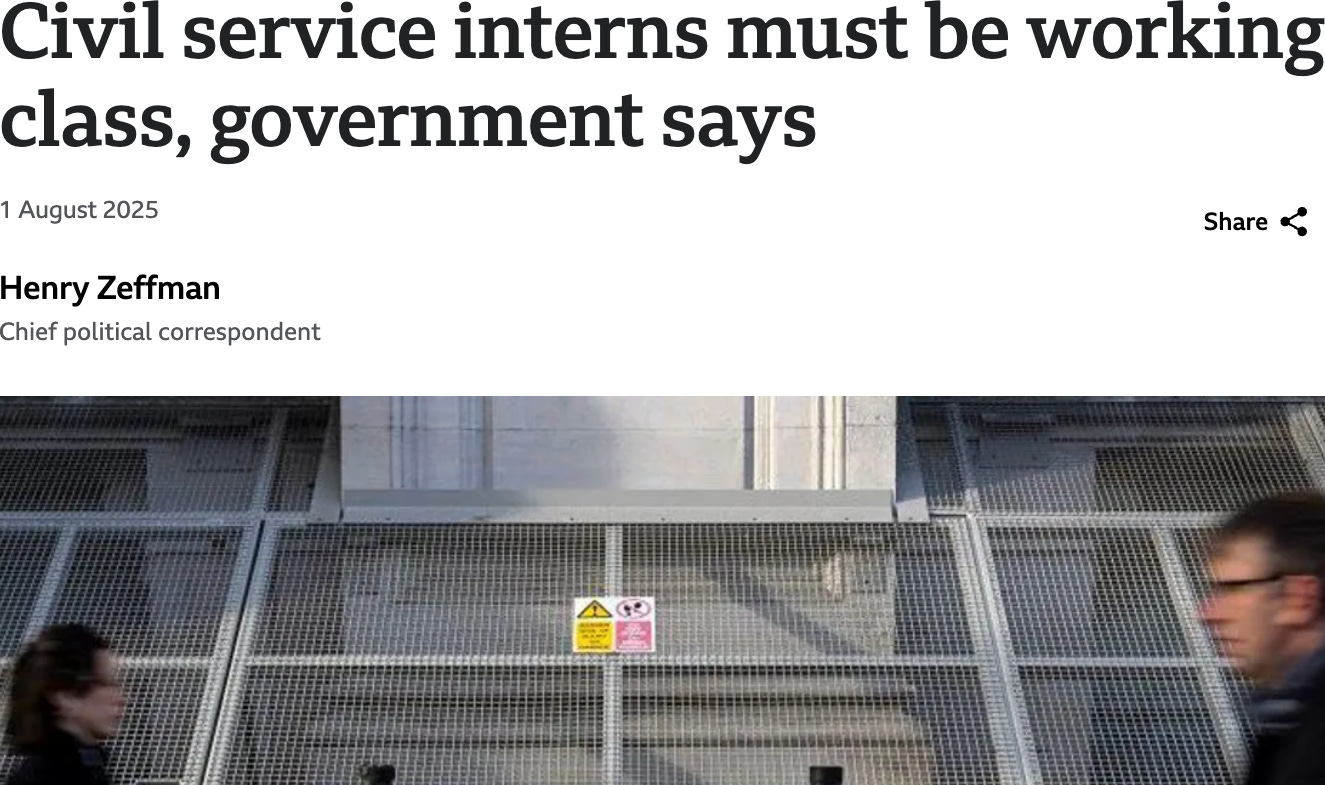
Against this background, the UK’s current trajectory is striking. Britain was once associated with administrative competence. It now has a low-productivity public sector that is estimated to cost the country £80 billion a year. Instead of addressing this problem through meritocratic recruitment, the current Labour government has decided to restrict civil service internships to university students from working class backgrounds. Although framed as an overdue reform, the policy rests on a misreading of how ability, class and performance relate to each other.
The literature shows that cognitive ability is a stronger predictor of job performance, training success and long-term occupational attainment than is social class — particularly for complex roles. This point bears emphasis because it’s often misunderstood.
Acknowledging the predictive power of intelligence does not imply that talent is absent from the working class. Rather, it implies that class is a weak and imprecise proxy for the traits that matter most in cognitively demanding roles. Socioeconomic status is correlated with IQ because intelligent people are better able to get ahead in every domain of life. Richer people are often smarter people. Selection rules that prioritise background over ability therefore lower the average cognitive ability of entrants, even if they benefit the subset of exceptional individuals who have working class origins.
Evidence from intergenerational studies reinforces this conclusion. As Linda Gottfredson notes: when sons have higher IQs than their fathers, they tend to surpass them in occupational attainment. Sons scoring roughly one standard deviation above their fathers are substantially more likely to move into higher-status occupations, even when they’re from disadvantaged backgrounds. Conversely, sons scoring roughly one standard deviation below their fathers are much more likely to experience downward mobility. The overall father–son correlation is moderate in size, leaving ample room for IQ-driven mobility. Indeed, cognitive differences account for a large share of movement within the social hierarchy.
More recent work lends further support to the conclusion above. Using Australian longitudinal data, Felix Bittman showed that when cognitive ability is taken into account, the apparent effects of social class on educational and occupational outcomes become substantially smaller. This replicates an earlier study by Michael O’Connell and Gary Marks, demonstrating that intelligence measured in adolescence strongly predicts later educational attainment, occupational status and income. Notably, these patterns hold across cohorts, suggesting they reflect real, structural relationships.
Recent genetic evidence points in the same direction. Polygenic scores for educational attainment predict academic achievement, persistence and later socioeconomic outcomes. And crucially, these effects operate within class categories rather than merely between them. Children from working class backgrounds with high polygenic scores consistently outperform peers with lower scores and often match or exceed higher-class peers with average scores. The explanation is not mysterious: highly intelligent individuals can extract more value from a given environment. They learn more from the same level of instruction and respond more effectively to training.
This matters because Britain already offers an extensive array of access schemes, upskilling programmes and training initiatives for people from disadvantaged backgrounds. When highly intelligent individuals from such backgrounds engage with these schemes, their outcomes are generally good. But the same is rarely true of their counterparts with low intelligence. “Underrepresented” sociological categories are no substitute for comprehensive measures of ability.
What’s more, the way class is operationalised in public policy has become increasingly incoherent. Under current definitions, a train driver earning £80,000 per year may be classified as “working class”, even if his income exceeds that of many professionals. (The fact that train drivers out-earn many people working in professional occupations is the result of unusual collective bargaining agreements.)
The risks of allowing politics to override meritocracy are clearly illustrated by the case of Jamaica. During the colonial period, Jamaica operated a civil service exam that aimed to select the best candidates for public service. As Henrice Altink notes, this exam was abolished in the early 20th century when segments of the white elite complained that too many black Jamaicans were securing prestigious administrative positions. Meritocratic selection proved politically unacceptable precisely because it allowed talent to surface regardless of racial background.
After independence in 1962, Jamaica became more corrupt and the civil service was no longer insulated from political pressures. Appointments and promotions were determined by party loyalty rather than administrative competence. This process intensified during the Manley years of the 1970s, a period marked by ideological polarisation, capital flight and the emigration of economic elites. The result was a substantial depletion of the country’s human capital. Jamaica’s civil service today is more working class than in earlier periods, yet it is arguably less effective.
Singapore’s experience stands in sharp contrast. By identifying talent early, cultivating it through education and training, and rewarding it generously, the country has been able to build world-class institutions. Britain’s current approach risks moving in the opposite direction. For a state already struggling with productivity, this could prove dire.
Lipton Matthews is a researcher and YouTuber. His work has been featured by the Mises Institute and Chronicles. He is the author of The Corporate Myth. You can reach him at: lo_matthews@yahoo.com
Become a free or paid subscriber:

Like and comment below.
If we ever hope to compete with China, we'll have to change our leadership selection process. Their civil service (which also handles politics) will hire 30,000 young graduates this year, none of whose IQs will be below 140.
Trump, 2015: “People say you don’t like China. No, I love them. But their leaders are much smarter than our leaders. And we can’t sustain ourselves like that. It’s like playing the New England Patriots and Tom Brady against your high school football team.”