


Written by Peter Frost.
If as race realists seem to believe higher intelligence reliably produces civilizational superiority, then East Asian civilizations should have dominated the world. The most technically capable civilizations on earth, possessing ships and navigational tools that their competitors lacked, looked out at the wider world and largely declined to conquer it.
—S.R. Kanobana, ‘What if race realists are right?’
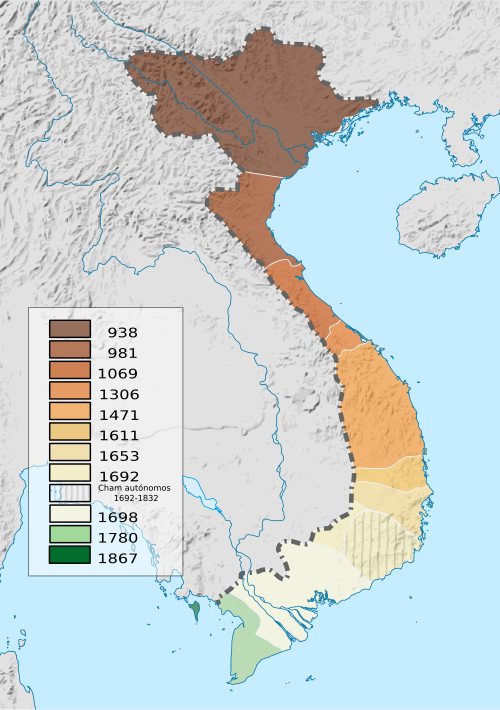
Why didn’t East Asians use their civilizational advantage to conquer new lands Actually, they did, and long before Western Europeans. The Han subjugated what is now South China and large parts of central Asia. On a smaller scale, Vietnam embarked on a southward push from the tenth century onward:
But this expansionism then gave way to self-imposed isolation — through the various Haijin policies of China beginning in the fourteenth century, the Sakoku policy of Japan from 1603 to 1868, and the Soeguk jeongchaek policy of nineteenth-century Korea. The main reason was fear of disruptive foreign influences, particularly via Christian missionaries.
If East Asia had not gone down this path, the last few centuries would have been rather different, with China absorbing much of Southeast Asia, and Japan becoming an imperial power much earlier.
The Japanese, remember them? Once they left their bubble, they lost no time getting into the game. By mid-1942, their empire comprised 12-15% of the world’s population, with close to a million Japanese settled in Manchuria, over 700,000 in Korea, and 300,000 in Taiwan, plus many more to come…
Yet Kanobana is right when he says that “the highest-IQ populations on the planet [did] not produce the grandest empires.” Whereas East Asian imperialism remained regional, European imperialism became decidedly global. Why?
Fear of foreign religions
Again, the main cause was self-imposed isolation at a time when European powers were pushing into the Americas, Africa and Asia. When Japan finally opened up to the world, there wasn’t much left to take — other than China and lands already taken by European powers.
The self-imposed isolation was driven mostly by a longstanding fear of foreign influences — especially foreign religions that promised a better life after death in exchange for renouncing betterment in the here and now. A millennium earlier, many Chinese were living in Buddhist monastic communities. One historian alleges that northern China had some 40,000 temples and 3,000,000 monks and nuns — more than a tenth of the population.1 These figures seem inflated, yet we have the example of neighboring Tibet, where monks once made up 13% of the population and 26% of the men.2
The loss of productive workers alarmed government officials, like this one in the eighth century:3
Today the Buddhist and Taoist clergy throughout the empire eat but do not till, clothe themselves but do not weave. They disseminate dangerous talk and harmful theories with which to deceive the ignorant. The annual cost of food and clothing for a single monk amounts to some thirty thousand cash. The taxes supplied by five adults do not equal that amount.
There were also demographic consequences. Monks rejected marriage, produced no heirs, and recognized no obligations to their parents — all this, to free themselves from earthly concerns and attain nirvāņa. These aims stood in contrast to those of Confucianism, which viewed the family as the foundation of society.4
Things came to a head in the ninth century, when the state forced nearly 300,000 monks and nuns to return to secular life, while confiscating temple properties and melting down statues to make coins.5 Eventually, the monasteries were allowed to operate — on the condition of being registered and taxed. They also had to accept the state’s role in approving high-ranking monastic leaders.
Thus, when Christian missionaries arrived in the sixteenth century, they were seen as bringing the same evils their Buddhist precursors had brought. By promoting celibacy and undermining family loyalty, these foreign religions challenged the Confucian view of life as a debt to be repaid to one’s ancestors and descendants.
No constraints on bad emperors or bad decisions
Empire-building was constrained not only by fear of foreign religions but also by lack of continuity in governance. The achievements of one emperor could be undone by the failures of the next. As Francis Fukuyama points out:6
In dynastic China, this was known as the “bad emperor” problem: Every now and then, a terrible tyrant would emerge and burst the boundaries of custom and accepted morality, doing enormous damage to the society.
For Fukuyama, even good emperors were not above this problem. “Even if a despot is benevolent, how does he or she know, in the absence of a free press and formal procedures such as elections that reveal preferences, what the common interest is?”7
European empires were more sustainable because religion acted as a check on state overreach. Christianity created parishes, schools, hospitals, universities, ecclesiastical courts and, more broadly, what we call “the rule of law” — all of which existed alongside the state and, to some degree, above it. In East Asia, religious institutions were weaker, less independent and less developed. State institutions were therefore less constrained, being accountable solely to the state.
Fukuyama’s argument overlaps with one advanced by Jonathan Schulz in a study of global variation in human psychology: Christianity replaced a situational morality based on kinship with a universal one of fair play toward kin and non-kin alike. This morality took root especially in northwest Europe, where human relations have long been characterized by weak kinship ties, nuclear families, late marriage and solitary living for at least part of adulthood. In such an environment, people “tend to be more individualistic, independent, analytically minded, and impersonally prosocial (e.g., trusting of strangers) while revealing less conformity, obedience, in-group loyalty, and nepotism.”8
Schulz attributes this mindset to the efforts of the Western Church, based in Rome, which banned cousin marriages up to the seventh degree. He argues that this ban promoted individualism by breaking up clans. However, a taboo against cousin marriage seems to have prevailed even in pre-Christian times, notably among the pagan Germanic peoples. The initial ban was taken from the Visigothic Code in the seventh century, and writers used the term “Germanic” to describe the stricter method, adopted in the ninth century, for calculating forbidden degrees of marriage.9 Also, studies of ancient DNA show a very low rate of cousin marriage in pre-Christian Western Europe.10
The Western Church probably adopted an existing taboo against cousin marriage in line with its policy of Christianizing pagan customs. As the new faith moved further west and north, it assimilated local traditions, including mental and behavioral norms.11
Western Christianity thus became focused on individualism, universal morality, original sin and the need to manage feelings of guilt. This mental and behavioral package — now enforced more effectively by the Church through its superior organization — helped create a society based more on universal rules than on shared kinship.
This was the magic bullet that led to global dominance by people who had hitherto lived on the fringes of the known world. Western Europeans proved to be better at building societies that encompassed not only close kin and close friends but also millions who might not even know each other.
Conclusion
East Asians failed to build global empires for two reasons: (1) self-imposed isolation, motivated mainly by fear of Christianity and the disruptive effects it might have; and (2) a failure to build institutions that can act independently of the state and limit its excesses.
In Europe, such institutions were built by the church. Does this mean that East Asia made a mistake in keeping Christianity out?
Not necessarily. A religion may have different consequences in different populations. Among practicing Buddhists, monks were much less widespread in India than in Tibet, where they became 26% of the male population. China might have become a second Tibet, with a similar level of material development, if it had treated this foreign faith more leniently.
Buddhist missionaries exploited a weakness of East Asians — low time preference, which leads to lifelong anxiety about death and the hereafter. Would Christian missionaries have exploited this weakness with even more success? And would they have been even more successful in undermining family loyalty?
In East Asia, Christianity has gone furthest in South Korea, where it is the largest organized religion and has converted almost a third of the population. Initially, converts destroyed their ancestral tablets and refused to bow before the corpse, tomb or picture of a deceased parent. Such practices are still condemned by the Protestant churches.12
Traditionally, ancestral reverence is seen as part of a social contract between the generations — as the glue that holds them together:13
Offspring are indebted to parents for the love and sacrifices of the latter during their earliest years. The care and support of elderly parents is a repayment, though inevitably inadequate, of this indebtedness … Korean children are not encouraged to be independent of their parents. Instead, parents view children as extensions of themselves and inculcate children with a spirit of mutual dependency between successive generations.
This view clashes with Western individualism: “Not only do American parents encourage their children to be independent and self-reliant in their earliest years, but parents are also extremely loathe to become dependent on their adult offspring in old age”.14
Elder care seems to be an Achilles heel of South Korea and, more broadly, the formerly Confucian countries of East Asia:15
While American caregivers cited love and affection more frequently, Korean caregivers emphasized that their motivations were primarily based on filial responsibility, strongly influenced by the Confucian sentiment, including three core values: (1) respect for parents, (2) family harmony, and (3) sacrifice for parents.
As these values disappear, elderly parents no longer receive the same support. Many turn to suicide: “South Korea’s elderly suicide rate is not merely the highest among the member nations of the Organization for Economic Cooperation and Development, it is the highest in the world.”16
South Korea also has the world’s lowest fertility rate, at only 0.8 children per woman.17 Relatedly, it has the highest rate of single-person households at 42%.18 Could all this be due to the replacement of Confucianism with Western individualism? China is not far behind. In fact, it might soon overtake South Korea in the race to the bottom.
This is what happens when the software of Western culture is run on the hardware of Eastern minds. Such an outcome was already foreseen a half-millennium ago, when East Asians put a stop to their empire-building and withdrew into isolation.
Peter Frost has a PhD in anthropology from Université Laval. His main research interest is the role of sexual selection in shaping highly visible human traits. Find his newsletter here.
Become a free or paid subscriber:


Like and comment below.
Liu, X. (n.d.). The socio-economic rationale behind Buddhist persecutions. Research essays. University of Melbourne. https://library.unimelb.edu.au/asc/whats-on/exhibitions/here-lives-our-culture-introduction/research-essays/the-socio-economic-rationale-behind-buddhist-persecutions
Goldstein, M.C. (1989). A History of Modern Tibet. Volume I: 1913-1951. The Demise of the Lamaist State. Berkeley: University of California Press, p. 21.
Gernet, J. (1995). Buddhism in Chinese Society. An Economic History from the Fifth to the Tenth Centuries. New York: Columbia University Press. p. 36.
Guang, X. (2010). A Buddhist-Confucian controversy on filial piety. Journal of Chinese Philosophy, 37(2), 248-260. https://doi.org/10.1111/j.1540-6253.2010.01582.x
Guang, X. (2013). Early buddhist and confucian concepts of filial piety: a comparative study. Journal of the Oxford Centre for Buddhist Studies, 4. https://jocbs.org/index.php/jocbs/article/view/42
Leo and Kaiser Bauch have discussed the indifference toward procreation in the Buddhist tradition: “The goal of Nirvana is literally the extinguishing of the cycle of rebirth, which implies that not being born again is the desirable outcome. Without venturing too deep into its theology, Buddhism is a tradition that gives its followers no particular reason to fill a cradle. The numbers bear this out: Buddhists were the only major religious group that had fewer people in 2020 than a decade earlier—their number fell by 19 million to 324 million.” “Not all gods are created equal.” Leo, May 1, 2026.
Gernet, J. (1995). Buddhism in Chinese Society. An Economic History from the Fifth to the Tenth Centuries. New York: Columbia University Press.
Liu, X. (n.d.). The socio-economic rationale behind Buddhist persecutions. Research essays. University of Melbourne. https://library.unimelb.edu.au/asc/whats-on/exhibitions/here-lives-our-culture-introduction/research-essays/the-socio-economic-rationale-behind-buddhist-persecutions
Fukuyama, F. (2012). China and East Asian democracy: the patterns of history. Journal of Democracy, 23(1), 14-26, p. 19. https://doi.org/10.1353/jod.2012.0005
Fukuyama, F. (2012). China and East Asian democracy: the patterns of history. Journal of Democracy, 23(1), 14-26, p. 19. https://doi.org/10.1353/jod.2012.0005
Schulz, J.F., Bahrami-Rad, D., Beauchamp, J.P., & Henrich, J. (2019). The Church, intensive kinship, and global psychological variation. Science, 366(707), 1-12. https://doi.org/10.1126/science.aau5141
Chandelier, J. (2021). L’Occident médiéval. D’Alaric à Léonard. 400-1450. Mondes anciens, Paris: Belin, p. 224. https://www.belin-editeur.com/loccident-medieval
McCann, C.A. (2010). Transgressing the Boundaries of Holiness: Sexual Deviance in the Early Medieval Penitential Handbooks of Ireland, England and France 500-1000. Theses, South Orange, NJ: Seton Hall University, pp. 57-58. https://scholarship.shu.edu/theses/76
Frost, P. (2025). When did northwest Europeans become WEIRD? August 5. Peter Frost’s Newsletter.
If Christianity did not create these ways of thinking and feeling, what did? Farther back in time, the North Sea and the Baltic were home to an unusual culture: the fisher-hunter-sealers of the late Mesolithic, i.e., 8,500 to 6,000 years ago. These societies supported much larger populations than those of other hunter-gatherers, thanks to an abundant food supply of fish, seals, and shellfish. They lived in coastal communities that formed in the spring and dispersed in the fall.
Within these communities, nuclear families lived together seasonally in large multi-unit dwellings. There was thus a yearly cycle of nuclear families coming together in the spring, breaking up in the fall, and then coming together the next spring. This type of social organization was absent during the early Mesolithic and has remained rare among hunter-gatherers elsewhere. It may have thus favored the openness toward non-kin that we see in the earliest historical records from northwest Europe.
This openness toward non-kin would have reduced the importance of kinship in regulating behavior, particularly the role of male kin in avenging wrongs or injuries. Specifically, universal rules became more important than situational rules based on kinship, and this cultural shift included a greater desire to punish or exclude rule-breakers regardless of their degree of relatedness to oneself. Conversely, rule-following was favored by selection for a greater capacity to feel guilt and empathy, probably by extending the empathy between mother and child to all relationships. The zone of high social trust thus became extended far beyond one’s circle of close kin and close friends.
Frost, P. (2020). The large society problem in Northwest Europe and East Asia. Advances in Anthropology, 10(3), 214-134. https://doi.org/10.4236/aa.2020.103012
Bae, C. S. (2008). Ancestor Worship and the Challenges it poses to the Christian Mission and Ministry (Doctoral dissertation, University of Pretoria), pp. 85-91. https://repository.up.ac.za/items/8271d74d-9ff4-4a99-befc-a6c41538086a
Yim, D. (1998). Psychocultural Features of Ancestor Worship in Modern Korean Society. In: W.H. Slote & G.A. DeVos. Confucianism and the Family, (pp. 163-186). Albany: State University of New York Press, p. 169.
Yim, D. (1998). Psychocultural Features of Ancestor Worship in Modern Korean Society. In: W.H. Slote & G.A. DeVos. Confucianism and the Family, (pp. 163-186). Albany: State University of New York Press, p. 169.
Chee, Y. K., & Levkoff, S. E. (2001). Culture and dementia: Accounts by family caregivers and health professionals for dementia-affected elders in South Korea. Journal of Cross-Cultural Gerontology, 16(2), 111-125. https://doi.org/10.1023/a:1010640527713
Cha, K. S., & Lee, H. S. (2018). The effects of ego-resilience, social support, and depression on suicidal ideation among the elderly in South Korea. Journal of Women & Aging, 30(5), 444-459. https://doi.org/10.1080/08952841.2017.1313023
Anon. (2026). South Korea’s birthrate, the world’s lowest, rises again amid signs of easing demographic crisis. The Straits Times, February 25. https://www.straitstimes.com/asia/east-asia/south-koreas-birthrate-the-worlds-lowest-rises-again-amid-signs-of-easing-demographic-crisis
Yasmin, S. (2025). South Korea records over 10 million one-person households — what this means for its ageing population. Independent, August 29. https://www.independent.co.uk/asia/east-asia/south-korea-10-million-one-person-households-population-decline-b2816397.html
Although this topic is fascinating, I just can’t help feeling really sad when reading about North East Asian demographic trends.
The article also made me wonder if Peter has researched or written anything about Islamic software being imposed on the hardware of us ”WEIRDos”? In my opinion, this is the defining conflict in the West.
For example, many people in Sweden have an aversion to the increasing prevalence of the hijab/niqab/burqa. Imposing this culture on our egalitarian one feels like abuse, because we have this long history of women’s rights dating back to the Viking Age (if not further), and in general, much about this Islamic mindset just feels unnatural for Europeans.
IQ has everything to do with civilizations greatness, but you need more than that of course. You need to be intelligent but also courageous, audacious and curious.