

Written by Adam Rochussen.
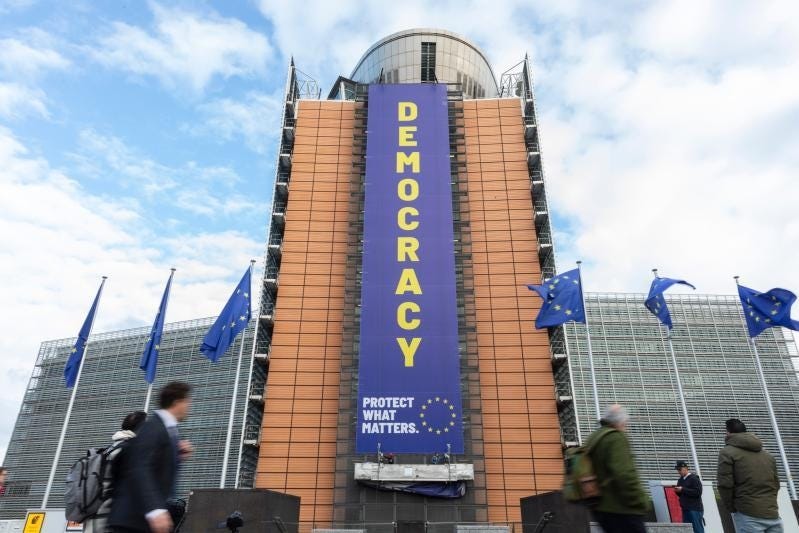
If you go to Brussels, the capital of Belgium and the European Union, you’ll encounter a building with a newly unveiled banner that displays the word “DEMOCRACY” in vertical lettering. Underneath is the imperative to “PROTECT WHAT MATTERS”. This is Ursula von der Leyen’s very subtle attempt to imply that the EU represents democracy and democracy is what matters.
The appeal to democracy as an axiomatic good is pervasive. Across the world, there are hundreds of political parties with the term “democratic” (or one of its derivatives) in their name. Germany alone has a “Christlich Demokratische Union”, a “Sozialdemokratische Partei Deutschlands” and a “Freie Demokratische Partei”. The Korean peninsula has also bought into the axiom, with the “Democratic People’s Republic of Korea” in the North and the “Democratic Party of Korea” ruling in the South.
In the US, we have the “Democratic Party” whose members claim to be deeply concerned about “defending democracy”. Though it’s not just the Democrats who play this game. Here in California, Republican gubernatorial candidate Chad Bianco has been trying to investigate election fraud—supposedly to defend democracy. In response, Democratic judges and politicians have been blocking him from doing so—also supposedly to defend democracy. We’ve seen dramatic gerrymandering shifts that we are told are essential to protect democracy, or at least one party’s version of it.
Democracy, in its modern manifestation, has become the ultimate thought-terminating cliché. Rarely do we see an elaboration of why democracy is good. It is simply taken for granted. What even is democracy? And where did it come from?
The myth of mob rule
“Δημοκρατία” (rule by the people) was a revolutionary Athenian idea that emerged roughly 2,500 years ago. Back then, things worked a little differently. Citizens saw political engagement as an essential duty of civic life. To be apolitical, as many profess they are nowadays, no doubt due to polarisation fatigue, carried social stigma. Instead of voting for representatives, the ancient Athenians used a lottery system, which randomly assigned a group of citizens to political office for a certain period. (Though military generals were elected.)
This had several advantages. First, the divide between politicians and citizens was non-existent. There was no such thing as a professional politician. Second, politicians weren’t constantly grovelling for votes by promising more free government money to various constituencies, such as pensioners or welfare recipients.1
They were motivated to rule well, rather than to win elections. Third, the ancient Athenian system avoided elite capture, as power was constantly being reassigned away from any one cabal. The main counter-argument to Athenian democracy is that such a direct system results in “mob rule”. Sounds scary. But is it true?
Claims of mob rule usually centre on rare, misunderstood cases. The trial and execution of Socrates is a prime example. We are told that Socrates was sentenced to death by a majority and that this is bad because we know he was a famous philosopher and therefore presumably innocent. Not quite.
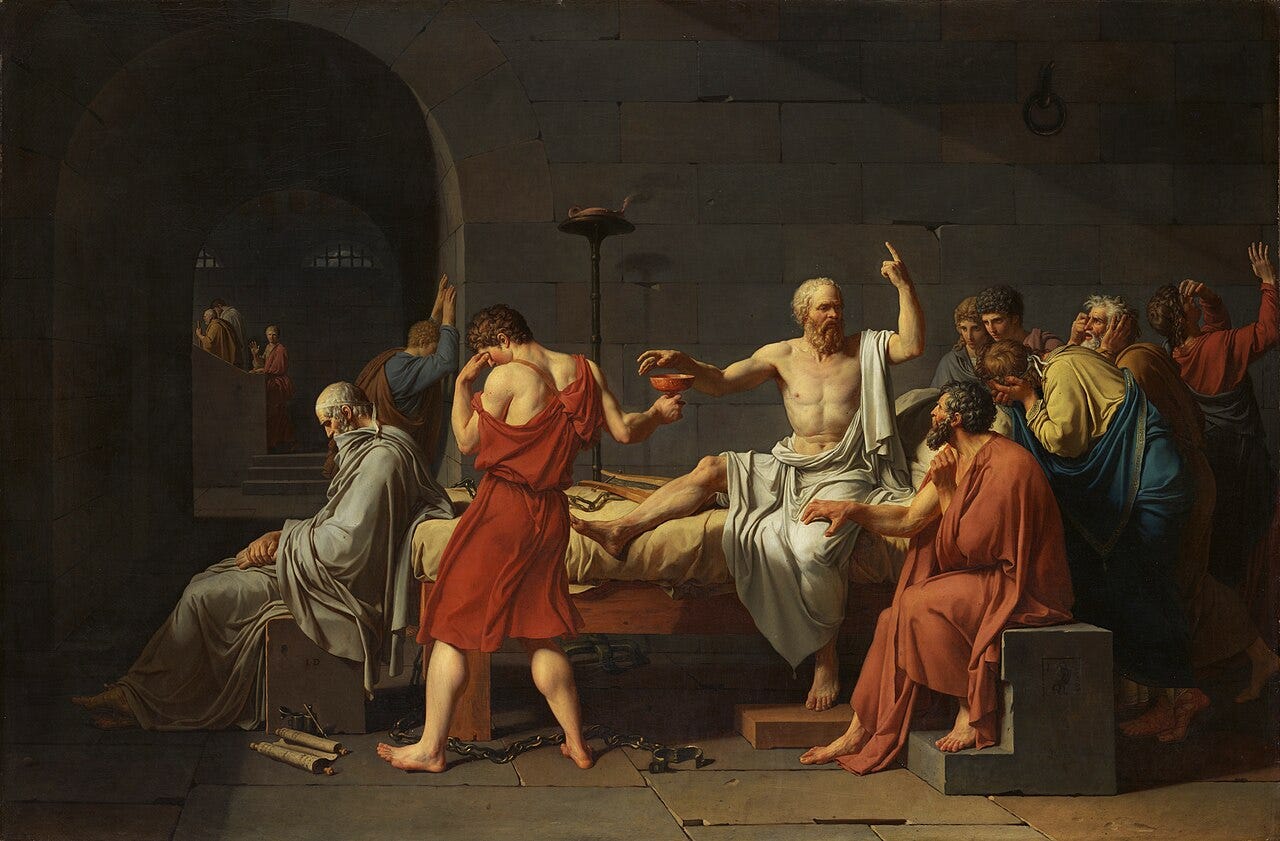
History has been very kind to Socrates, mainly because much of it was written by his student Plato. In reality, Socrates was an anti-democratic (ergo, anti-Athenian) radical who many saw as complicit with the Thirty Tyrants regime—a Sparta-backed violent dictatorship that ruled Athens for eight months in 404 BC.
That regime, led by several of Socrates’ former associates, massacred thousands of Athenians without trial, confiscated private property to fund the Spartan army, and stripped citizenship from everyone who wasn’t loyal.
While the official charges raised against Socrates were quite nebulous—impiety and corrupting the youth—it is likely that his associations with the despised Thirty Tyrants regime played a role in his prosecution. (Note that, after Athenian democracy was restored, an amnesty was passed, granting immunity for crimes carried out during the tyranny.) In any case, the charges against him were perfectly consistent with Athenian law of the time.
But being sentenced to death seems a bit extreme, doesn’t it? Surely that is mob rule gone mad? Again—not quite. Under Athenian law, defendants in Socrates’s position were invited to suggest their own punishments, and Socrates initially joked that he should be rewarded, before suggesting a trivial fine. Unsurprisingly, this mockery resulted in the jurors showing him little mercy. On balance, his execution was probably justified.
Of course, technocratic critics will often cry “mob rule” whenever more political power is extended to citizens. But if the “mob” comprises intelligent and virtuous citizens, who have skin in the game and shared cultural values, then such rule is preferable to the alternative—i.e., professional politicians buying votes, and elites playing status games over which views are more fashionable.
Mob rule is only bad for the elites when ordinary people hold very different views, as seems to be increasingly the case in modern Western democracies. But it was not true in ancient Athens. There, “mob rule” was democracy, and it was good.
We don’t have real democracy
Athenian democracy was a resounding success. It lasted almost 200 years and was only brought to an end because the Athenians lost an opportunistic war against the Macedonians in the wake of the death of Alexander the Great in 322 BC. Despite constant warring, it never broke down for purely internal reasons, and most of its participants were advocates until the end. The Athenians certainly believed in democracy, and many of them died to protect it.
I would actually take Ursula von der Leyen’s advice and “protect democracy” too—if it was the Athenian kind. But today’s democracy is so far removed from Athenian democracy that the only thing tying the two systems together is the name. Before you accuse me of being too radical, I am far from alone here: half of young Britons say they would never fight to defend their country, and 77% of young Americans are physically ineligible for military service due to drug use, lack of physical fitness (being obese) or mental health problems. Most people don’t seem that keen on protecting modern “democracy” either.
The same is true of politicians. As I’ve already described, opposing parties often use the same slogan (“protecting democracy”) to support diametrically opposed policies. The issue of voter ID in the US is a case in point. Republican politicians are currently trying to pass a bill (the SAVE Act) that would make photo ID a legal requirement for voting, citing the need to protect democracy. Democratic politicians, on the other hand, are vehemently against the bill—also citing the need to protect democracy. (Apparently, legitimate voters might not have a photo ID and could therefore be disenfranchised.) This is despite Americans overwhelmingly supporting voter ID.
Politicians contravening the will of the people is remarkably common. Take the 2016 Brexit referendum in the UK. A majority of people, motivated primarily by a desire to curb immigration and reduce European control over British law, voted to leave the EU. The technocrats who run the “democracy”, though, simply couldn’t bring themselves to implement the result.2 The Conservative party dragged their heels, completely lost sight of what the referendum was about, took almost four years to actually leave the EU, remained a part of the European Convention on Human Rights, and then ramped up non-EU immigration in the subsequent years.

Back in 2016, Brits were stronger believers in democracy. The referendum saw an impressive 72% turnout. As a freshly enfranchised 18-year-old, I was among the slim minority who voted “Remain”. Despite me disagreeing with the majority at the time, the unwillingness of our politicians and civil service to enact the will of the majority has only degraded my faith and that of many others in British democracy.
The same pattern emerges across other, modern democracies. Even the mighty EU has seen voter turnout in its elections decline since 1979 (albeit with a slight bump after Brexit).
Perhaps people aren’t bothering to vote because they are slowly realising that voting isn’t actually the point of democracy. Progressive movements like women’s suffrage and civil rights in the US have always focused on the universal right to vote as the ultimate end goal. This isn’t how democracy was practiced by the Athenians at all. Lest we forget, there were no votes for politicians in ancient Athens. Rule by the people meant that the people did the ruling: thousands of citizens would gather on the Pynx Hill, discuss motions, and pass them by a simple show of hands. The voting came with the debate. If you weren’t present, you didn’t get to vote.
We are so far removed from the Athenian ideal today that we have lost sight of this notion of civic engagement (beyond marking a ballot every few years). We feel like we’re a part of the debate because we watch clickbait arguments on YouTube, and laugh at clips of the least charitable renditions of our opponents’ views. Or we read cynical, smug op-eds in our favourite “we-are-the-good-guys” news outlet. We identify with a political tribe, but the people leading that tribe hardly care about us beyond their desire to secure our vote.
Helvetian Hellenism
You have probably gleaned by now that I am pretty fond of Athenian democracy. But we can’t have that in the modern world. It’s fantasy! Well, maybe.
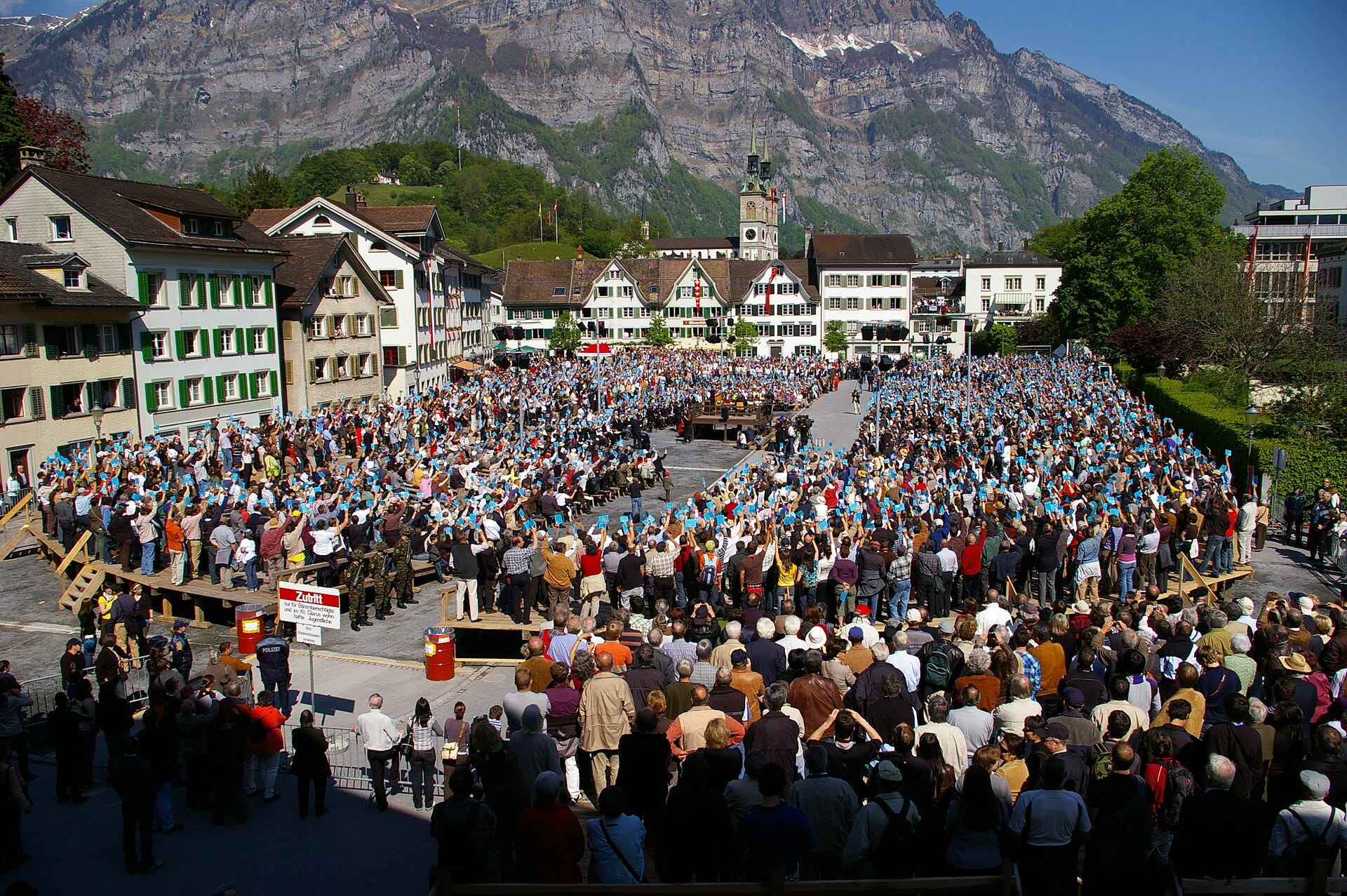
Switzerland gets pretty close. Yes, the Swiss have a representative parliament like many other Western countries, but they also retain some Athenian mechanisms, including both mandatory and optional referenda. Federalism assists with the scaling issue, and some Swiss cantons even retain Pynx-style open-air assemblies where voting is done by a show of hands (they call these Landsgemeinde). While Switzerland seems to be thriving under a more Athenian version of democracy, I’m not sure that its system is generalisable across the West as a whole.
I have already referred to the “mob” of Athenians being “highly intelligent and virtuous citizens, who have skin in the game and shared cultural values”. Indeed, it has been conjectured that ancient Athenians had IQs around a standard deviation higher than modern-day Greeks (though polygenic scoring of ancient Greeks does not support this more broadly outside of Athens).
I suspect that this is key for direct democracy to work well. The Swiss enjoy a very high GDP per capita (~13% higher than the US, adjusted for purchasing power). They have a strong national identity, bolstered by strong civic education (despite the country’s ethnolinguistic diversity). And they have a high national IQ. Switzerland therefore shares many of the democracy-enabling characteristics of ancient Athens.
One thing missing from the Swiss model is the random lottery for political leaders (sortition). Clearly, the main worry here is that of ensuring competency (though our present system has hardly solved this problem). We don’t have a good example from the modern era, but there’s certainly a strong, pragmatic case for sortition.
Values and process
When technocratic types get cagey about giving too much power to the people, they reveal that it’s not democracy they care about, but their preferred values. The elephant in the room is that democracy is only useful as long as the people have the right values.
Take Uganda, a reasonably democratic country. In 2023, its parliament passed the Anti-Homosexuality Act with 389 votes for and only 2 against. Critics complain about executive influence on the parliament and general corruption, but this particular law cannot be ascribed to those factors. Opposition to homosexuality was and is extremely popular among Ugandans.
According to polling by Afrobarometer, 97% of Ugandans believe that homosexuality should be illegal. This isn’t because they’re intolerant in general—Ugandans are quite accepting of other religions, ethnicities and nationalities. They just really don’t like homosexuals. Nor does the picture seem to be changing much over time—despite relentless pressure from western NGOs.
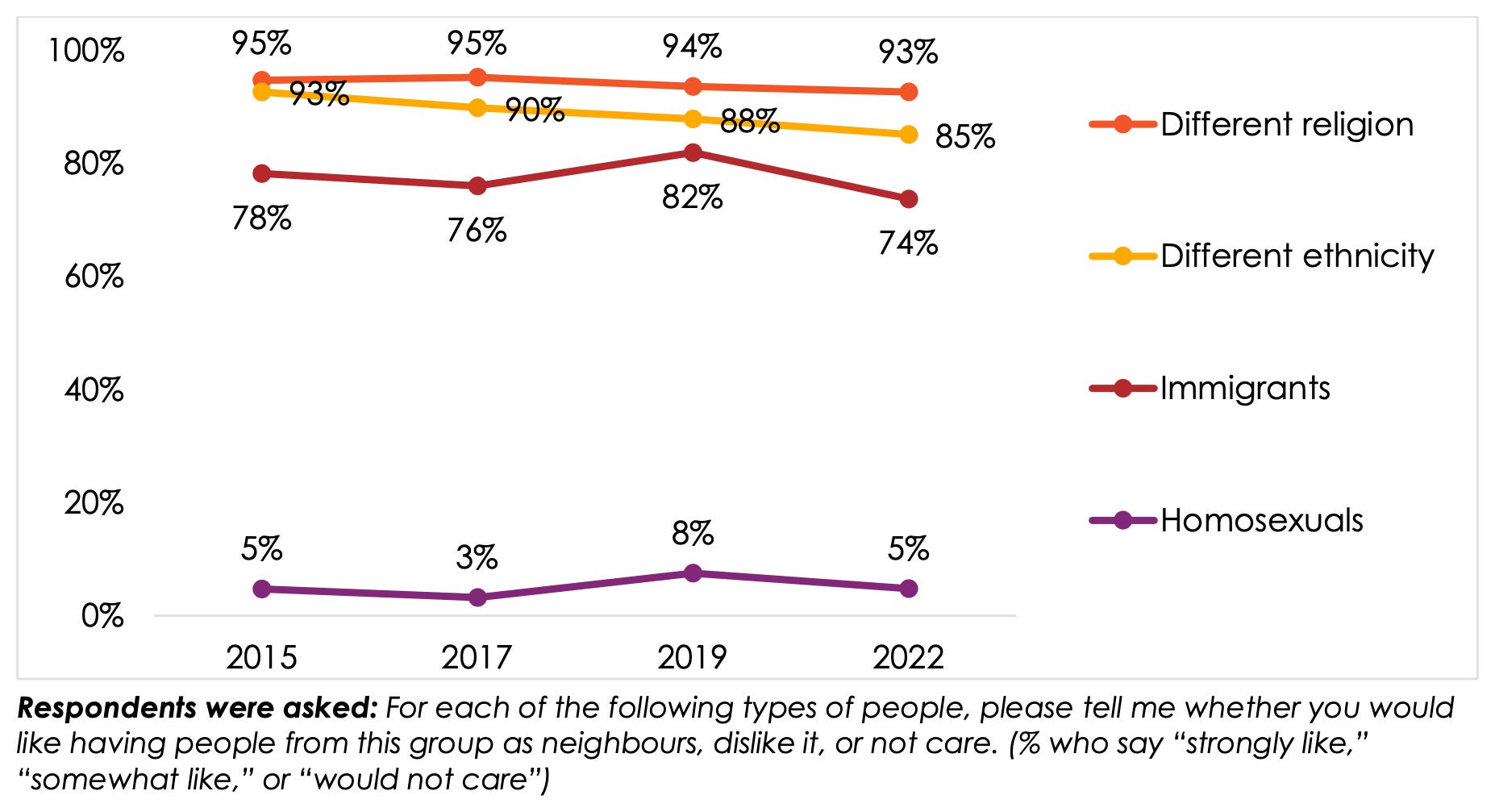
The obvious truth is that the process of democracy, when allowed to play out in a population with somewhat illiberal values, does not arrive at liberalism.
Indeed, the Founding Fathers of the United States heavily favoured liberty over democracy when they established the republic. By contrast, Athens prospered under a pure form of democracy because it was small and its citizens were unusually virtuous and civically minded. Either we aspire to create polities with the same class of citizens, or we favour our preferred values over democratic ones when the two come into conflict. Historically, the West has done latter, and we should stop pretending otherwise.
This essay is adapted from one published at Fruit of Eden.
Adam Rochussen is Postdoctoral fellow at the Salk Institute for Biological Studies. He writes about science, politics, culture and philosophy.
Become a free or paid subscriber:


Like and comment below.
Lots of pro-democracy advocates demand we remove money and special interests from politics. Yes, there is a tremendous amount of bribery in modern democracy, but it is bribery of voters by economically illiterate and vote-hungry politicians. Consider the comparative magnitudes of social spending versus lobbying of government.
Although the UK is nominally a constitutional monarchy, it very much brands itself and acts as a representative democracy.
You mostly failed to mention the two largest problems with our "democracy".
In theory, representative democracy means elected officials trying to fulfill their promises to their voters and look out for their interests.
This system can break down in two ways:
1. Politicians systematically not delivering on their promises.
2. Power being vested in people other than elected officials.
Both of these undemocratic phenomena are rampant in nearly all so called democratic states.
1.
Politicians are far more susceptible to media pressure than voter pressure, and media organisations have become interest groups of their own rather than guardians of the public interests.
Donor interests also plays a role, especially in those countries where few limits are placed on the size of political donations.
2.
Civil service bureaucracies have their own institutional incentives and ideological leanings, and often manage to frustrate elected officials from implementing their own policies.
Government decision making and policy implementation is often outsourced to NGO's and expert panels, who are not accountable to voters at all.
Law courts are also more activist than ever before, not content to merely enforce laws but rather to stretch their interpretation to or beyond the limit in accordance with their own political preferences.
The article doesn't mention it, but only free adult male Athenian citizens born to Athenian parents could participate in Athenian democracy.
Women, slaves, and foreigners were excluded. Pretty racist stuff!
That's actually close to the original American standard for democratic participation (free White men in good standing).
Makes one wonder, how did the inclusion of Ursula von der Leyens, Alexandria Occasional Cortices, and yesterday-arrived non-binary transgenders improve the process?
https://timesofindia.indiatimes.com/world/uk/non-binary-indian-on-student-visa-elected-to-scottish-parliament/articleshow/130998924.cms