

Written by Jonathan Salem-Wiseman.
The reception to claims about an Indigenous “way of knowing” tends to be determined by our political tribe. On the left, the very idea of a distinct, non-Western way of knowing is accepted as an obvious truth, if not an unimpeachable piety. Indigenous peoples, it is argued, live in harmony with nature and are thus uniquely attuned to the “interconnections between all things.” On the right, such a claim is often met with derision, and is dismissed as the latest iteration of faddish, “noble savage” mysticism.
I think both these positions are wrong and misleading, and they overlook a much more interesting story. An Indigenous “way of knowing” is a real phenomenon, but it falls short of exaggerated claims about an epistemic access to the world that is just as rigorous as the natural sciences. I want to argue that an Indigenous way of knowing, properly understood, is explained by global psychological variation, manifesting as a set of differences in visual processing skills and cognitive dispositions.
A case study
An interesting recent development within anthropology is the idea of combining Indigenous ways of knowing with contemporary scientific methods.
In parts of Eastern Canada, this is typically referred to as “two-eyed seeing”, a framework developed by the Mi’kmaq Elder, Albert Marshall, which seeks to combine the strengths of Indigenous ways of knowing with mainstream, scientific methodologies. In New Zealand, a similar idea was formalized in 2018, according to which knowledge is conceptualized as two canoes lashed together. In north-eastern Australia, the analogy involves the confluence of sea water and fresh water, which allows for interaction while maintaining separateness at the same time. Robin Kimmerer embraces something similar: “a polyculture of complimentary knowledges”.
In a recent article, Marshall and several other Indigenous scholars applied the two-eyed seeing model to study the aquatic health of a North Saskatchewan ecosystem. Participants included both local Indigenous Elders and academic scientists flown in from six universities. The big question was whether the Indigenous observers would arrive at the same conclusions as the scientists.
Where water quality and fish health could be described in terms of ‘turbidity’ (in Nephelometric Turbidity units) or ‘fish external anomalies’ (number of cysts, tumours, lesions and malformations) through a Western scientific lens, they could likewise be understood in terms of the physical appearance of the water (changes in water visibility or movement over time) or ‘fish aesthetics’ (changes in frequency of lesions or deformities over time) through an Indigenous lens.
After several years of study, the scientists arrived at a more optimistic assessment of the water and fish quality than their Indigenous counterparts did. Were they simply more objective? Perhaps.
Another possibility is that the scientists were outsiders and therefore didn’t have decades-old memories of water and fish qualities before the introduction of upstream industries that altered the health of the ecosystem.
It is also possible that the scientists overlooked or failed to include some rather obvious empirical criteria, like water visibility, before making their assessment. If one sample of water is less clear than another, this difference could be accounted for by the measurable, physical differences between the two samples. So the contrast is not so much between an Indigenous way of knowing and a scientific one, but rather between which observable criteria are most relevant. If the Indigenous participants were able to point to criteria that were systematically overlooked by the scientists, this might tell us something interesting about possible, subtle cognitive variations between the two groups.
There are a couple of things to keep in mind. First, under the aegis of Indigenous ways of knowing, there are some exaggerated, quasi-mystical claims that run afoul of any responsible account of how knowledge is acquired. These “extra-intellectual” methods reduce to trial-and-error at best, and pseudo-scientific hunches at worst. Given the backlash such claims tend to generate, the case for Indigenous ways of knowing would be strengthened if they were simply dropped and discarded.
Second, there are differences between Indigenous ways of knowing and standard scientific methodologies that deserve our attention and merit further consideration. In the study mentioned above, the Indigenous participants were not claiming to intuit unobservable qualities beyond the epistemic reach of the scientists; rather, they were drawing attention to real, observable cues that were overlooked by the scientists, but which may well have been relevant.
Whether these subtle cognitive differences can themselves be empirically vindicated and explained in some way is the question to which I shall now turn.
Something WEIRD is happening
Most educated people have been taught that, despite cultural differences, there is a universal human psychology and, by extension, a common suite of evolved cognitive traits or dispositions.
It turns out that our assumptions about a common human nature rest upon data generated by psychological studies of a highly peculiar group: university students from Western, educated, industrialized, rich and democratic countries. These “WEIRD” people are not representative of humanity, and thus the conclusions we have drawn about cognition, perception, personality traits, moral intuitions and behavioural dispositions simply do not translate to the global population.
This insight is the subject matter of Joe Henrich’s remarkable book, The WEIRDest People in the World. Despite our decades-long assumptions, Henrich and his colleagues have shown that university students at elite Western universities are not the human norm, psychologically speaking, and are in fact statistical outliers. It is Western psychologies, Western cognitive dispositions, that need to be explained. My tentative hypothesis is that Indigenous “ways of knowing” should not be viewed as anomalous or even peculiar — a unique phenomenon that requires special explanation — but as the global norm that existed before the Europeans began exporting their WEIRD institutions and practices around the world.
So what event was responsible for the onset and development of WEIRDness? According to Henrich, it was the Catholic Church’s “marriage and family programme” (hereafter MFP) that began in fits and starts in the early Middle Ages, and had the effect of transforming the structure of family and inheritance practices.
Now, historians have written about this before. Francis Fukuyama drew popular attention to the topic in his book, The Origins of Political Order. Henrich, however, was the first to explain its massive significance, arguing that the MFP not only abolished the intense kinship relationships that preceded today’s “normal” nuclear families, but also changed our psychologies — including our cognitive dispositions and thinking styles — in a profound and far-reaching way.
Before the Catholic Church launched the MFP in the early Middle Ages, European social life was structured by thick kinship ties. This meant many things, but a highlight reel would include: arranged marriages, cousin marriage, polygyny, patrilineally organized families, and the submergence of individuality within the larger community. In fact, individual identities were shaped by the various roles they played in the kinship network, which in turn exerted control over land and property. These kinship units were also tasked with resolving conflicts and providing a rudimentary “safety net” for the weak and infirm.
Despite the cultural and material differences between 7th century Western Europe and the rest of the world, a time-travelling anthropologist looking down from a considerable height would observe one key, structural similarity: a dense system of kinship relations. All this changed in Europe when the MFP reforms were introduced. But why the change of Church policy?
It was certainly not out of morality or high-mindedness. Instead, the MFP reforms were designed to extract land and property from extended tribal families and clans. By implementing strict rules against cousin marriage, levirate marriage, polygamy, and arranged marriages, the MFP broke down the extended kinship networks of medieval Europe, and property that had previously been “kept in the family” was gobbled up by the Catholic Church.
By dismantling the intensive kinship systems, the MFP unwittingly led to smaller, mobile nuclear families, neo-local marriage and individual autonomy. This, in turn, led to impersonal prosociality (getting along with strangers, basically) and the development of important voluntary associations like guilds, universities, charter towns and market economies.
Max Weber was right to highlight the Protestant Reformation’s role in the promotion of individualism and other psychological traits conducive to modern economic life, but Henrich moves the origin-story back several centuries. The early Protestants certainly promoted the development of WEIRDness — but this historical trajectory was already set in motion almost a thousand years earlier by their theological adversaries.
Did the MFP actually cause this wide array of psychological and institutional changes. (Some have argued that European WEIRDness actually predates Christianity.) Henrich argues that it did, and brings forth a wealth of supporting data. Across ninety-three Italian provinces, there are measurable differences — often between neighboring villages — in the local population’s thought and behaviour, and these depend on the degree of exposure to the Church’s MFP. To this day, we can measure the differences in rates of cousin marriage between Northern and Southern Italians.
WEIRD perception
I will now zero in on the perceptual and cognitive dispositions that reveal the differences between Western and Indigenous minds.
First, there is some evidence that WEIRD individuals are more likely to be fooled by the Müller-Lyer illusion. Two parallel lines of equal length appear to be unequal due to the arrow-like tips on the ends of each pointing either outwards (which makes the line look longer) or inwards (which makes the line look shorter). While WEIRD people are routinely duped by this, when non-WEIRD African cultures, like the San, are presented with the same visual stimulus, individuals typically report that the lines are the same length.
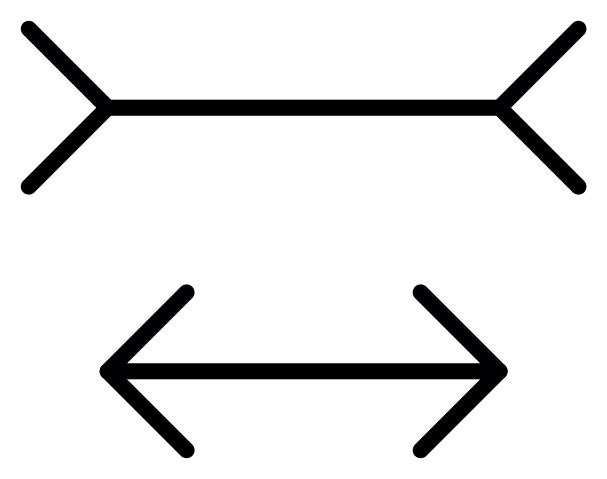
Henrich speculates that the reason for this difference lies in the fact that WEIRD people live in highly “carpentered” environments and spend their days navigating through a world of dry, medium-sized objects featuring lots of straight lines and right-angles, and thus the presence of the angled lines throws off our ability to judge the lengths accurately. (Though it should be noted that the difference in perception has recently been called into question.)
WEIRD people are also distinct with respect to “focal object bias” in scene description. Fancy jargon aside, this simply means that when WEIRD people are presented with visual images of, say, a lion crouching in the middle of a detailed forest scene (as in Henri Rousseau’s jungle paintings), we are more likely to focus on the lion while ignoring the framing, contextual details.
Non-WEIRD observers, on the other hand, devote their attention across the entire picture and have an easier time picking out the interactions of the flora and fauna in the background.
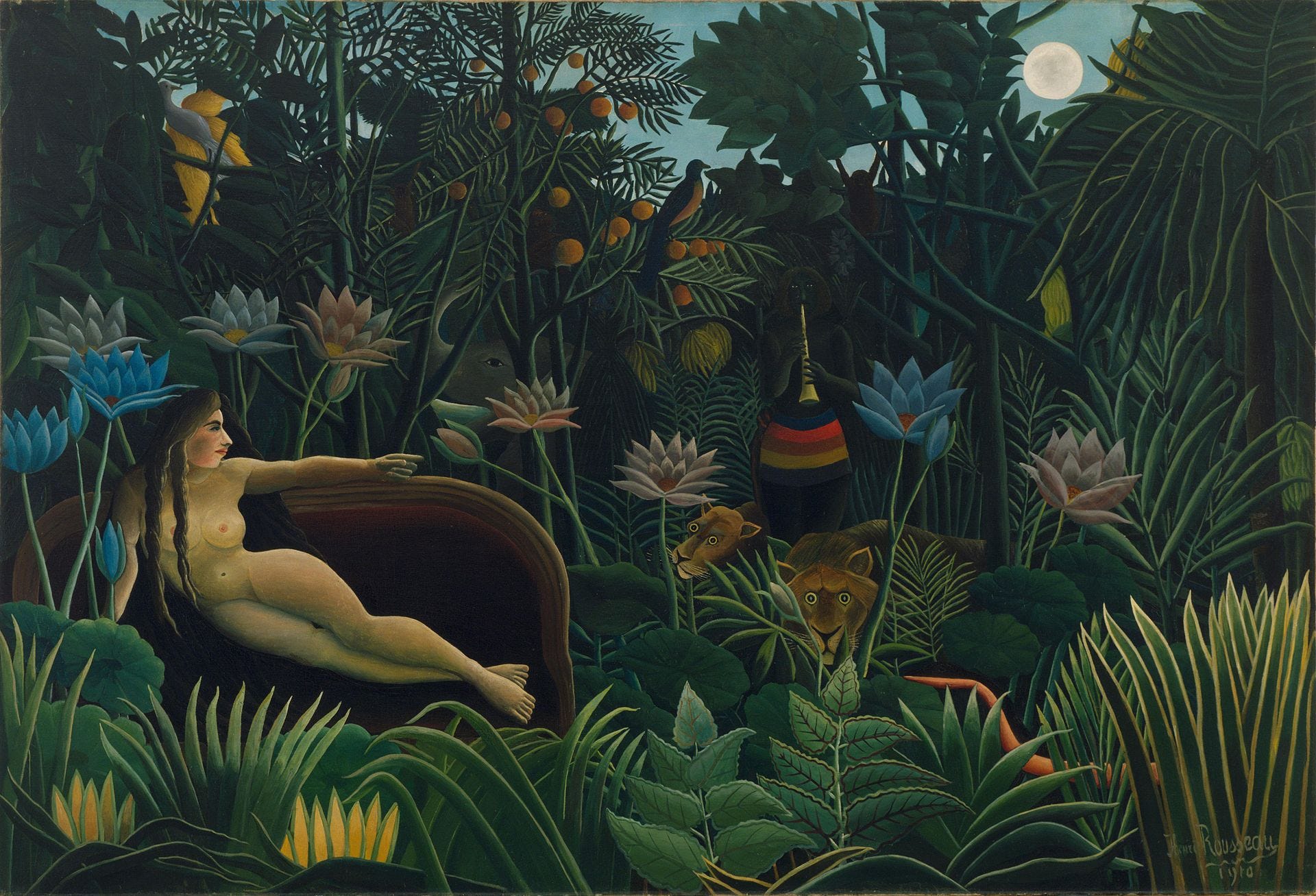
This finding sheds light on the different assessments made by Indigenous observers and scientists in the fishery case-study mentioned above. While the scientists zeroed in on the measurable, physical anomalies on the fish, the Indigenous observers appealed to a broader range of seemingly peripheral, contextual cues to inform their assessment of the ecosystem’s health.
This supports the Indigenous scholars who maintain that Indigenous people are more apt to survey interconnections and inter-relationships than Westerners, even trained scientists (who are psychologically predisposed to focus on the shiny object in the middle). Several other WEIRD–non-WEIRD differences in visual perception have been documented in the literature.
WEIRD cognition
The distinction between WEIRD and non-WEIRD minds is also evidenced in cognition. As an aside, it is worth noting that these two populations, mixing and mingling for centuries, do not exist in separate boxes. Instead, the cognitive differences between them vary along a spectrum.
The most important cognitive difference is that between holistic and analytical thinking styles. But what, exactly, do we mean by “analytical” and “holistic” thinking? As Henrich notes:
The idea here is that intensive kinship cultivates more holistic thinkers who focus on broader contexts and on the relationships among things, including the interconnections among individuals, animals, or objects. By contrast, societies with less intensive kinship foster more analytically-oriented thinkers who tend to parse the world by assigning properties, attributes, or personalities to people and objects, often by classifying them into discrete categories according to presumed underlying essences or dispositions.
The purely analytic thinker looks out at a world and understands it as a collection of distinct, isolated objects possessing various identifiable attributes. These attributes, in turn, explain the objects’ actions and demarcate them from other objects. Each separate entity can be pried from its context and understood by virtue of whatever properties it has.
Analytic thinkers also tend to assume that time is linear, and that a trend will continue to unfold in its current direction unless something intervenes to disrupt it. And they tend to complete “I am X” sentences with words that refer to personal attributes, achievements or membership in idealized social groups” (like “a professor” or “a wine-tasting contest winner” or “a Toronto Maple Leafs fan”).
In contrast, the purely holistic thinker looks out at a world and sees a field of relationships, where nothing makes sense in isolation from these interconnections. Time itself is experienced not just as a linear flow of points in one direction, but as cyclical, as if attuned to the cycles of nature. According to Shawn Wilson, “the relationship with something (a person, object or idea) is more important than the thing itself.” Holistic thinkers complete “I am X” sentences by specifying social roles and relationships (“Michael’s father” or “a member of the Anishinaabe First Nation”).
To be somewhat reductive, we might say that holistic thinkers see the forest, whereas analytic thinkers see the individual trees. Given how Indigenous ways of knowing focus on interconnections and interrelationships, it should be clear that Indigenous scholars are making the same point as Henrich, often using the same descriptive language.
How do these different cognitive dispositions show up in the psychology lab? It turns out that when subjects are given triad tasks, holistic and analytical thinkers tend to pick different answers. (In such tasks, subjects must say which two objects out of three have most in common.)
To use Henrich’s example, subjects are given a picture of a rabbit, and are asked whether the rabbit goes with a cat or a carrot. The analytic thinker will probably choose “cat” while the holistic thinker will typically choose “carrot.” The analytic thinker is relying upon a rules-based mode of categorization (“both the rabbit and the cat are mammals, so they should go together”), whereas the holistic thinker is relying upon a relational mode of categorization (“the rabbit eats the carrot, so they should go together”). Again, there is no “right answer” here. In some contexts, it might be more useful to see cats and rabbits as fellow mammals; in other contexts, it might be more useful to know what rabbits like to eat.
The philosophers Michael Polanyi and Martin Heidegger have drawn a distinction between “tacit knowledge” (Polanyi) or “background understanding” (Heidegger) on the one hand, and focal or explicit knowledge on the other. The former refers to knowledge that is difficult to convey or write down but still invaluable. It seems likely that various non-WEIRD peoples possess extensive tacit knowledge about the environments they inhabit, and that this knowledge reflects their somewhat distinct faculties of perception and cognition.
A different worldview
It is not particularly surprising that as analytical thinking took hold in Europe, it led to a profound updating of pre-modern worldviews. Europeans began to view nature itself as separated from the supernatural and moral orders.
Material entities were no longer invested with intrinsic meaning or value, but were viewed instead as just matter in motion, open to quantitative description and analysis. There was no longer any larger suite of mysteries, no longer any purpose or “final cause” governing the cosmos. We were left with a universe that is desolate, empty and huge, despite being made up of tiny particles too small to be observed by the naked eye.
Human nature itself was likewise transformed: the soul and the body were pried apart and consigned to different metaphysical realities. Galileo even took colours, smells and tastes — what became known as “secondary” qualities — out of the physical universe and deposited them inside human consciousness. While this made possible the development of physics, it left us with a world that is alien to our common, everyday experience.
In his recent book Rationality, Steven Pinker discusses the work of Louis Liebenberg, a tracking scientist who has studied the hunting practices of the Indigenous San people in southern Africa. Despite their harsh environment, the San have survived for thousands of years by employing “logic, critical thinking, statistical reasoning, causal inference, and game theory.”
While they may not have heard of Bayes’ theorem, their hunters use Bayesian reasoning to determine the likelihood that an ambiguous track belongs to one species of game or another, based on prior probabilities. In other words, they employ the same basic tools of rationality as Westerners. Quoting Pinker, “The cognitive wherewithal to understand the world and bend it to our advantage is not a trophy of Western civilization; it’s the patrimony of our species.”
I do not dispute Pinker’s claim. However, beneath this smooth surface of universalism churns important variation. When we look under the hood of our shared human nature, we find cognitive differences that are real and relevant.
These differences correlate with specific cultural practices and natural environments. Certain Indigenous groups may therefore have an edge in understanding their environments and how to navigate them — relative to other peoples, including Westerners. To speak of Indigenous ways of knowing is, therefore, not so unreasonable.
Jonathan Salem-Wiseman is a philosophy professor in Canada, specializing in 19th and 20th century Continental philosophy and political theory. He has published articles in Areo, Arc Digital, Merion West and Quillette.
Become a free or paid subscriber:

Like and comment below.
I enjoyed the article.
Despite inferring that you are a Leafs fan - Go Sens!
That said, I believe "indigenous ways of knowing" is unlikely to be redeemable for the simple reason that implies the indigenous have different ways of obtaining knowledge. They do not.
Do they have a different perspective? Perhaps.
Do they know things Western scientists do not. Quite possibly.
Does their knowledge come from a different source? Most definitely.
However, all knowledge of the natural world comes from observation.
You are attempting to salvage the term by turning "knowing" into a synonym for "thinking."
I am open to "indigenous ways of thinking" and "indigenous ways of looking at the world," but unless "knowing" is specifically in reference to oral tradition vs. reading a book, I'm afraid I will continue to view it as “noble savage” mysticism.
Haha great article. One of the few writings on HBD I would feel comfortable sharing with my left wing, “WEIRD” acquaintances.