


Written by Rosemary Hopcraft.
One of my older brothers and I were very similar growing up. We were both good at school, both wore glasses, had similar colouring—unlike my other brother who was different. Yet there was one noticeable difference between my brother and me, which reflects a more general difference between the sexes. He was intensely and obsessively focused on whatever interested him at the time—to the exclusion of everything else, and I really mean everything else. I just wasn’t going to do this. I wanted to be “normal” and have a social life.
This sex difference is widely observed. Simon Baron Cohen points out in his book The Essential Difference that obsessive behaviour is common among autistic children, who are disproportionately male.
In the movie Rain Man, the autistic brother (played by Dustin Hoffman) is obsessed with statistics on airplane crashes. He knows crash statistics for all the airlines and is therefore only willing to fly on one, Qantas. A student once told me about the autistic man her church employed to police the church parking lot. He had memorized all the license plates of the cars that were allowed in the lot, and thus knew instantly when a car was parked there without permission, and even when a car was parked in the wrong space.
There is some evidence that this kind of intense, obsessive focus leads to extremely high-level achievement. Since males are more likely to display such focus, the high achievers tend to be male. One of my favorite examples relates to competitive Scrabble. Many women play Scrabble and are often better than their male counterparts. Yet the very highest levels of competitive Scrabble are dominated by men.
For example, the greatest competitive Scrabble player in history is Nigel Richards from New Zealand. He was World Champion in 2007, 2011, 2013, 2018 and 2019. He is a 15-time winner of the King’s Cup in Bangkok, the world’s biggest Scrabble competition. He also won the French World Scrabble Championship in 2015 and 2018, and the Spanish-language World Championship in 2024—despite not speaking those languages fluently beforehand.
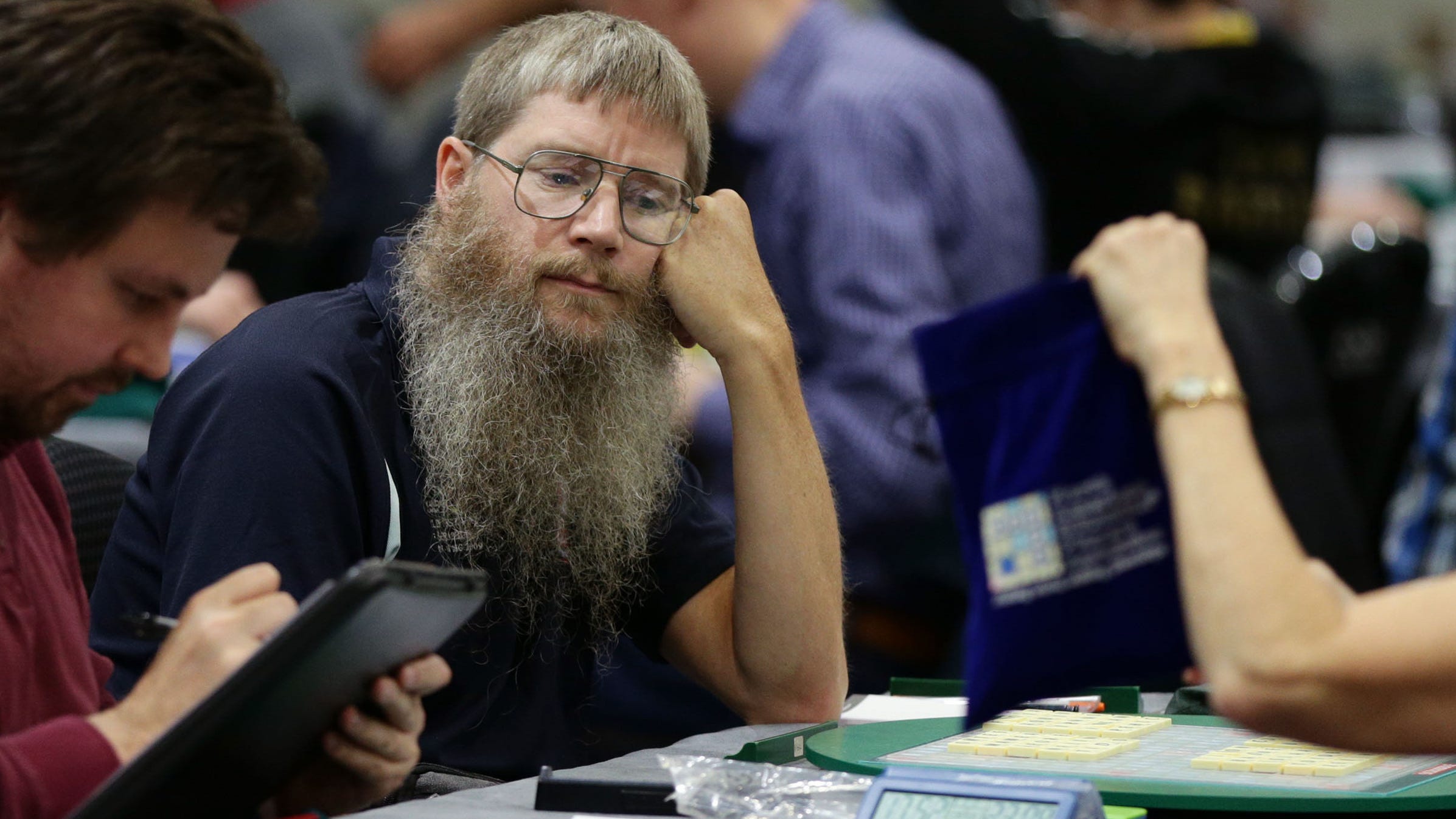
How did he do this? Remarkably, he memorized whole dictionaries (not most people’s idea of a fun activity). But it illustrates the extraordinary intensity and obsessiveness that can produce exceptional achievement.
There is evidence that intense, obsessive focus produces extraordinary achievement in a variety of areas, not just Scrabble. There are the guitarists who spend hours playing guitar, the soccer players who are always at the training ground, the painters who spend all their time painting, the gamers who are never away from their console, and so on.
There is also anecdotal evidence that extraordinary scientific achievements come from people who are intensely and obsessively focused on what they do. In the divorce announcement in a local paper, the ex-wife of legendary physicist Richard Feynman complained that “her husband worked calculus problems all day, as soon as he arose, while he drove his car, while sitting in the living room, and while lying in bed at night.”
And the movie Oppenheimer popularized the story of when the physicist J. Robert Oppenheimer was asked to deliver a physics lecture in Dutch (a language he did not speak). He locked himself in a room with a Dutch grammar book for a month and a half, and then delivered the lecture in pretty much flawless Dutch.
High-achieving scientists also tend to have very high IQs, but my point is not simply about IQ. Although high-achievers in many academic fields are disproportionately likely to be men, this is not necessarily because men are smarter. The evidence suggests that average IQ for males is about the same or perhaps slightly higher than average IQ for females. There is also evidence of a higher variance among men, which means there are more males in the far right and far left tails of the distributions (“more geniuses and more idiots,” as E. O. Wilson once memorably put it).
My point is that high-achievers, including high-achieving scientists, are more likely to be male because men are more likely to focus obsessively on their area of interest, and this helps them to rise to the top. They are also more willing to pay the costs of such intensive and obsessive focus, such as having your wife divorce you in the case of Feynman, or repelling people because of your inattention to personal hygiene, which I have been told is not uncommon at some technical schools.
This does not mean that women cannot display the same kind of obsessive focus. Clearly, some do. Using another example from my family: my sister is an artist, and when we are together she draws and paints all the time—during concerts, at museums, while waiting for something or someone, and so on. My claim is simply that this kind of behaviour is less common among women.
Many of the achievements of obsessive men do not confer any obvious benefits on the rest of humanity. It is unclear what benefits society gets from Scrabble tournaments, for example—although winning one likely does benefit the winner himself. The same applies to Oppenheimer’s delivering a physics lecture in Dutch after only six weeks of learning the language. It massively boosted his social status in the physics community (we are still talking about it) but had no wider benefits.
One important individual benefit for obsessive male high achievers may be that they are disproportionately selected as mates. There is some evidence of this. For example, my research has shown that in the U.S. today men with high incomes are more likely to be married—but there is no such effect for women.
This points to an evolutionary reason why obsessive behavior appears more common in males than females. If the ability to focus obsessively on a difficult task makes exceptional achievement more likely, and exceptional achievement increases mating opportunities for men more than for women, the trait would have conferred greater reproductive benefits on men and would therefore have been selected for more in males than in females.
Yet it’s also true that the high-level achievements of obsessive men sometimes do confer benefits on all of humanity, not just the individual achiever. This is particularly so in science. We remember Feynman and Oppenheimer not because Feynman spent all his waking hours doing calculus and Oppenheimer learnt Dutch in six weeks to present one physics lecture, but because of their lasting contributions to science. Both men worked on the Manhattan Project, which many argue hastened the end of the Second World War. It certainly paved the way for nuclear power, which has benefited the whole human race.
In short, there is evidence that men are more likely than women to obsessively focus on their chosen area to the exclusion of all else, and this often leads to extraordinary achievement. While the achievements often only benefit the achiever himself, in cognitively demanding areas like science they frequently have tremendous public benefits. Thus, it is likely that extraordinary achievements with the greatest public benefit come disproportionately from obsessive, high IQ men. They deserve our gratitude.
Rosemary Hopcroft is Professor Emerita of Sociology at the University of North Carolina, Charlotte. She is interested in applying evolutionary theory to sociological issues, as well as comparative and historical sociology.
Become a free or paid subscriber:

Like and comment below.
Excellent observations on this subject.
I believe autism has a rather wide spectrum and overlaps with compulsive obsession, which also has a wide spectrum in some of its manifestations. These conditions are very complex in the way they affect a person's ability to function in the world. They can be very advantageous or terribly debilitating.
"In the divorce announcement in a local paper, the ex-wife of legendary physicist Richard Feynman complained that “her husband worked calculus problems all day, as soon as he arose, while he drove his car, while sitting in the living room, and while lying in bed at night.”
From what I understand, Feynman didn't always spend his time lying in bed doing calculus.
"High-achieving scientists also tend to have very high IQs, but my point is not simply about IQ. Although high-achievers in many academic fields are disproportionately likely to be men, this is not necessarily because men are smarter. The evidence suggests that average IQ for males is about the same or perhaps slightly higher than average IQ for females. There is also evidence of a higher variance among men, which means there are more males in the far right and far left tails of the distributions (“more geniuses and more idiots,” as E. O. Wilson once memorably put it)."
I believe this is the case, and I believe, as you go on to point out, obsession is a great advantage for success.
" It is unclear what benefits society gets from Scrabble tournaments, for example—although winning one likely does benefit the winner himself. The same applies to Oppenheimer’s delivering a physics lecture in Dutch after only six weeks of learning the language. It massively boosted his social status in the physics community (we are still talking about it) but had no wider benefits."
I agree; I see no benefit to humanity in being able to win at Scrabble. But I do see a possible benefit in the Oppenheimer situation, i.e., perhaps he was able to inspire budding scientists.
"One important individual benefit for obsessive male high achievers may be that they are disproportionately selected as mates.
For example, my research has shown that in the U.S. today men with high incomes are more likely to be married—but there is no such effect for women."
This is a common occurrence: using the term 'high achievers' in conflation with 'high incomes'.
One must define what is meant by 'high achievers' and 'high incomes'. Neither Feynman nor Oppenheimer had what is considered a high income. An obsession with science rarely comes with an obsession with wealth.