


Written by Peter Frost.
Mean IQ has risen in Europeans over the past 10,000 years. This upward trend began when hunting and gathering gave way to farming, and it continued as farming brought a cascade of new challenges.1 Nonetheless, there were periods of stagnation and even decline, notably during the Imperial Era of Rome and, more recently, since the early 20th century.2
These are the findings of a new field of research, archaeogenetics, which uses ancient DNA to chart genetic change over time, such as changes in genes associated with cognitive ability. To date, the focus has been on Europe, where we have the most data. But at least one study concerns East Asia, where mean IQ has followed a similar trajectory over time, albeit with interesting differences.3 Eventually, we’ll learn how cognitive ability has evolved in South Asia, the Middle East, West Africa and other regions.4
A new picture of human evolution is taking shape. Was it ever anticipated by Charles Darwin or any of his contemporaries? This question prompted me to look through the early literature for anyone making the following points:
Mean IQ rose at a faster rate when hunting and gathering gave way to farming.
This rise continued well into the time of recorded history. It continued as long as new demands were made on cognitive ability, and as long as individuals who met such demands enjoyed higher reproductive success. Whenever this selection pressure weakened, mean IQ stopped rising or even fell.
There was a positive feedback loop between human intellect and the products of human intellect.
Darwin, in fact, did argue that human evolution continued past the transition from hunting and gathering to farming. But he believed it proceeded at a slower pace. In this, he was influenced by two of his closest associates: Alfred Russell Wallace and Francis Galton.
Wallace thought that cultural change made genetic evolution less necessary for material advancement, particularly with the rise of civilization.5 Meanwhile, Galton saw civilization as weakening natural selection: “the finest young men” are killed in war; the children of short-lived parents marry earlier and have children earlier; and primogeniture prevents the younger sons of landowners from marrying.6
Darwin concluded that cognitive ability increased only somewhat, or perhaps not at all, as humans became “civilized”:7
Hence in civilised nations there will be some tendency to an increase both in the number and in the standard of the intellectually able. But I do not wish to assert that this tendency may not be more than counterbalanced in other ways, as by the multiplication of the reckless and improvident; but even to such as these, ability must be some advantage.
After Darwin, academia followed the lead of either Wallace or Galton. But one contemporary did argue that cognitive evolution accelerated during the time of modern humans.
His name? Friedrich Engels — the lifelong collaborator of Karl Marx. Engels was interested in the natural sciences and the works of Darwin specifically. In 1859, he made a point of obtaining a copy of the first edition of On the Origin of Species. He immediately wrote to Marx:8
Darwin, by the way, whom I am just reading, is quite splendid. There was one aspect of teleology that had not yet been destroyed, but now that has been done. Never before has such a wonderful attempt been made to prove historical development in nature, and certainly never with such success.
Over the following decades, he wrote several essays from a Darwinian perspective, most notably The Part Played by Labour in the Transition from Apes to Man (1876).9
This essay seems to argue for all three of the above points, particularly the tendency of cultural evolution and genetic evolution to drive each other forward:
The reaction on labour and speech of the development of the brain and its attendant senses, of the increasing clarity of consciousness, power of abstraction and of conclusion, gave both labour and speech an ever-renewed impulse to further development. This development did not reach its conclusion when man finally became distinct from the ape, but on the whole made further powerful progress, its degree and direction varying among different peoples and at different times, and here and there even being interrupted by local or temporary regression. This further development has been strongly urged forward, on the one hand, and guided along more definite directions, on the other, by a new element which came into play with the appearance of fully-fledged man, namely, society.
The first part seemed obscure to me, so I went back to the original German and used Google Translate:10
The feedback effect of the development of the brain and its obedient senses, of the increasingly clarified consciousness, capacity for abstraction, and power of drawing conclusions on labor and language gave both [labor and language] constant new impulses for further development—a development that by no means came to an end once humans had finally separated from the apes.
In other words, there was a positive feedback loop between the development of the brain (consciousness, abstraction, reasoning) and the growing complexity of work and language, which in turn favored further development of the brain. This is the feedback loop at the heart of gene-culture coevolution — a concept that would remain unknown for another century and a half.
Am I seeing something that isn’t there? Perhaps my interest in gene-culture coevolution is making me assume that others share this interest, particularly the evolutionarily inclined. It is significant, then, that another writer also thought “the best nineteenth-century case for gene-culture coevolution was made by Friedrich Engels in his remarkable essay of 1876.”
That writer was Stephen Jay Gould, and he saw the same feedback loop between genes and culture:11
An enlarging brain (biology, or genes in later parlance) then fed back upon tools and language (culture), improving them in turn and setting the basis for further growth of the brain—the positive feedback loop of gene-culture coevolution.
Adapting to nature: cold winters theory
According to Engels, gene-culture coevolution was not yet predominant when humans were still adapting to new natural environments as they spread around the globe. These humans were already modern Homo sapiens, as shown by his use of the term “fully-fledged man” [des fertigen Menschen].
[Man] spread over the whole of the habitable world, being the only animal fully able to do so of its own accord. The other animals that have become accustomed to all climates — domestic animals and vermin — did not become so independently, but only in the wake of man. And the transition from the uniformly hot climate of the original home of man to colder regions, where the year was divided into summer and winter, created new requirements — shelter and clothing as protection against cold and damp, and hence new spheres of labour, new forms of activity, which further and further separated man from the animal.
This is “cold winters theory” — the idea that the seasonal cycle of northern regions selects for planning, as well as the ability to create special clothing and shelters for winter. It had many proponents in the 19th century, but Engels is most likely referring to a paper written by Wallace in 1864:12
So when a glacial epoch comes on, some animals must acquire warmer fur, or a covering of fat, or else die of cold. Those best clothed by nature are, therefore, preserved by natural selection. Man, under the same circumstances, will make himself warmer clothing, and build better houses; and the necessity of doing this will react upon his mental organisation and social condition … a hardier, a more provident, and a more social race would be developed, than in those regions where the earth produces a perennial supply of vegetable food, and where neither foresight nor ingenuity are required to prepare for the rigours of winter. And is it not the fact that in all ages, and in every quarter of the globe, the inhabitants of temperate have been superior to those of tropical countries? All the great invasions and displacements of races have been from North to South, rather than the reverse.
Adapting to culture: gene-culture coevolution
With the rise of farming, the human mind no longer had to grapple solely with the cognitive demands of the natural environment. Cognitive demands were now being created by culture, itself a creation of the human mind.
Selection for cognitive ability thus shifted farther south, to temperate or even subtropical latitudes. Such regions had the greatest potential for population growth and hence for social complexity — what we call “civilization.”
Engels describes this new stage of human evolution:
By the combined functioning of hand, speech organs and brain, not only in each individual but also in society, men became capable of executing more and more complicated operations, and were able to set themselves, and achieve, higher and higher aims. The work of each generation itself became different, more perfect and more diversified. Agriculture was added to hunting and cattle raising; then came spinning, weaving, metalworking, pottery and navigation. Along with trade and industry, art and science finally appeared. Tribes developed into nations and states. Law and politics arose, and with them that fantastic reflection of human things in the human mind — religion.
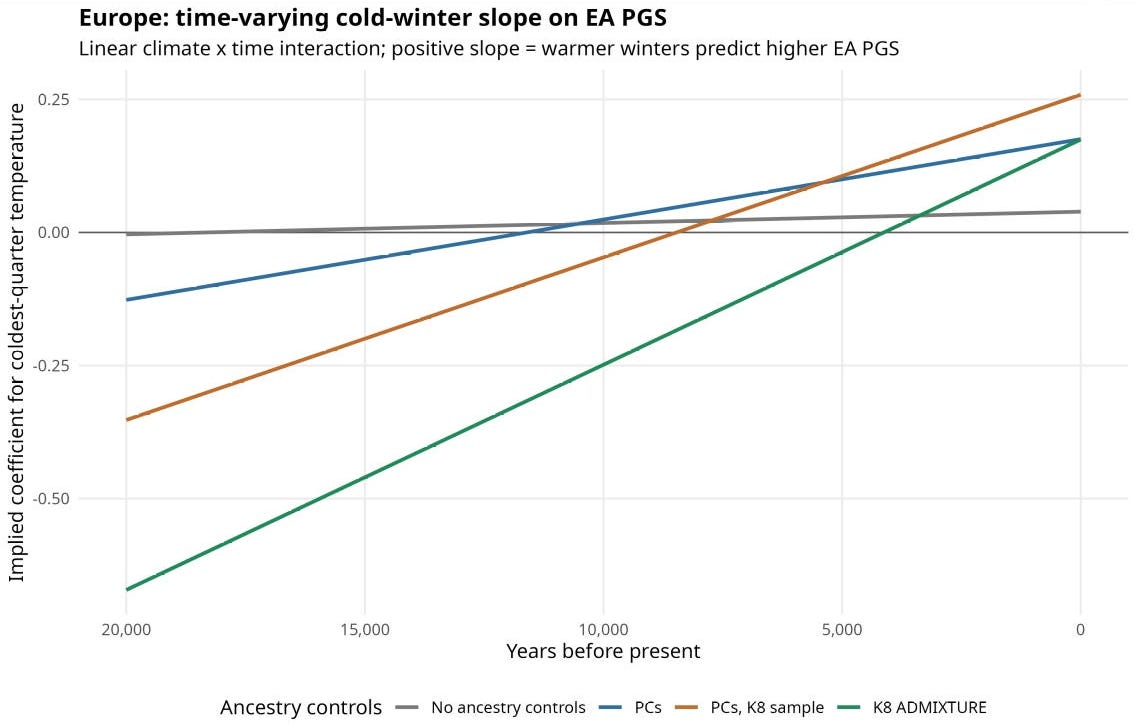
The southward shift in selection for cognitive ability can be seen in ancient DNA. The inverse correlation between winter temperature and cognitive ability is strongest in the oldest European samples. It then grows weaker over time and finally disappears with the end of hunting and gathering in Europe.13
Engels ended his essay with a criticism of the “Darwinian school” for tending to see the human mind as a disembodied entity — a ghost in a machine — and not as an organ that has evolved to meet specific needs.
All merit for the swift advance of civilisation was ascribed to the mind, to the development and activity of the brain. Men became accustomed to explain their actions as arising out of thought instead of their needs (which in any case are reflected and perceived in the mind); and so in the course of time there emerged that idealistic world outlook which, especially since the fall of the world of antiquity, has dominated men’s minds. It still rules them to such a degree that even the most materialistic natural scientists of the Darwinian school are still unable to form any clear idea of the origin of man, because under this ideological influence they do not recognise the part that has been played therein by labour.
Animals, as has already been pointed out, change the environment by their activities in the same way, even if not to the same extent, as man does, and these changes, as we have seen, in turn react upon and change those who made them. In nature nothing takes place in isolation. Everything affects and is affected by every other thing.
Conclusion
It may seem jarring to see Engels advocating not only gene-culture coevolution but also cold winters theory and the idea that the human brain continued evolving into historical times. No less jarring is Gould’s apparent endorsement. For this, I have but one explanation: life isn’t simple.
Engel’s essay was never finished. It would eventually be published in 1925, long after his death, together with other incomplete manuscripts by him on the natural sciences. Had he finished it, and found a better translator, he might have influenced evolutionary thought in the years after Darwin.
As things turned out, the leading intellectual heirs of Darwin were Wallace and Galton. For different reasons, their legacy has discouraged researchers from investigating the recent evolution of cognitive ability.
Wallace rightly believed that the pace of cultural change overtook the pace of genetic evolution in our species. But he wrongly concluded that the growing importance of culture caused genetic evolution to slow down and lose importance. In fact, the human genome changed more quickly as Homo sapiens adapted to faster-changing cultural environments.14
Wallace’s view of human evolution gained broad support, particularly its corollary that culture is overwhelmingly responsible for human differences. The latter view became especially popular from 1933 onward, as alarm grew over the rise of Hitler and Nazi blood-and-soil nationalism — the original meaning of “racism.”15 For many, the struggle against Hitler would continue long after 1945 and eventually become a struggle against any belief that human differences are more than skin-deep.16
As for Galton, he rightly believed that civilization can cause cognitive evolution to halt or even reverse. But he wrongly assumed that stagnation and decline were the usual outcome. In fact, civilization has more often been an impetus for higher levels of cognitive ability.
We’re now in the year 2026. With Nature publishing the latest Reich Lab paper, we can read Engel’s 1876 essay in a new light and acknowledge its significance. Will the same be done for the papers by Davide Piffer, Emil Kirkegaard, Yunus Kuijpers and Michael Woodley of Menie?
The advance of science is due not only to exceptional individuals but also to our willingness to recognize them and build on their work.
Peter Frost has a PhD in anthropology from Université Laval. His main research interest is the role of sexual selection in shaping highly visible human traits. Find his newsletter here.
Become a free or paid subscriber:

Like and comment below.
Akbari, A., Perry, A., Barton, A.R. et al. (2026). Ancient DNA reveals pervasive directional selection across West Eurasia. Nature April 15. https://doi.org/10.1038/s41586-026-10358-1
Kuijpers, Y., Domínguez-Andrés, J., Bakker, O.B., Gupta, M.K., Grasshoff, M., Xu, C.J., Joosten, L.A.B., Bertranpetit, J., Netea, M.G., & Li, Y. (2022). Evolutionary Trajectories of Complex Traits in European Populations of Modern Humans. Frontiers in Genetics, 13, 833190. https://doi.org/10.3389/fgene.2022.833190
Piffer, D., & Kirkegaard, E. O. (2024). Evolutionary trends of polygenic scores in European populations from the Paleolithic to modern times. Twin Research and Human Genetics, 27(1), 30-49. https://doi.org/10.1017/thg.2024.8
Woodley, M. A., Younuskunju, S., Balan, B., & Piffer, D. (2017). Holocene selection for variants associated with general cognitive ability: Comparing ancient and modern genomes. Twin Research and Human Genetics, 20(4), 271-280. https://doi.org/10.1017/thg.2017.37
Frost, P. (2022). The Great Decline. Peter Frost’s Newsletter, December 20.
Frost, P. (2024). How Christianity rebooted cognitive evolution. Aporia Magazine, October 10.
Piffer, D. (2025). Directional selection and evolution of polygenic traits in Eastern Eurasia: Insights from ancient DNA. Twin Research and Human Genetics, 28(1), 1-20. https://doi.org/10.1017/thg.2024.49
Frost, P. (2025). Cognitive evolution in eastern Eurasia. Aporia Magazine, February 8.
Frost, P. (2024). Recent cognitive evolution in West Africa. Peter Frost’s Newsletter. January 2.
Darwin, C. (1874). The Descent of Man and Selection in Relation to Sex. Second Edition, p. 86. https://charles-darwin.classic-literature.co.uk/the-descent-of-man/
Darwin, C. (1874). The Descent of Man and Selection in Relation to Sex. Second Edition, p. 90-92. https://charles-darwin.classic-literature.co.uk/the-descent-of-man/
Darwin, C. (1874). The Descent of Man and Selection in Relation to Sex. Second Edition, p. 92. https://charles-darwin.classic-literature.co.uk/the-descent-of-man/
Weikart, R. (1998). Socialist Darwinism. Evolution in German Socialist Thought from Marx to Bernstein. http://acdc2007.free.fr/weikart1998.pdf
Engels, F. (1876). The Part Played by Labor in the Transition from Ape to Man. Transl. from the German by C. Dutt. Moscow: Progress Publishers. https://www.marxists.org/archive/marx/works/1876/part-played-labour/index.htm
Actioforma (2014). Works of Frederick Engels 1876. The Part Played by Labour in the Transition from Ape to Man (original German text, plus translations in Russian, Italian, French, Japanese, and Chinese). https://www.actioforma.net/kokikawa/evolution/ape_to_man.pdf
Gould, S.J. (1987). An Urchin in the Storm. Essays about Books and Ideas. New York: W.W. Norton, p. 111.
Wallace, A.R. (1864). The Origin of Human Races and the Antiquity of Man deduced from the Theory of “Natural Selection. J. Anthropol. Soc. Lond. 2, clviii–clxxxvii. https://digitalcommons.wku.edu/cgi/viewcontent.cgi?referer=&httpsredir=1&article=1005&context=dlps_fac_arw
Piffer, D. (2026). Did Harsh Seasons Make Complex Societies? PifferPilfer, May 4.
Frost, P. (2019). The Original Industrial Revolution. Did Cold Winters Select for Cognitive Ability? Psych, 1(1), 166-181. https://doi.org/10.3390/psych1010012
Hawks, J., Wang, E.T., Cochran, G.M., Harpending, H.C., & Moyzis, R.K. (2007). Recent acceleration of human adaptive evolution. Proceedings of the National Academy of Sciences, USA, 104, 20753-20758. https://doi.org/10.1073/pnas.0707650104
Cochran, G. & Harpending, H. (2009). The 10,000 Year Explosion: How Civilization Accelerated Human Evolution. Basic Books: New York. https://www.amazon.ca/000-Year-Explosion-Civilization-Accelerated/dp/0465020429
Frost, P. (2013). More thoughts. The evolution of a word. Evo and Proud, May 18. https://evoandproud.blogspot.com/2013/05/more-thoughts-evolution-of-word.html
Frost, P. (2015). Birth of a word. Evo and Proud, May 23. https://evoandproud.blogspot.com/2015/05/birth-of-word.html
Frost, P. (2025). Was Franz Boas a race realist? Aporia Magazine, March 13.
Interesting, as always.
It's refreshing to hear from the 19th century, before people started to over-indulge in polite hedging and endless qualifications. All most of us want is 'the main thing', which writers like Wallace and Engels give us.
Reading this made me think that it's rather infair that everyone knows the name 'Marx' but not everyone has never heard of Engels.
Strange the way that when someone (here Wallace and Galton) propose an idea it's difficult for others who come later to think passed it to some other possible solution. It's the same at our pub quiz. The first round is always to name the band from the song. As soon as one of our team suggests a band name I'm incapable of thinking of any alternative, so much so that we have now agreed to keep our suggestions to ourselves until each of us has had a chance to think for himself. Of course Engels, being dead by then, never had much of a chance to voice his opinion.
Engels, huh? History might look different if these ideas had found a place in Communist thought.