


Written by Peter Frost.
At the height of the Middle Ages, most Western Europeans were still trapped in ways of thinking that discouraged the use of reason. This was due not only to a lesser capacity for reasoning but also to rival modes of thought, like revealed truth, finalism, animism and anthropomorphism.
The stars, the moon, the sea and the weather were thus conscious entities that could help or harm, depending on their mood, while “good luck” and “bad luck” were intentional processes of supernatural origin. In general, people did not draw sharp distinctions between animate and inanimate, subjective and objective or cause and effect (Oesterdiekhoff, 2012).
Some did rise above this mindset, but they were isolated individuals with few opportunities to meet others like themselves. Their capacity for reason thus had limited value. Even as counsellors to monarchs, they were alone in the world, their full worth neither recognized nor appreciated, and their best ideas going no further than their own minds. Intellectual progress requires numerous people who can understand an idea, criticize it, suggest improvements and, finally, put it into practice.
Things changed during the Late Middle Ages. A ferment was at work among scholars, as shown by a renewed interest in ancient writings and the rise of scholasticism — the use of analytical argument to reconcile Christianity with pagan philosophy. There were also more opportunities for “men of reason” to come together. At first, they met in each other’s homes or at monastic schools. Later, as they became more numerous, they gathered in secular venues, like salons, coffeehouses and learned societies. Such men ushered in the post-medieval era — a time of accelerating progress not only in the sciences but also in literature, music and the arts (de Courson et al., 2023).
What caused this profound change? For Gregory Clark, who has studied English demographic history, the cause was the growth of the middle class. As the market economy expanded from late medieval times onward, it created niches for young middle-class men and women — who could now marry earlier and have more children. But their higher rate of natural increase often overshot the number of niches created, thus forcing some children to move down the social ladder. Meanwhile, the lower class was not reproducing itself, due to its higher death rate and lower marriage rate. As a result, the entire English population became increasingly of middle-class descent.
This demographic shift was paralleled by a mental and behavioral one: “Thrift, prudence, negotiation, and hard work were becoming values for communities that previously had been spendthrift, impulsive, violent, and leisure loving” (Clark, 2007, p. 166; see also Clark, 2009; Clark, 2023).
Were the mental and behavioral characteristics of the middle class due to good upbringing or good genes? Likely both. Middle-class parents were passing on both a certain morality and a certain genotype, including alleles associated with higher cognitive ability. This is what we see in the data.
A new research tool
Our understanding of recent human evolution has undergone a sea change with the retrieval of DNA from human remains. By examining certain genes at different points of history and prehistory, we can observe how human populations have evolved — not only physically but also mentally and behaviorally.
The evolution of cognitive ability can be measured by genes associated with IQ or educational attainment. Although this polygenic measure is unreliable for any one person, it can be reasonably accurate for a group (Piffer, 2025). In fact, its correlation with mean population IQ is high — in the range of 0.82 to 0.98 (Piffer, 2019).
To chart the cognitive evolution of Western Europeans, Davide Piffer and Emil Kirkegaard compared 467 genomes from two periods: 1) Late Antiquity to the Middle Ages; and 2) the present day. Their comparison showed a large rise in cognitive ability over time — between one third and one half of a standard deviation (Frost, 2024a; Piffer & Kirkegaard, 2024).
The actual rise may have been even larger because the comparison was between medieval and present-day genomes. According to Gregory Clark, cognitive ability was already rising during the Late Middle Ages, at least in England and probably elsewhere in Western Europe. At the other end of the timeline, cognitive evolution seems to have stalled during the Victorian Era and then reversed in the 20th century (Frost, 2022; Kong et al., 2017; Woodley et al., 2013).
To identify the actual timeline, Davide Piffer and Gregory Connor did a second study with 269 genomes from one region of England (Cambridge and surrounding area) between the 11th and 19th centuries (Piffer & Connor, 2025a). This study brings the timeline into sharper focus: little change at first, followed by a steady rise from the 1300s onward. Particularly impressive is the increase in the “smart fraction”: the top 1% in 1850 was as smart as the top 0.1% in the year 1000.
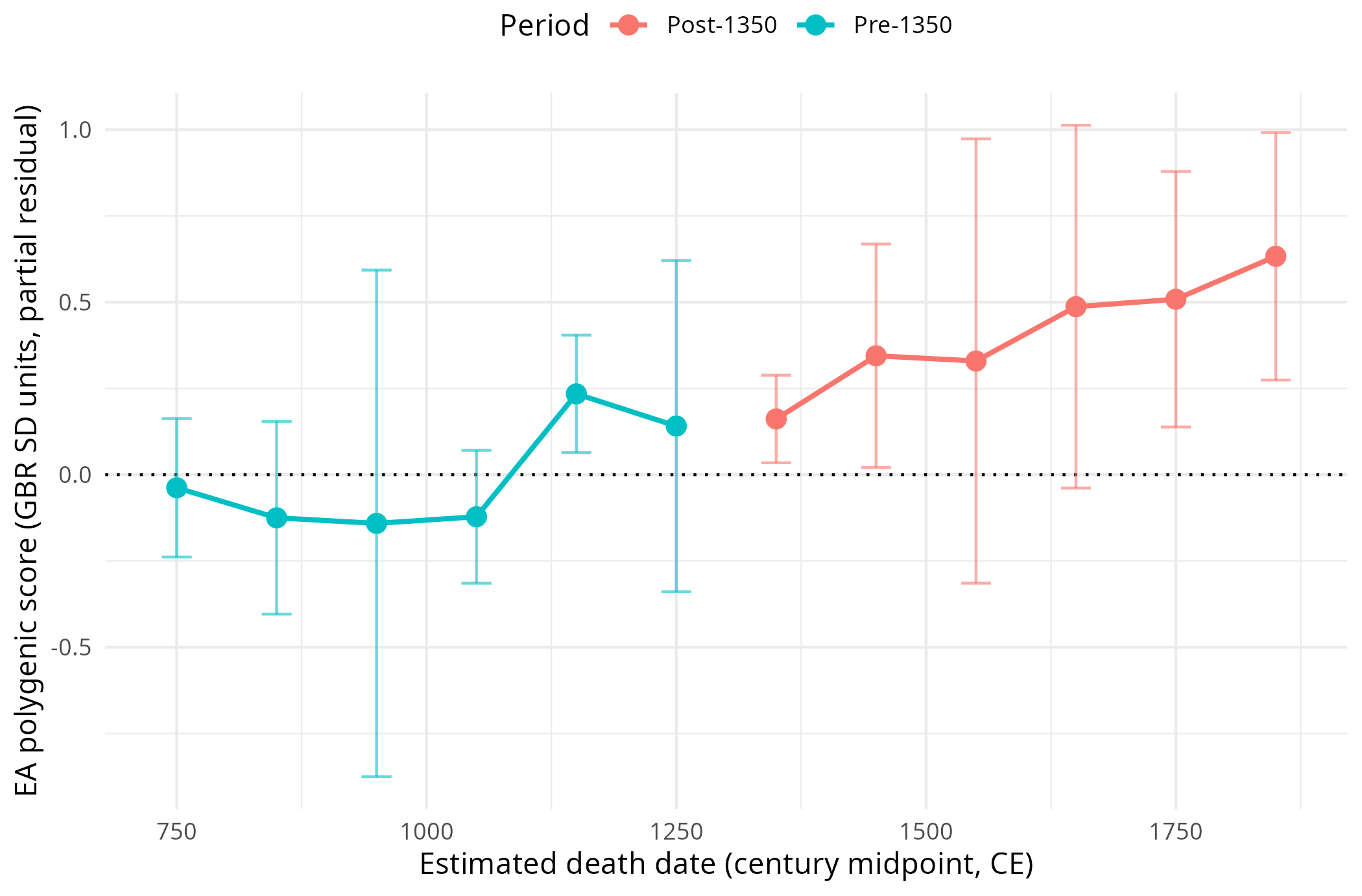
Piffer and Connor then did a third study with a larger sample of 600 genomes and a broader geographic and temporal scope — Belgium, Denmark, England, Germany and the Netherlands between the 8th and 19th centuries.
They again found the same timeline:
No clear change until about 1350, followed by a steady rise until 1850. The total increase was a little over three quarters of a standard deviation.
The inflection point seems to be the Black Death (1346-1353). This major pandemic may have kickstarted cognitive evolution in Western Europe by weakening feudalism and freeing up human capital for the emerging market economy: “labour became scarcer, wages rose, and land and capital became relatively cheaper. In that new environment, individuals who could exploit opportunities in trade, crafts, and skilled work had strong advantages” (Piffer, 2025b).
On a per capita basis, the highly intelligent became over ten times more numerous in Western Europe between 700 and 1850. In other words, the top 1% in 1850 were smarter than the top 0.1% in700 (Piffer & Connor, 2025b; Piffer, 2025b).
Discussion
These findings shed new light on Western European history, particularly the arbitrary line drawn between the Middle Ages and later times — typically at the year 1500. In reality, the entry into modernity was gradual. If a line must be drawn between pre-modernity and modernity, it should be set at around 1350, when the Black Death ravaged feudal Europe, wiping out between 30 and 60% of the population and facilitating the rise of a new economic system and dominant class.
Its aftermath saw a sustained expansion of the market economy. Young middle-class men and women could marry earlier and have more children, who had the added benefit of providing family businesses with cheap labor. Such families formed a growing proportion of the population. With each passing generation, more and more people could exploit market opportunities through their skills in literacy, numeracy and planning. The new economic conditions were favoring their success and, hence, the success of their moral values and genetic traits.
In sum, a changing economy was coevolving with a changing genome, with each pushing the other forward. And the spillover effects on intellectual life went far beyond bookkeeping and merchandising. As average cognitive ability increased, so did the numbers of the highly intelligent. They were becoming a class of their own.
The last point is crucial. Progress is driven not only by individuals but also by communities that can fully appreciate new ideas and put them to good use. Otherwise, new ideas are left to rot on the vine. For example, the printing press wasn’t really invented by Johannes Gutenberg in 1440 — this was when it became commercially viable. It could have been invented earlier, and traders had already seen movable-type presses in East Asia, but there was no need to mass-produce books, at least not in Europe. Now there was a need.
The great cognitive advance after 1350 is part of a bigger picture. If we combine the recent study of northwest Europe with an earlier one of central Italy, we get the following timeline since the Roman Period:
27 BCE–300 (Imperial Era). Cognitive ability declined on average, primarily because the elite was failing to reproduce itself (Frost, 2024b; Piffer et al., 2023). Possible causes:
Decline of marriage. This is mentioned by Augustus in a speech to the equestrian class: “[W]hen the knights were very urgent, during the games, in seeking the repeal of the law regarding the unmarried and the childless, he assembled in one part of the Forum the unmarried men of their number, and in another those who were married, including those who also had children. Then, perceiving that the latter were much fewer in number than the former, he was filled with grief” (Cassius Dio, Roman History, 56).
Hypogamy between elite men and women of low status, often slaves or ex-slaves. Elite women thus became less important to elite fertility. If a slave owner had no children by a wife, he could leave his estate to the children he had presumably fathered with slave women or to emancipated boys and girls for whom he had developed affection (Rawson, 1986, 2014, pp. 173-179).
Increase in the slave population. Previously, elite offspring could, if need be, find niches further down the social ladder. In this way, the lower class (which had negative natural increase) was continually replenished by the demographic surplus of higher classes. Mean cognitive ability thus rose progressively from generation to generation. During the Imperial Era, however, there was less downward mobility: lower social niches were deemed unfit for higher-class offspring and filled normally by slaves or freedmen. (Harris, 1999; Saller, 1994).
300–800? (Late Antiquity). The decline of cognitive ability reversed with the rise of Christianity. Possible causes:
Aggressive promotion of monogamy by the Church. Elite men had to focus on procreation with a lawful wife — usually of similar status — rather than on sex with prostitutes or slave women. Socioeconomic success thus translated into reproductive success, and hence into selection for cognitive ability.
Rules-based religion. Christianity favored those who were better at learning and following rules.
800?–1350 (Middle Ages to the Black Death). There was stasis or a slow increase in cognitive ability that cannot be measured with current data. Possible causes:
Rise of feudalism. This occurred from the 9th century onward. Feudal manors provided security in exchange for personal freedom. With fewer life choices, and less scope for innovation, serfs had fewer cognitive demands to deal with (Schooler, 1976).
Rise of monasticism (especially the Cluniac movement, founded in 910). Monks came disproportionately from aristocratic families, who provided endowments and appreciated the education provided by monastic living (Janin & Carlson, 2023, pp. 14, 39). Their vows of chastity kept them from passing on their aptitudes.
1350–1850 (late medieval and post-medieval periods). Cognitive evolution accelerated after the Black Death and continued at a fast pace until the Victorian Era. Possible causes:
Growth of the middle class. This was a consequence of the expanding market economy.
Gradual replacement of the lower class by the demographic surplus of the growing middle class. Meanwhile, the lower class was failing to reproduce itself due to a higher death rate and lower marriage rate.
1850 – present (Modern Era). Cognitive ability plateaued and eventually declined (Frost, 2022). Possible causes:
Shift from cottage industry to factory capitalism. The workforce was no longer composed of family members and could now be expanded or contracted at will through hiring or firing. Because businesses were no longer “ma and pa” shops, the owners, generally men, had no economic incentive to marry early and have children. Reproductive success was thus severed from socioeconomic success.
Creation of new needs to maintain a middle-class lifestyle. These included the maintenance of a wife and family. Children became more costly and offered less economic benefit.
Decline of religion. Of particular importance was the relaxation of its restrictions on marriage, divorce and sexual behavior.
The pre-medieval timeline, like the later one already discussed, sheds new light on the historical process. The Imperial Era now seems less impressive. Despite its grandeur, it coincided with an unsustainable running down of human capital, as often happens in empires. This decline then reversed during Late Antiquity, which now seems less tragic. Yes, the Western Empire collapsed, as did much of Roman culture, but this period also brought the rise of Christianity and a reorganization of society on a more sustainable basis.
Future research
Hopefully, we will see more studies of the sort reviewed here, particularly for late medieval and post-medieval times. By charting the cognitive advance by region and by century, we may learn more about the historical processes leading to the Renaissance, the Reformation, the Scientific Revolution, the Enlightenment and the Industrial Revolution.
Here are a few research questions:
Did cognitive ability begin to rise earlier in some regions than in others? While the Black Death clearly assisted the rise of the market economy, and the consequent expansion of the middle class, both trends were already under way in North Sea ports from the 7th century onward and in Italy after the year 1000. Did these regions experience an earlier rise in cognitive ability? In Italy, for instance, scholasticism was already reaching its high point in the 1200s and early 1300s, well before the Black Death.
Were there “hot spots” of unusually strong cognitive evolution? Such hot spots may have arisen wherever cottage industry predominated between the 15th and 19th centuries, particularly in Westphalia, Saxony, the Zurich uplands, Piedmont, Lombardy, Alsace, Flanders, Brittany, Lancashire, Yorkshire and Ulster. In such areas, semi-rural cottagers enjoyed a population boom due to low mortality and high fertility. On the one hand, they lived away from urban areas, where disease and malnutrition kept population growth in check. On the other, they employed family members in their workshops and had no other means of expanding their workforce.
These cottagers produced their wares on contract for urban merchants. They thus operated in an elastic, competitive market, with some doing better than others. Because of the tight linkage between economic and reproductive success, some of them had more children — generally by marrying earlier and helping their offspring do likewise (Seccombe, 1992, pp. 205, 217). This situation must have created strong selection for cognitive ability.
Was the rise in cognitive ability part of a broader mental and behavioral shift? Gregory Clark has argued that the English population underwent a broad shift toward “middle class” qualities of mind and behavior — not only higher cognitive ability but also lower time preference, greater impulse control and less willingness to settle disputes through violence (Clark, 2007, p. 166).
Georg Oesterdiekhoff has argued for a similar shift across Western Europe. He describes it in terms of Jean Piaget’s stages of cognitive development. More and more people could go beyond “preoperational thinking” as seen in egocentrism, anthropomorphism, finalism and animism. They could now achieve “operational thinking” — the ability to understand probability, cause and effect and another person’s perspective (Oesterdiekhoff, 2023)
Should the genomic data be controlled for socioeconomic status? There is a risk of sampling bias because the physical remains of elite individuals are more likely to survive the passage of time. Consequently, their DNA should be overrepresented in older samples, and cognitive ability would seem to decrease over time. Of course, we generally see the opposite: an increase in cognitive ability over time. The actual increase may have therefore been even greater than current findings suggest.
In any case, we should certainly attempt to control for the SES of ancient DNA. It is often known from parish records. If not, it can be inferred through isotope analysis of bones and teeth. High SES is associated with an ample, high-meat diet, and low SES with coarse grains and malnutrition.
Peter Frost has a PhD in anthropology from Université Laval. His main research interest is the role of sexual selection in shaping highly visible human traits. Find his newsletter here.
Become a free or paid subscriber:

Like and comment below.
References
Cassius Dio (1924) Roman History. Loeb Classical Library. Boston: Harvard University Press. https://penelope.uchicago.edu/Thayer/E/Roman/Texts/Cassius_Dio/56*.html
Clark, G. (2007). A Farewell to Alms. A Brief Economic History of the World. Princeton University Press: Princeton. https://press.princeton.edu/books/paperback/9780691141282/a-farewell-to-alms
Clark, G. (2009). The domestication of man: the social implications of Darwin. ArtefaCToS, 2, 64-80. https://www.researchgate.net/publication/277275046_The_Domestication_of_Man_The_Social_Implications_of_Darwin
Clark, G. (2023). The inheritance of social status: England, 1600 to 2022. Proceedings of the National Academy of Sciences, U.S.A., 120(27), e2300926120 https://doi.org/10.1073/pnas.2300926120
de Courson, B., Thouzeau, V., & Baumard, N. (2023). Quantifying the scientific revolution. Evolutionary Human Sciences, 5, E19. https://doi.org/10.1017/ehs.2023.6
Frost, P. (2022). The Great Decline. Peter Frost’s Newsletter, December 20.
Frost, P. (2024a). Cognitive evolution in Europe: Two new studies. Peter Frost’s Newsletter, March 14.
Frost, P. (2024b). How Christianity rebooted cognitive evolution, Aporia Magazine, October 10.
Harris, W. (1999). Demography, Geography and the Sources of Roman Slaves. Journal of Roman Studies 89: 62-75. https://doi.org/10.2307/300734
Janin, H., & Carlson, U. (2023). Medieval Monks and Monasteries. McFarland.
Kong, A., Frigge, M.L., Thorleifsson, G., Stefansson, H., Young, A.I., Zink, F., Jonsdottir, G.A., Okbay, A., Sulem, P., Masson, G., Gudbjartsson, D.F., Helgason, A., Bjornsdottir, G., Thorsteinsdottir, U., & Stefansson, K. (2017). Selection against variants in the genome associated with educational attainment. Proceedings of the National Academy of Sciences, 114(5), E727-E732. https://doi.org/10.1073/pnas.1612113114
Oesterdiekhoff, G.W. (2012). Was pre-modern man a child? The quintessence of the psychometric and developmental approaches. Intelligence 40, 470–478. https://doi.org/10.1016/j.intell.2012.05.005
Piffer, D. (2019). Evidence for Recent Polygenic Selection on Educational Attainment and Intelligence Inferred from Gwas Hits: A Replication of Previous Findings Using Recent Data. Psych, 1(1), 55-75. https://doi.org/10.3390/psych1010005
Piffer, D. (2025). Why individual prediction doesn’t scale to group differences in polygenic scores: debunking a common fallacy. PifferPilfer, November 21.
Piffer, D., & Connor, G. (2025a). Genomic Evidence for Clark’s Theory of the British Industrial Revolution, preprint, ResearchGate, June. https://www.researchgate.net/publication/392808200_Genomic_Evidence_for_Clark’s_Theory_of_the_British_Industrial_Revolution
Piffer, D., & Connor, G. (2025b). Genomic Evidence for Clark’s Theory of the Industrial Revolution, preprint, ResearchGate, November. https://www.researchgate.net/publication/392808200_Genomic_evidence_for_Clark’s_theory_of_the_Industrial_Revolution
Piffer D, Dutton, E., & Kirkegaard, E.O.W. (2023). Intelligence Trends in Ancient Rome: The Rise and Fall of Roman Polygenic Scores. OpenPsych, July 21, 2023. https://doi.org/10.26775/OP.2023.07.21
Piffer, D., & Kirkegaard, E.O.W. (2024). Evolutionary Trends of Polygenic Scores in European Populations from the Paleolithic to Modern Times. Twin Research and Human Genetics, 27(1), 30-49. https://doi.org/10.1017/thg.2024.8
Rawson, B. (1986). Children in the Roman familia. In: B. Rawson (ed.) The family in ancient Rome: new perspectives, (pp. 170-200). Ithaca (New York): Cornell University Press.
Saller, R. P. (1994). Patriarchy, property and death in the Roman family (Vol. 25). Cambridge University Press.
Schooler, C. (1976). Serfdom’s legacy: An ethnic continuum. American Journal of Sociology, 81(6), 1265-1286. https://doi.org/10.1086/226223
Seccombe, W. (1992). A Millennium of Family Change. Feudalism to Capitalism in Northwestern Europe. London: Verso. https://archive.org/details/millenniumoffami0000secc/page/n3/mode/2up
Woodley, M.A., J. Nijenhuis, & Murphy, R. (2013). Were the Victorians cleverer than us? The decline in general intelligence estimated from a meta-analysis of the slowing of simple reaction time. Intelligence, 41, 843-850. https://doi.org/10.1016/j.intell.2013.04.006
"At the height of the Middle Ages, most Western Europeans were still trapped in ways of thinking that discouraged the use of reason."
Are you going to argue that things have changed much? LOL. In light of the current actions of 'elected' European 'leaders', that may be a hard sell.
It appears that the West is undergoing another pause, or worse, a decline in capacity for reason.
Thanks for an interesting article.
Powerful article