


Written by Peter Frost.
“I found a region and a culture that finishes high in societal ‘trust’ rankings globally, yet has little trust in outsiders.”
In 2023, Shafi Musaddique left England for Estonia, “lured in by the promise of clean air, quiet and a chance to continue freelance journalism” — plus the benefits of a high-trust society. (Apparently, this promise is no longer available in England.) His disappointment wasn’t long in coming.
He found himself “living in one of Europe’s last remaining countries without proper hate speech laws, encountering racism and White Supremacists in broad daylight.” He also discovered that Estonians reserve their trust for insiders:
Estonia (and neighbouring Nordic countries) often score high in rankings that measure public trust. Yet such metrics hide the ingrained distrust of outsiders, handed down generationally. (Musaddique, 2026)
It’s no fun being excluded from a high-trust society, but how could things be otherwise? Most humans on this planet trust only close kin and long-time friends, so they don’t have the reflex of trying to keep the wider community clean, peaceful and orderly. If Estonia opened its borders to the rest of the world, it would become like … the rest of the world. And our journalist friend would have to seek greener pastures elsewhere.
Such an outcome doesn’t seem to worry Shafi, who prefers to frame the issue in moral terms: we have a duty not to discriminate against fellow humans. But do we? Morality doesn’t exist in a vacuum. It exists within a community of people who, consciously or unconsciously, respect certain norms. It is thus culturally bound.
This point is made in a recent paper on the future of liberalism:
Besides the high-profile foreign policy failures arising from the failure to conceive of liberalism as culturally bound, it has also led to a neglect of the interests of the liberal moral community as such. Reconceptualizing liberalism, not as the universal birthright of humanity or the inevitable conclusion of rational thinking, but as a particular moral community with an interest in its own continuation, may be important to ensure that it does indeed continue. (Harwick & Bawa-Allah, 2026, p. 14)
Preservation of the moral community overrides the duty to be moral. If certain aspects of morality are leading your community to extinction, you should change course and adjust those aspects accordingly. You don’t just plunge ahead.
This is especially so for high-trust societies. Belonging to one isn’t like belonging to a football club. It requires thinking and behaving in ways that run counter to the way most humans think and behave. In concrete terms, it means being unusually prone to empathy, rule following and feelings of guilt (Frost, 2020).
But if high-trust societies like Estonia have such an ingrained distrust of outsiders, wouldn’t they seal their borders long before they risk demographic replacement? Aren’t there both geographical and psychological limits to social trust? As Shafi notes, “the borders of Estonian empathy fall short.” His hosts seem unwilling to feel empathy for the entire planet.
Of course, a single observer cannot fully answer this question. Let’s turn to the academic literature and see what it has to say. Its findings may surprise you. Or maybe not.
South Korea. This country has recently interested researchers because “its high level of in-group trust coupled with a low level of out-group trust offers an intriguing case for exploring the association between social trust and anti-immigration attitudes” (Kim & Kang, 2026).
South Korea has 2.7 million people of “migration background” — foreign residents, naturalized citizens and second-generation immigrants — who make up over 5% of the population (Yonhap, 2025). Admittedly, some are ethnic Koreans from China, Russia and elsewhere. There are also nearly 400,000 undocumented residents (Seo, 2025). In the elementary schools, 3.5% of all students are of non-Korean descent, with this figure rising to over 10% in a quarter of all cities, counties and metropolitan regions. About half of these students have origins in Southeast Asia, chiefly Vietnam and the Philippines. Compared to Koreans, they have lower attendance rates and trouble keeping up with classwork (Frost, 2021; Kim, 2024; Park, 2024).
How then does the host society respond to immigration? With surprisingly little pushback. When 1,245 South Koreans were interviewed for the World Values Survey between 2017 and 2020, a slight majority said they favored a liberal immigration policy:
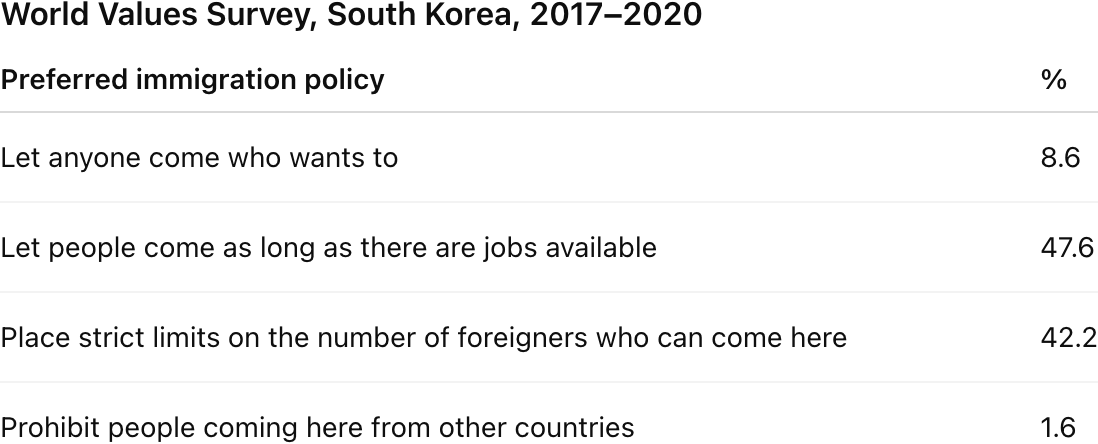
Even more had no problem with immigrants as neighbors. These respondents formed a super-majority of 78% that included half of those who wanted strict limits on immigration. Evidently, consensus is needed in a high-trust society before people act on their personal beliefs, including xenophobia.
Along with the need for consensus, there is also the need for moral approval from authority figures, particularly those in government. If the government is considered trustworthy, and if it wants more immigration, people will suppress any misgivings they may have:
Those who are confident in the government’s capacity to manage potential security risks, are less likely to support restrictive policy preferences despite their security concerns. This moderating role of political trust has broader theoretical implications for understanding how institutional trust serves as an anxiety-reducing psychological mechanism; especially, when facing influx of immigrants (Kim & Kang, 2026, p. 13).
Sweden. This country has experienced a greater influx than South Korea in recent years, particularly from lower-trust societies within and beyond Europe. In 2019, 20% of the population was foreign-born and more than a third had one or two foreign-born parents.
A study of 1,352 young native Swedes showed that trust in the political system is key to reducing xenophobia. When politicians deliver on their promises and ensure well-being in the main areas of life, people trust the system, including immigration policy. The result is “a generalised expectation of trustworthiness and a widening of their circles of trusted others. This then translates into more positive attitudes toward immigrants” (Korol & Bevelander, 2023, p. 5599).
European Union. Social trust is higher in Europe as a whole than in the main immigrant-sending regions, i.e., the Middle East, North Africa, Sub-Saharan Africa and South Asia. It also varies across the European continent, being higher in the northwest and lower toward the south and the east (Beilmann & Lilleoja, 2015).
High-trust European societies have received most of the influx, partly because they offer a higher standard of living and partly because they are more accepting of cultural differences. This was the finding of a cross-country study of about 1,500 people in 29 EU member states: “residents are more tolerant towards cultural minorities in high trusting societies, liberal democracies, prosperous nations and in non-postcommunist societies” (Reeskens, 2012, p. 17).
Cultural minorities are less tolerated in Eastern Europe, as are sexual minorities and other people with unconventional lifestyles: “Tolerance towards people of deviant behavior is higher in economically wealthy countries, and only marginally higher in democratic societies and in culturally diverse countries, while it is lower in postcommunist societies” (Reeskens, 2012, p. 17).
This difference is attributed by Anatoly Karlin to the “Soviet freezer” — during the communist era, traditional values were better preserved in the East than in the West, which remained open to American culture throughout the Cold War (Karlin, 2018b).
Others have argued that this east-west difference goes back farther in time. For at least the past millennium, individualism, weak kinship ties and impersonal prosociality have characterized human relations to a greater degree north and west of the “Hajnal line” — an imaginary line running from Trieste to St. Petersburg (Frost, 2025a; Hajnal, 1965; hbd*chick, 2014; JayMan, 2018; Schulz et al., 2019).
Perhaps both explanations are true. Because the Iron Curtain hindered the inflow of American culture, and because all regimes need to shore up their legitimacy by respecting local values, communism came to reflect the pre-existing characteristics of those who lived under it, including greater attachment to family and community.
While Eastern Europeans are less accepting of cultural and sexual minorities, they are more accepting of intellectual dissent (Reeskens, 2012, p. 21). This finding is consistent with both of the above explanations. On the one hand, Eastern Europeans favorably remember the dissenters of communist times. On the other, Western Europeans have a long history of excluding people for heresy, witchcraft and the like — the “Other” is a moral outsider, and not just a stranger (Frost, 2025).
With removal from the Soviet freezer, growing numbers of East Europeans have embraced the current Western model of intolerance for intellectual minorities and tolerance for racial and sexual minorities. This is especially true for younger generations, as shown by support for gay marriage in Estonia:
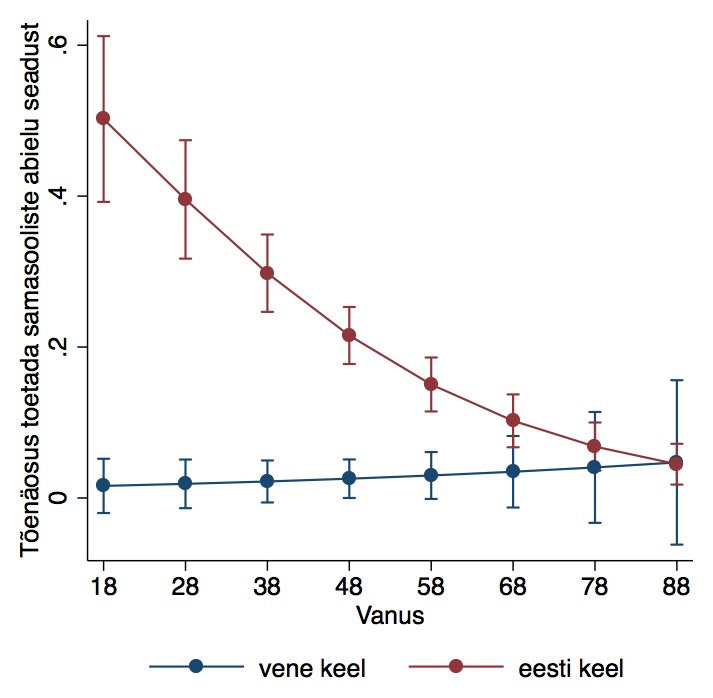
Younger generations of Estonian-speakers have been more exposed to American cultural messaging via the Estonian-language media. They thus have more liberal attitudes toward gay marriage. Older generations have been shaped much more by the media of Soviet times and are less liberal. No such generational difference exists within the minority of Russian-speakers, who continue to be influenced by media based in Russia (Karlin, 2018a).
Discussion
Some nuance is needed if we wish to describe high-trust societies as xenophobic. Clearly, they no longer are. They now receive immigration on a large scale, with only sporadic and ineffectual pushback. Violent incidents do occur, but, in the vast majority of cases, the victims are natives (Immigration to Denmark - Crime).
This begs the question. If high-trust societies are a minority in the world, and if their existence requires atypical levels of empathy, rule following and guilt proneness, why haven’t they been diluted out of existence? Why are they still around?
First, their authority figures used to act as gatekeepers. The line between “us” and “them” was not only between “kin” and “non-kin” but also — and more importantly — between “the trustworthy” and “the untrustworthy.” This dividing line had a moral dimension that was defined largely by figures of moral authority: church leaders, public officials, respected writers and so forth. Over the past century, however, these gatekeepers have come to see discrimination as immoral: we are now told to trust everyone equally; and if we refuse, we become the moral outcasts.
Second, high-trust societies have been economically more successful, and this economic success used to be translated into demographic success. When you can take people at their word and not have to check and double-check every commercial exchange, transaction costs are reduced throughout the economy, and many activities become cost-effective that would otherwise not be. Markets no longer confine themselves to isolated points in space and time, i.e., physical marketplaces. They can spread into all areas of life to create a true market economy.
In Western Europe, this economic success had demographic consequences. More people lived to adulthood, and more had the means to marry and have children. In particular, successful entrepreneurs married earlier and had larger families, if only to expand their workforce. The result was a long-running population boom, while population growth remained anemic elsewhere.
This boom overflowed the confines of Western Europe and pushed into other regions, particularly North America. As the actor John Wayne put it: “Our so-called stealing of this country from them was just a matter of survival. There were great numbers of people who needed new land, and the Indians were selfishly trying to keep it for themselves” (Wayne, 1971).
All of this changed with industrial capitalism and the rise of labor markets in the 1800s. Industrialists found that they could more easily expand and contract their workforce by hiring and firing non-family members. Meanwhile, compulsory education made young people less available as a source of labor. Children became a net cost, and their numbers shrank. Thus ended the West’s population boom, first during the 1920s and 1930s and then for good in the 1970s. Meanwhile, the rest of the world began to experience substantial population growth due to Western advances in medicine, sanitation and agriculture.
For a long time, Western societies didn’t have to worry about being replaced. They were doing the replacing. They thus fell prey to an excess of confidence that persisted into the amber zone and beyond. Today, the tables have turned. The West may be on the brink of a collapse as dramatic as the one that befell the North American Indian.
Let’s not end on a dark note. Yes, the West is on the brink, but it might still save itself. Recent data from the U.S. are showing a much smaller fertility decline for Euro-Americans than for other groups. As strange as it may seem, they are poised to become the most fertile group in the U.S. — thanks largely to subcultures like the Amish, the Mormons and the Hassidic Jews and, more generally, to conservative Protestants and Catholics. A similar pattern may be emerging elsewhere in the world (Frost, 2025b). Northwest Europeans seem to be adept at following rules, and this is no less true for the rules of natalism.
If immigration can be restricted — an admittedly big “if” — the West will cure itself through internal population replacement. We will be replaced, but by people like us.
Peter Frost has a PhD in anthropology from Université Laval. His main research interest is the role of sexual selection in shaping highly visible human traits. Find his newsletter here.
Become a free or paid subscriber:

Like and comment below.
References
Beilmann, M., & Lilleoja, L. (2015). Social trust and value similarity: the relationship between social trust and human values in Europe. Studies of Transition States and Societies, 7(2), 19-30. https://doi.org/10.58036/stss.v7i2.267
Frost, P. (2020). The large society problem in Northwest Europe and East Asia. Advances in Anthropology, 10(3), 214-134. https://doi.org/10.4236/aa.2020.103012
Frost, P. (2021). Damunwha in South Korea: A case study of divergences in cognition and behavior. Advances in Anthropology, 11(2), 153-162. https://doi.org/10.4236/aa.2021.112010
Frost, P. (2025a). Did Christianity make Europeans WEIRD? Aporia Magazine, June 26.
Frost, P. (2025b). Is individualism less toxic for northwest Europeans? Peter Frost’s Newsletter, August 21.
Hajnal, J. (1965). European marriage pattern in perspective. In: D.V. Glass & D.E.C. Eversley (eds). Population in History. Essays in Historical Demography. London, Arnold.
Harwick, C. & Bawa-Allah, Q. (2026). The Sabbath Was Made For Man: On Dynamic Stability as a Metaethical Criterion (January 26, 2026). Available at SSRN: https://ssrn.com/abstract=6169889
hbd*chick (2014). Big summary post on the Hajnal Line. October 3. https://hbdchick.wordpress.com/2014/03/10/big-summary-post-on-the-hajnal-line/
Immigration to Denmark - Crime. (2026). Wikipedia. https://en.wikipedia.org/wiki/Immigration_to_Denmark#Crime
JayMan. (2018). Forest, Trees, and the Hajnal Line. JayMan’s Blog, November 19. https://jaymans.wordpress.com/2018/11/19/forests-trees-and-the-hajnal-line/
Karlin, A. (2018a). Gay marriage in Estonia. The Unz Review, October 30. https://www.unz.com/akarlin/estonian-freezer/
Karlin, A. (2018b). PEW confirms “Soviet freezer” theory, The Unz Review, November 3. https://www.unz.com/akarlin/soviet-freezer/
Kim, K., & Kang, S. W. (2026). Anti-immigration attitudes in a homogeneous society: the case of Korea. International Review of Public Administration, 31(1), 1–22. https://doi.org/10.1080/12294659.2025.2485341
Kim, Y-J. (2024). South Korea’s unprepared classrooms tested by rising multiculturalism. KoreaPro, April 2. https://koreapro.org/2024/04/south-koreas-unprepared-classrooms-tested-by-rising-multiculturalism
Korol, L., & Bevelander, P. (2023). Does young adults’ life satisfaction promote tolerance towards immigrants? The role of political satisfaction and social trust. Current Psychology, 42(7), 5599-5610. https://psycnet.apa.org/doi/10.1007/s12144-021-01923-0
Musaddique, S. (2026). My Estonia. White Man’s Dark Paradise. From the Frontier, February 16.

Park, J-H. (2024). Korean schools becoming more diverse. The Korea Herald, January 7. https://www.koreaherald.com/article/3297760
Reeskens, T. (2012). But… who are those “most people” that can be trusted? An evaluation of the relation between generalized trust and social tolerance across 29 European societies. Paper presented to Annual Meeting of the Midwest Political Science Association, in January 2012 (Chicago).
Schulz, J.F., Bahrami-Rad, D., Beauchamp, J.P., & Henrich, J. (2019). The Church, intensive kinship, and global psychological variation. Science, 366(707), 1-12. https://doi.org/10.1126/science.aau5141
Seo, J-E. (2025). Illegal foreign residents in Korea fall below 400,000 for first time in 4 years after crackdowns. Korea JoongAng Daily, February 7. https://koreajoongangdaily.joins.com/news/2025-02-07/national/socialAffairs/Illegal-foreign-residents-in-Korea-fall-below-400000-for-first-time-in-4-years-after-crackdowns/2237571
Wayne, J. (1971). “Playboy Interview: John Wayne. A candid conversation with the straight-shooting superstar / superpatriot.” Playboy, May, p. 75. https://www.iplayboy.com/issue/19710501
Yonhap. (2025). Immigrants account for over 5% of Korea’s population in 2024. The Korea Times. December 8. https://www.koreatimes.co.kr/southkorea/globalcommunity/20251208/immigrants-account-for-over-5-of-koreas-population-in-2024
In-group bias (Us/Them) is ingrained not just in humans but also in all hominids and many primates too. Preferring my family and my people over your family and people has nothing to do with "xenophobia" but everything to do with safety and survival. Kin groups and other social bonds were the social security, welfare, military and police before these things existed.
Only people far removed from the struggle to survive could even contemplate the idea of turning their societies into open bazaars where whoever arrived yesterday is a much a member of the community as someone whose family has been there multiple generations.
Universal egalitarianism is another remnant of our dying Christian roots ("There is neither Jew nor Gentile, neither slave nor free, nor is there male and female, for you are all one in Christ Jesus."), but has become the sine qua non of liberal morality mostly because of the needs of the global marketplace and of our progressive aristocracy, who believe fervently in their own providential destiny to rule and who are held together not by nationality but by ideology, conformity and class interests.
Xenophilia/xenophobia has been made the hinge of modern liberal morality because of profits and because of the power needs of various bureaucrats, academics and journalists, who posit themselves as an enlightened priesthood ("Anyone can love their families, we love everyone!"), and who have ably weaponized this sentimentalized humanism as a way to paint all their opponents as dangerous and backwards bigots reeking of incipient Nazism.
One of the best parts of living at the top of the social pyramid in the very rich and very safe West is being able to wave away biology, anthropology or any inconvenient facts as too "unenlightened" to take seriously, to ignore it because no one else in your social strata would even think it. But all peoples and countries prefer themselves over arriving strangers—the Chinese keep out the Koreans, the Pakistanis keep out the Afghans, the Dominicans keep out the Haitians, etc etc.
None of this is bigoted or xenophobic, it is simply prioritizing reality and survival over the Marxist-Lennonist fantasy that defines Social Justice ideology, the great faith of our age held by all Western liberals.
To be trusted, one must be trustworthy. Trust must be earned. Betrayal of trust must have consequences.